
Virginia: The First Draft Heard Around the World
[This is the second post in a series about declarations of rights that the newly independent states adopted in 1776. You can read the first one here. We are running the posts in the lead up to a conference called “The Other Declarations of 1776.” Co-sponsored with our friends at the Liberty & Law Center at George Mason University’s Antonin Scalia Law School, it is an all-day conference (with a free lunch!) in Arlington, Virginia on April 10, 2026. Members of the public—including you!—are very much invited to attend in person. See the details, and register, here!]
Most writers aren’t known for their first drafts. At least, they certainly hope not. Yet, that happened to George Mason, the primary author of both Virginia’s first constitution and its declaration of rights. But it doesn’t seem like that was a bad thing in Mason’s case. His draft inspired countless others to declare their rights and their independence. Further, Mason’s experience also serves as an inspiration for anyone frustrated by committee work.
Independence can’t wait
In late spring 1776 the Independence writing was very much on the wall. A budding nation cast its eyes on Philadelphia, where the Continental Congress was about to invite more colonies to set up their own governments in preparation for a full severing of allegiance to the British Crown. In all this, Virginia was ahead of the game. The colony had been holding serial “conventions” acting as a state legislature since the fall of formal British rule in 1775. The fifth convention began on May 6 and started considering the subject of declaring independence. Just a few days later they formally asked Virginia’s delegation in Congress to push for the colonies to consider it together.
In tandem, the convention began the task of drawing up a new plan of government. Unlike New Hampshire and South Carolina before them, which had already adopted constitutions, Virginia’s delegates wanted to append a “declaration of rights” to its new governing law. A declaration of rights was not a new thing. All of the delegates would have been familiar with the English Declaration (or “Bill”) of Rights of 1689. That act of Parliament both secured William and Mary as the new king and queen and also declared a number of liberties of the English that should be respected. Some of these would be familiar to us today, including a ban on cruel and unusual punishment and a right to “have arms” (at least for Protestants). And there were many other examples of formal enumerations of rights, most famously Magna Carta.
Like legislation, constitutions are generally drafted in committees. Virginia’s committee for the declaration of rights was large—a full twenty-seven members. This included Mason, a Virginia planter. He was a former legislator in the Virginia colony and, like many founders, was widely familiar with political theory and history. (For a dive into his reading habits, see Mason’s chapter in the excellent The Pursuit of Happiness by Jeffrey Rosen.) Unsurprisingly to anyone who has served on certain committees (we’ll just leave it at that) Mason thought the committee was moving too slow and some of its members were “useless.” So he thought he’d just do it himself.
One take George
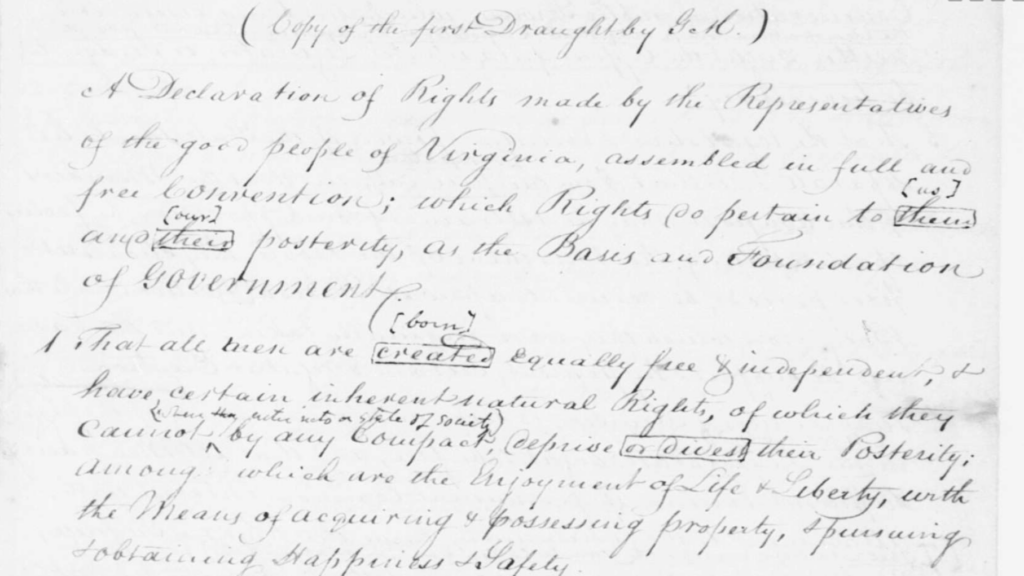
With his friend Thomas Ludwell Lee’s assistance, Mason proceeded to bang out a draft around May 20 to 24. The editor of Mason’s papers, Robert Rutland, tells us that the first ten of the sections were in Mason’s handwriting and two in Lee’s. They then submitted the draft to the committee which, evidently, was quite pleased. The committee did then add some more provisions—perhaps proving they weren’t entirely useless—and the full draft was released on May 27, 1776. (I should note many of these details, and those in subsequent posts, are taken from now-Judge Dan Friedman’s meticulous Tracing the Lineage in the Rutgers Law Journal (vol. 33, p. 929, from 2002). If you want the full story, be sure to check it out.)
What was in the draft? First and foremost, a statement that we should quote here in full and that should at least ring a bell to every American’s ears:
That all Men are born equally free and independent, and have certain inherent natural Rights, of which they can not by any Compact, deprive or divest their Posterity; among which are the Enjoyment of Life and Liberty, with the Means of acquiring and possessing Property, and pursuing and obtaining Happiness and Safety.
It should be familiar for no other reason than that Thomas Jefferson and his committee in the Continental Congress soon afterward used some of this language for the Declaration of Independence itself.
There is no space here to discuss all the other provisions, but versions of most of them later became common in other declarations and bills of rights. In Mason’s original draft alone there are property rights, trial by jury, freedom of religion, freedom of the press, and many others.
The committee’s May 27 draft caused a sensation up and down the eastern seaboard. Even though it had yet to be considered and approved by the full convention, newspapers published it and revolutionaries everywhere exchanged copies with each other. It was this draft that was to go on to influence other declarations adopted later in 1776 and many other documents as well, including even the Declaration of the Rights of Man and of the Citizen, adopted by the French National Assembly in August 1789.
The Rights of the Slave?
In the full convention there was some resistance to Mason’s words, especially among certain slaveowners. The irony is that Mason himself owned slaves. As Rosen details, Mason had a similar complicated relationship to the peculiar institution like Jefferson and James Madison did, finding it distasteful but never having the courage of his convictions to free all of the enslaved people under his ownership. Indeed, of the founders with slaves only Washington actually freed all of them, and then only upon his wife’s death (via his will, after he himself had died).
Still, Mason’s stirring words scared some delegates. A compromise was reached where the first section was changed to say “all men are by nature equally free and independent” and the phrase “when they enter into a state of society” was added—thus disqualifying slaves, who were not considered part of “society.” Other important changes were made as well for which we simply don’t have the space to cover here. But by and large it was still Mason’s handiwork. This adopted version did eventually go on to influence some other state constitutions (as I partly detail in this article) but not in the way the committee draft did.
Ideas over laws
Thus, the curious story of the Virginia Declaration of Rights is that the draft (today we might say the preprint—not yet “peer reviewed”) had a greater impact outside Virginia than the final “lawful” version. It is a reminder that the power of rights and the words that support them is not necessarily just tied to the law—although the law is important—but the ideas that resonate with others. It is often argued that Thomas Paine’s Common Sense, published in January 1776, gave the American Revolution its final push to independence. Paine’s pamphlet, of course, was just words. The same is true of Mason’s first draft. Nevertheless, it had a similar effect: in the lines of the Declaration of Independence, in other declarations of rights (which we’ll discuss in future posts), and even in Paris in 1789. Not bad for a first draft.
Anthony Sanders is the Director of the Center for Judicial Engagement at the Institute for Justice.