Liberalism, the Constitution, and Big Tents
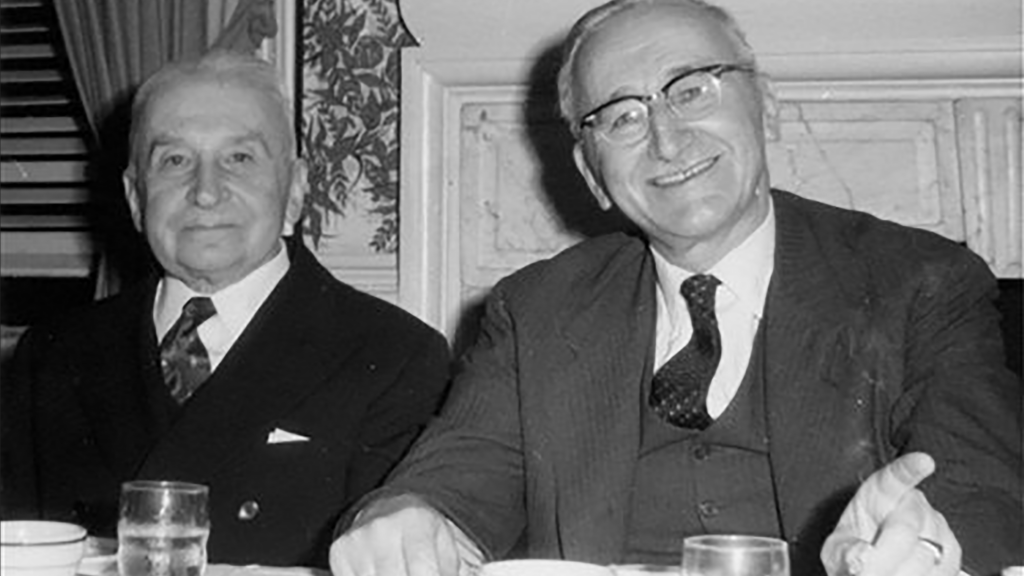
This piece highlights law professor Cass Sunstein’s “strange new respect” for libertarians and explains how in recent years we at IJ and Sunstein have gone on increasingly similar paths.
Since IJ opened its doors in 1991 we have stood for, and fought for, liberalism and the rule of law. Indeed, a highly related concept, “justice,” is right there in our name! Yet, those who know us well—whether as friends or critics—would be correct in saying we haven’t leaned on “liberalism,” “rule of law,” or even “justice” as much as we could have for much of our history. IJ’s four pillars of economic liberty, property rights, free speech, and educational choice are more focused on specific aspects of constitutional law than the general, and inherently contestable, terms like “rule of law” or “justice.” Further, IJ is philosophically an explicitly small-l “libertarian” organization. “Libertarian” is one flavor of the broad outlook that is called “liberalism,” but “liberal” had become so stretched by the time we started that it hardly seemed like one worth highlighting. In popular discourse in the U.S., “liberal” had grown to mean someone who believes in a big, modern, redistributive government that minimizes constitutional restraints on power—something not up IJ’s alley. And even though in some circles, especially in Europe, “liberal” still had more of its old meaning of someone who believes in things like property rights, constitutional democracy, and due process, with “libertarian” already at hand to distinguish us from believers in bigger government, “liberal” wasn’t a word for us to throw around very much.
But 2025 isn’t 1991. And although we haven’t changed our principles in those 34 years we realize that highlighting liberalism, the rule of law, and the justice that is part of our namesake is something that makes more sense and is, frankly, more important today. It also makes more sense to point out where we have common cause on these wider issues with other “liberals.”
Coming to Hayek
It seems law professor Cass Sunstein agrees. Sunstein is one of the most prolific and well-known legal academics of the last few decades. He’s written countless books and articles on all kinds of subjects. Among those subjects, though, are criticisms of some of the things IJ has fought for, especially heightened protection for the right to earn a living and property rights. To give just one example, his influential 1987 article “Lochner’s Legacy” argued that the right to contract case Lochner v. New York (1905) and similar early-twentieth century cases were wrongly decided and the Court should continue to exile that right from the Constitution. We at IJ, to put it mildly, deeply disagree with that view. There are many other examples of divergence between Sunstein’s views and ours. So it was quite a surprise when last week I read this on his Substack:
I like Hayek a lot less ambivalently than I once did, and von Mises, who once seemed to me a crude and irascible precursor of Hayek, now seems to me to be (mostly) a shining star (and sometimes fun, not least because of his crudeness and irascibility). The reason is simple: They were apostles of freedom. They believed in freedom from fear.
“Hayek,” of course, does not refer to a certain Mexican-American actress but to Friedrich Hayek, the author of The Road to Serfdom and The Constitution of Liberty. Many of us at IJ are huge fans of Hayek. To give a tiny example, I once co-authored a piece about his views on the rule of law. And the other name Sunstein mentions is Hayek’s fellow Austrian economist, Ludwig von Mises, a giant of that school of economics who inspired so many libertarians and whose book Human Action inspired the name of our pro bono lawyer program, the “Human Action Network.”
For Sunstein to announce that not only is he a much bigger admirer of both libertarian icons but also that he considers both “apostles of freedom” was a bit of a jaw-dropping moment for me. Is this the same guy who has been warning against us “judicial-activist libertarians” for decades?
The Liberal Big Tent
It actually shouldn’t be so surprising. A couple years ago Sunstein published a widely discussed oped in the New York Times on the shared values of “liberals.” He emphasized something many have done lately, which is the commonalities of those of us in the “liberal” family. Those who believe in freedom of speech, free elections, separation of powers, and due process protections for all. These may seem like blasé concepts that are so obvious they don’t mean anything. But, unfortunately, even if that was once true it no longer is. A point of Sunstein’s in that oped, in the Substack post, and in a forthcoming book, On Liberalism, is to extend an olive branch to us more libertarian members of the liberal big tent both as an exercise in humility but, I believe, more importantly to make common cause for fights that are brewing.
What are those? The various efforts of illiberalism. Critics of liberalism are all too common these days, as any reader is undoubtedly aware. They’re on the right, the left, and everywhere. From authoritarian tactics in the executive branch to efforts to extinguish dissent in public institutions and in houses of learning, being against values such as freedom of speech, free elections, and due process for all isn’t just a position some “mainstream” advocates secretly harbor. It is what many outright call for.
When IJ has fought for things like due process in civil forfeiture hearings or meaningful review of restrictions on the right to earn a living we’ve usually thought we were simply pointing out to other “big tent liberals” (whether they called themselves progressives or conservatives) that they were misguided in how “liberal” the Constitution truly is. And that the ideals of liberalism, such as the rule of law, extended further than they realized.
These days, however, there are many people out there who might say, “Yes, I realize civil forfeiture is illiberal, and I like it that way.” And this, it seems, is part of what has given Sunstein strange new respect for libertarians like Hayek and von Mises. He writes
Back in the 1980s and 1990s, I did not see that clearly enough, because they seemed to me to be writing against a background that was sharp and visible to them, but that seemed murky and not so relevant to me — the background set by the 1930s and 1940s, for which Hitler and Stalin were defining. (After all, Hayek helped found the Mont Pelerin Society in 1947.)
Back in the 1980s and 1990s, socialist planning certainly did not seem like a good idea, not at all, but liberalism, as I saw it, had other and newer fish to fry.
When Sunstein was throwing bombs at Lochner, he thought we were fighting yesterday’s wars. Why are libertarians so worried about all this “road to serfdom” stuff? We need to get on with problems of the modern era and not be so hung up about things like a slippage into overenthusiastic government that a flexible view of the Constitution might entail. And as Sunstein says elsewhere in the piece, he hasn’t become a later-in-life libertarian or anything. He still believes in much more governmental redistribution and a more activist government than others in the “liberal coalition.” I’m sure he’s still as critical of Lochner as ever.
But with the forces of illiberalism in the open he now sees the point that Hayek, von Mises, and libertarians like his University of Chicago colleagues Richard Epstein and Gary Becker, tried to make. Freedom, liberalism, and the rule of law, are always fragile. We need to continually work to keep them. Unfortunately, their threats are never just yesterday’s problem. As he closes in his piece:
But those battles never were old. In important ways, Hayek and the Mont Pelerins (and Posner and Epstein, and Becker and Stigler) were right. Liberalism is a big tent. It’s much more than good to see them under it. It’s an honor to be there with them.
And it’s an honor, Cass, to be in the tent with you. Liberalism, the rule of law, and justice for all.
Anthony Sanders is the Director of the Center for Judicial Engagement at the Institute for Justice.
