School Choice Showdown at U.S. Supreme Court
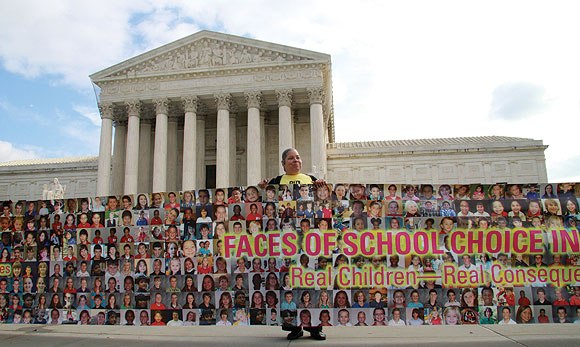
On a bright, clear and cold November morning in the heart of our nation’s capitol, 800 smiling Arizona children faced out from the U.S. Supreme Court while the Justices inside questioned lawyers about the constitutionality of a tax credit scholarship program those children rely on to attend private schools—schools chosen by their parents. And IJ was in the thick of the battle to save these children’s educational futures. IJ represents parents and children in the case who use these scholarships and hope to preserve this educational lifeline.
The children outside the courtroom were not physically present, but—thanks to the creativity of IJ’s Director of Activism and Coalitions Christina Walsh and the graphic design wizardry of IJ’s Production and Design team members Don Wilson and Robyn Patterson—the children were there when we unfurled a 50-foot banner featuring photographs representing many of the 27,000 children who depend on the scholarship program. The banner declared in simple and stark terms: “Faces of School Choice in Arizona: Real Children, Real Consequences.”
Inside the courtroom, months of intense briefing and preparation played out in a dramatic and intense oral argument. There are two legal questions at issue in Garriott v. Winn. The first question is whether a small handful of Arizona taxpayers who oppose school choice even have “standing” to challenge the program. The standing question asks whether the plaintiffs have been harmed by the program. Through our litigation and briefing, IJ has consistently argued that these plaintiffs have not been harmed because they have not paid a single penny in taxes to support private or religious schools. In fact, everybody benefits from increasing parental liberty to choose the school that best fits their child’s individual learning style. And the government benefits financially from being relieved of the obligation to pay for the education of those children who participate in the scholarship program.
If the Court determines the plaintiffs were not harmed, it will not reach the second question, which asks whether the program violates the Establishment Clause’s prohibition against laws “respecting an establishment of religion.” The Court has consistently upheld school choice programs—like Arizona’s—that are based on private choice, where private individuals rather than government bureaucrats choose where the aid is used. And private choice is the defining characteristic of Arizona’s scholarship program.
But the Court’s liberal bloc—Justices Ginsburg, Breyer, Kagan and Sotomayor—asked questions that seemed generally hostile to the program. The questions Chief Justice Roberts and Justices Scalia and Alito asked suggested they believed the program operates like the Cleveland school voucher program the Court upheld in its 2002 Zelman v. Simmons-Harris decision (a decision in which Justice Kennedy joined). Justice Thomas, as is his custom, asked no questions, and the Court’s presumptive swing vote, Justice Kennedy, asked probing questions of both sides.
Now comes the hardest part of all—waiting for a decision, which is expected to be announced sometime this spring. When it does come, we expect the Court will, even if by a narrow margin, reaffirm that the Constitution permits school choice programs that empower parents to choose the school best suited to meet their child’s educational needs.
That will help set the stage for next year when we expect to see a groundswell of new legislative initiatives for school choice across the nation. IJ will be on call to help craft and defend those programs, too, even if it means another long journey to the Supreme Court.
Tim Keller is the IJ Arizona Chapter executive director.
Also in this Issue
Liberty & Law
Need for Judicial Engagement Makes IJ More Critical Than Ever

Liberty & Law
IJ Scores Major Free Speech Victory for Parker North Neighbor
Liberty & Law
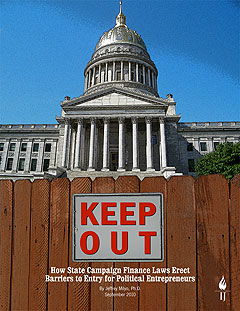
Keep Out! Campaign Finance Laws as Barriers to Entry

Liberty & Law
Camp Politics Video Teaches with Humor

Liberty & Law
An IJ Victory Down on the Farm

Liberty & Law
IJ Launches Nationwide Defense of Citizen Speech

Liberty & Law
IJ’s New City Studies: Want to Create Jobs? Remove Red Tape.
Subscribe to get Liberty & Law magazine direct to your mailbox!
Sign up to receive IJ's bimonthly magazine, Liberty & Law, along with breaking news updates about the Institute for Justice's fight to protect the rights of all Americans.