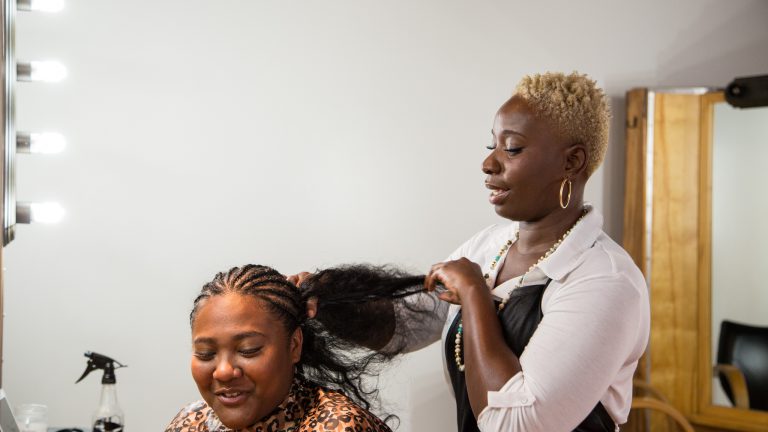
Jestina Clayton began braiding hair during her childhood in Sierra Leone, where braiding is a part of the cultural heritage, and has been braiding hair for most of her life. Jestina brought this special skill with her to the United States after fleeing from the Sierra Leone civil war. In 2006, Jestina, then a college student in Utah, started her own African braiding business to help provide for her family while her husband also finished his education. She just braided hair—she never cut hair or used any chemicals. And when she asked the State whether she needed a license to start her business she was told no—not if she was just braiding hair.
After a couple of years in business, however, Jestina received an anonymous threat to report her to the cosmetology board for braiding without a license. This time when Jestina asked the Sate if she needed a cosmetology license to just braid hair she was told yes, she did need that license.
To get a Utah cosmetology license Jestina would have to spend thousands of dollars on 2,000 hours of government-mandated cosmetology training. In the same number of class hours, a person also could qualify to be an armed security guard, mortgage loan originator, real estate sales agent, EMT and lawyer—combined. Worse yet, as the State admitted, these 2,000 hours had little, if anything, to do with African hair braiding.
On August 8, 2012, a federal judge struck down Utah’s hair braiding law as unconstitutional and recognized that Utah had violated Jestina’s right to earn an honest living. The judge ruled that “Utah’s cosmetology/barbering licensing scheme is so disconnected from the practice of African hair braiding, much less from whatever minimal threats to public health and safety are connected to braiding, that to premise Jestina’s right to earn a living by braiding hair on that scheme is wholly irrational and a violation of her constitutionally protected rights.”
With this ruling, Jestina was free to go back to her business.
Case Team
Clients
Attorneys

Paul Avelar
Managing Attorney of the Arizona Office
Case Documents
Court Decision
Media Resources
Get in touch with the media contact and take a look at the image resources for the case.
Related News
The History and Art of African Hair Braiding
The art and foundation of “traditional” or “natural” hair braiding traces back thousands of years to Africa. Today, thousands of practitioners engage in the intricate crafts of twisting, braiding, weaving and locking natural styles, mostly for African-American clients whose characteristically textured hair is perfect for such styling. These distinct techniques are generally grouped together under the rubric of “natural hair care” because they do not use any chemicals, heat, or other artificial hairstyling techniques.
Hair braiding is more than a means of entrepreneurship; it is an important form of cultural expression. Until very recently, the dominant standard of beauty had been defined in Western terms, and black women (particularly professionals) have struggled to comport with this definition, often at great damage to their hair because of the use of chemical straighteners and relaxers. More recently, traditional African hairstyles geared toward the natural texture and beauty of black hair have re-emerged and steadily gained popularity. The hairstyles are a form of artistic, cultural and individualized expression, and the techniques avoid serious damage that can occur when hair is treated with chemicals and other artificial products.
Nationwide, natural hair care has grown into a multi-million dollar industry. Because it requires fairly little capital and modest training, in a free and open market the natural hair care industry would have unlimited potential to provide entrepreneurial and employment opportunities, as well as popular services and products to millions of consumers.
But because of cosmetology licensing laws in many states, mainstream cosmetologists—trained in Western hair care techniques—have a virtual monopoly over all forms of hairstyling, including braiding (though several states, including California, Washington, Arizona, Minnesota and Mississippi have deregulated the hair braiding industry as a result of Institute for Justice litigation[1]). Most hair braiders are thus forced to operate underground, and many would-be practitioners are discouraged altogether. As a result, natural hair care providers are consigned to the status of an outsider, still fighting against prevailing orthodoxy enforced by the state.
Hair Braiding and Occupational Licensing
Government at all levels restricts entry into trades and professions. When those regulations exceed legitimate health and safety objectives, they needlessly cut off the bottom rungs of the economic ladder, particularly for people with little financial capital, few skills and limited education. Among the most pervasive and oppressive barriers are occupational licensing laws. Occupations requiring government licenses include not only the medical, legal and other highly specialized professions, but also professions in which justification for restrictions on entry is virtually nonexistent. In the 1950s, less than five percent of the workforce was required to obtain a government license to do their job.[2] Today, that number exceeds 30 percent.[3] Research shows that occupational licensing laws make it more difficult for people—especially poor, minority, immigrant and older workers—to start or change careers, and these laws do little more than protect industry insiders from new competition. Government-imposed roadblocks like Utah’s cut off the bottom rung of the economic ladder to those who need it most. It forces them into the “underground economy.”
Typically, licensing boards are comprised of members of the regulated profession, with the coercive power of government at their disposal. As a result, licensing requirements often exceed valid public health and safety objectives, and instead are used to reduce competition from newcomers. As economist Walter Williams observes, these laws and regulations “discriminate against certain people,” particularly “outsiders, latecomers and the resourceless,” among whom members of minority groups disproportionately are represented.[4]
Ironically, the licensing laws that now shackle African hair braiders were put in place during the 1930s by hairdressers (today’s cosmetologists), who at that time, like natural hairstylists today, were renegades fighting an entrenched monopoly. Prior to the 1920s, barbers and cosmeticians (who performed skin care and some hair cutting) enjoyed an exclusive monopoly, bestowed by government through occupational licensing laws, over all types of hair treatment.[5] Hairdressers were arrested in several states for violating the licensing laws.[6] During that time, hairdressers organized their own trade association and sought to break the barbers’ monopoly through lobbying and litigation. The following resolution, passed by National Hairdressers Association at its 1923 convention, parallels hair braiders’ struggle today:
RESOLVED, while expressing our good will to those engaged in business as barbers and repudiating any thought of encroaching on the domain of their work or of soliciting the patronage of men for work ordinarily done in the barber shop, we condemn the antagonistic legislation which would attempt to classify as barbers and subject to barbers’ laws those who are engaged in the practice of our profession, and we assert the right of engaging in all work . . . ordinarily done in the hairdressing and beauty parlor on women and children, free from the domination of barbers’ laws.[7]
The cosmetologists ultimately succeeded in freeing themselves from the barbers’ monopoly and obtaining a separate licensing process—through which they then created a state-enforced cartel of their own that subjects everyone engaged in the care or styling of hair, skin or fingernails to their domination.
Utah’s Licensing Scheme
Utah’s cosmetology law is typical of licensing laws around the nation. The statutory scheme[8] places regulation of all hairstyling under the control of the Utah Barber, Cosmetologist/Barber, Esthetician, Electrologist, and Nail Technician Licensing Board. By law, only two of the Board’s nine members represent the public; the remaining seven members represent industry insiders.[9] The Board in turn issues and enforces extensive regulations, including requiring at least 2,000 hours of prescribed training in Board-approved cosmetology schools and an examination.[10] Schools, instructors and salons also must obtain licenses. Cosmetology schools do not teach African hair braiding and the licensing examination does not test it. The effect is that Utah requires would-be braiders to spend as much as $18,000 to take 2,000 hours of instruction—none of which actually teaches you how to braid hair. In the same number of class hours, a person also qualify to be an armed security guard, mortgage loan originator, real estate sales agent, EMT and lawyer—combined. Such arbitrary and excessive government-imposed licensing on such an ordinary, safe and uncomplicated practice as hair braiding is not only outrageous, it is unconstitutional.
The entire system creates a mismatch between regulatory objectives and realities. In the unfounded guise of protecting public health and safety, the regulatory process licenses people who have no training in certain services to offer those services to the public, yet forbids people who are proficient in those same services from using their talents to earn an honest living. In Utah, individuals with no experience in braiding may legally braid hair so long as they hold a government-issued license, and yet practitioners like Jestina Clayton with a lifetime of experience braiding hair may not. This must change.
Utah’s cosmetology scheme blocks opportunities for entrepreneurs and forces consumers to pay more for worse service. Many braiders and their clients are thus forced into an underground economy of “kitchen braiding” where they are afraid that next knock on the door may be a government official looking to shut them down, and consumers must go out of state to get their hair braided.[11] The government authorities who are looking to shut down braiders are often doing so at the behest of cosmetologists who want to limit competition. The government could create some minimum requirement covering basic sanitation and health concerns—information that could be covered in just a few hours of training and with a brochure. But instead, Utah has chosen to bow to the wishes of the cosmetology cartel and, in so doing, has violated the constitutional rights of the Institute for Justice’s clients.
The Plaintiff
Jestina Clayton—her name means justice in her native language—fled the Sierra Leone civil war to come to the United States for a better life. Since coming here she has graduated from college (Weber State, 2008), met and married her husband Paul, and become the mother of two with a third on the way.
Jestina has been braiding hair since her childhood in Sierra Leone. In 2005, as a college student with a young family, she started braiding hair for money—but only after she was told by the state of Utah that it was okay. In 2009, however, a licensed cosmetologist complained that Jestina did not have a cosmetology license and the state threatened to prosecute her unless she shut down. Not wanting to break the law, Jestina stopped braiding. She merely wants to use her considerable skills to earn an honest living in an occupation the State says she may not practice unless she spends thousands of dollars on 2,000 hours of government-mandated training, not one hour of which actually teaches her to braid hair.
The Right to Earn an Honest Living
Both the Due Process and Privileges or Immunities Clauses of the Fourteenth Amendment prevent the government from arbitrarily interfering with people’s ability to earn an honest living in their chosen occupation. The Fourteenth Amendment was adopted to protect, among other civil rights, the economic liberties of newly emancipated slaves following the Civil War. After the war, Southern governments sought to protect entrenched white businessmen from black competition by heavily regulating entry into trades and businesses. Both the Fourteenth Amendment and the Civil Rights Act of 1866 sought to protect the economic liberty of all Americans among the “privileges or immunities of citizenship” that states were prohibited from violating. But two legal developments dramatically undercut the Constitution’s protection of economic liberties.
First, and almost immediately after its adoption, a sharply divided U.S. Supreme Court read the Privileges or Immunities Clause out of the U.S. Constitution by a 5-4 vote in the 1873 Slaughter-House Cases. That decision gave states carte blanche to enact shameful Jim Crow-era laws restricting economic opportunities for black Americans. In addition to oppressing their black citizens, the states also used their now-unchecked regulatory power to protect all sorts of entrenched interests and interfere in otherwise honest enterprises. Essentially, the Slaughter-House Cases ushered in our modern Nanny State under which government no longer feels restricted from imposing arbitrary or irrational restriction after restriction on businesses nationwide.
Second, in the 1938 case of United States v. Carolene Products Co., the Supreme Court almost totally abandoned economic liberty. In a single infamous footnote, the Court created an artificial hierarchy of rights under the Constitution. Some rights, notably free speech, were elevated to a preferred tier and now rightly receive vigorous constitutional protection. Rights demoted to the bottom tier—specifically economic liberty and property rights—wrongly were to receive far less constitutional protection.
In its 20 years of litigating for liberty, the Institute for Justice has fought to reinvigorate the Constitution’s protection of economic liberty and to secure protection for the right to earn a living. Although there is a long way yet to go, there are hopeful signs that courts will again take seriously their duty to enforce the constitution as a bulwark of liberty against overreaching government. Among these signs are IJ’s successful prosecution of economic liberty claims and multiple courts’ express recognition that bare economic protectionism of favored interests is not a legitimate end of government.[12] And in 2010, in a powerful and widely-lauded concurring opinion, Justice Clarence Thomas rejected nearly 140 years of bad precedent and called on the Supreme Court to correct the travesty of Slaughter-House.[13] Although the Court did not heed his call, the other justices recognized the validity of Thomas’ devastating take-down of Slaughter-House and recognition that the Privileges or Immunities Clause protects Americans’ rights.
Legal Claims
Under the Due Process and Privileges or Immunities Clauses, the government may only restrict braiders’ right to run their businesses when there is some “rational basis” for that restriction. To demonstrate that rational basis, the government must show a reasonable connection between the restrictions in question and public health and safety. But there is no threat to public health or safety presented by braiding hair—and certainly not any threat that can justify 2,000 hours and as much as $18,000 of irrelevant cosmetology classes.
Jestina Clayton asks the court to declare that, under the U.S. and Utah constitutions, Utah’s cosmetology licensing scheme, as applied to hair braiders, violates due process rights to earn an honest living, equal protection, and the right to economic liberty protected by the Due Process and Privileges or Immunities Clauses. Both the federal and Utah constitutions protect every individual’s right to earn an honest living in their chosen occupation free from arbitrary and irrational government regulations. But this constitutional right is meaningless unless courts enforce it.
Litigation Team
IJ litigates across the country for economic liberty, private property rights, educational choice, free speech, and other vital liberties secured by the United States and state constitutions. IJ Staff Attorney Paul Avelar will lead the litigation team, assisted by Tim Keller, Executive Director for the Institute for Justice Arizona Chapter. They will be assisted by local counsel Maxwell Miller and Randy Grimshaw of Parsons Behle & Latimer in Salt Lake City.
The Institute for Justice has scored victories for entrepreneurs across the nation including:
Chauvin v. Strain—In direct response to a lawsuit filed by the Institute for Justice, Louisiana passed a law in 2010 so that Louisiana florists will no longer find themselves fenced out of the industry by an arbitrary, subjective and antiquated licensing exam in which their own future competitors decide whether they are “good enough” to sell floral arrangements.
Mitz v. Texas State Board of Veterinary Medical Examiners—After a nearly three-year battle, the Institute for Justice achieved victory for its clients in 2010 when a judge blocked an effort by the Texas Board of Veterinary Medical Examiners to put horse teeth floaters out of business.
Clemens v. Maryland State Board of Veterinary Medical Examiners—One year after filing suit, a judge declared in 2009 that IJ client and Maryland equine-massage entrepreneur Mercedes Clemens was now free to return to the occupation she loves.
Swedenburg v. Kelly—The Institute for Justice successfully waged the nation’s leading legal battle to reestablish the American ideal of economic liberty when, on May 16, 2005, the U.S. Supreme Court struck down discriminatory laws that existed only to protect the monopoly power of large, politically connected liquor wholesalers.
Diaw v. Washington State Cosmetology, Barbering, Esthetics, and Manicuring Advisory Board—In March 2005, after being sued by the Institute for Justice Washington Chapter, state bureaucrats exempted hair braiders from discriminatory cosmetology licensing requirements.
Armstrong v. Lunsford—The Institute for Justice opened the hair braiding profession in Mississippi in 2005 when the state Legislature responded to this lawsuit, filed in federal court in 2004, by allowing IJ’s clients to continue their entrepreneurship without obtaining a needless government license.
Farmer v. Arizona Board of Cosmetology—In 2004, as a result of an IJ-AZ lawsuit, the Arizona Legislature exempted hair braiders from the state’s outdated cosmetology scheme.
Wexler v. City of New Orleans—In 2003, the Institute for Justice successfully persuaded a federal court to strike down an absurd ordinance that prohibited booksellers from selling books on city sidewalks without a government-issued permit.
Craigmiles v. Giles—In this IJ suit the 6th U.S. Circuit Court of Appeals found Tennessee’s casket sales licensing scheme unconstitutional in 2002. This marked the first federal appeals court victory for economic liberty since the New Deal.
Clutter v. Transportation Services Authority—In 2001, the Institute for Justice defeated Nevada’s Transportation Services Authority and its entrenched limousine cartel that had stifled competition in the Las Vegas limousine market.
Cornwell v. California Board of Barbering and Cosmetology—In 1999, the Institute for Justice defeated California’s arbitrary cosmetology licensing requirement for African hair braiders.
Ricketts v. City of New York—The Institute for Justice successfully defended commuter van entrepreneurs in 1999 in a fight against the government bus monopoly that would not allow any jitney entrepreneurs to provide service to consumers in underserved metropolitan neighborhoods in New York City.
Jones v. Temmer—In 1995, the Institute for Justice helped three entrepreneurs overcome Colorado’s protectionist taxicab monopoly to open Denver’s first new cab company in nearly 50 years. IJ used this victory to help break open government-sanctioned taxicab monopolies in Indianapolis and Cincinnati.
Uqdah v. D.C. Board of Cosmetology—In 1993, the work of the Institute for Justice in court and the court of public opinion led the District of Columbia to eliminate a 1938 Jim Crow-era licensing law against African hair braiders.
For more information, please contact:
Shira RawlinsonCommunications CoordinatorInstitute for Justice901 N. Glebe Rd # 900 Arlington, VA 22203-1854
(703) 682-9320
[1] See, e.g., Ariz. Rev Stat. § 32-506(10); Cal. Bus. & Prof. Code § 7316(d)(2).
[2] Morris M. Kleiner, Licensing occupations: Ensuring Quality or Restricting Competition, at 1 (Kalamazoo, MI: Upjohn Institute, 2006).
[3] Morris M. Kleiner & Alan B. Krueger, Analyzing the Extent and Influence of Occupational Licensing on the Labor Market, NBER Working Paper Series #14979, available at http://www.nber.org/papers/w14979.
[4] Walter Williams, The State Against Blacks (New York: McGraw-Hill, 1982), p. xvi.
[5] NCA’s Diamond Jubilee Years, at 4-11 (National Cosmetology Association, 1995).
[6] Keith v. State Barber Bd., 212 P. 871 (Kan. 1923); Lane v. State, 232 N.W. 96 (Neb. 1930); Banghart v. Walsh, 171 N.E. 154 (Ill. 1930); Johnson v. Ervin, 285 N.W. 77 (Minn. 1939); Jeffs v. Bd. of Examiners of Barbers, 30 N.W.2d 445 (Mich. 1948); cf. Leetham v. McGinn, 524 P.2d 323 (Utah 1974) ) (invalidating law allowing only barbers and not cosmetologists to cut hair of both sexes); Whitcomb v. Emerson, 46 Cal.App.2d 263, 115 P.2d 892 (Cal. App. 4th Dist. 1941) (striking down application of California cosmetology licensing to facial massage); New York State Hairdressers & Cosmetologists Ass’n v. Cuomo, 369 N.Y.S.2d 965 (Sup. Ct. N.Y. Cty. 1975) (invalidating law allowing only barbers and not cosmetologists to cut hair of both sexes).
[7] NCA’s Diamond Jubilee Years, at 7.
[8] Utah’s Barber, Cosmetologist/Barber, Esthetician, Electrologist, and Nail Technician Licensing Act is codified at Utah Code Ann., §§ 58-11a-101 et seq.
[9] Utah Code Ann. § 25-11a-201(1).
[10] Utah Code Ann. § 58-11a-302(4)(d)(i).
[11] See Dick M. Carpenter & John K. Ross, The Power of One Entrepreneur: Melony Armstrong, African Hair Braider, Oct. 2009, at 16-17, available at http://www.ij.org/images/pdf_folder/economic_liberty/powerofone-armstrong.pdf.
[12] E.g., Craigmiles v. Giles, 312 F.3d 220, 224 (6th Cir. 2002) (“protecting a discrete interest group from economic
competition is not a legitimate governmental purpose”); Smith Setzer & Sons, Inc. v. South Carolina Procurement Review Panel, 20 F.3d 1311, 1322 (4th Cir. 1994) (protectionism must “advance[] a purpose, beyond . . . naked preference . . . . [or] ‘parochial discrimination’ ”).
[13] McDonald v. Chicago, 130 S. Ct. 3020, 3058-88 (2010).
Related Cases
Economic Liberty | Hair Braiding | Occupational Licensing
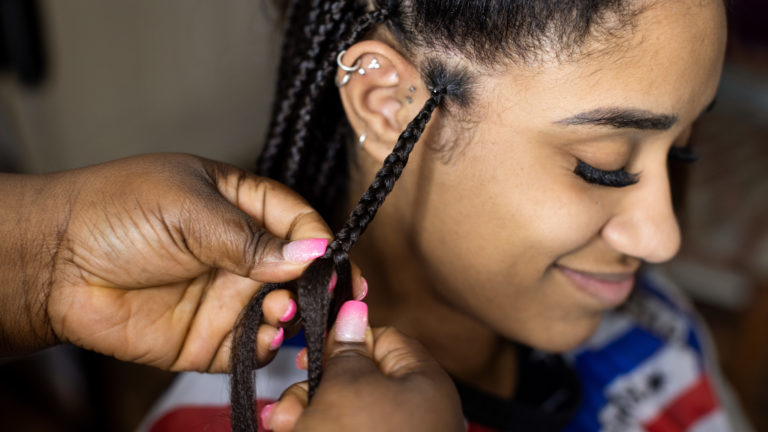
Idaho Braiding
Three braiders in Idaho challenged state requirements to spend thousands of dollars and a year of their lives for an unnecessary license.
Economic Liberty | Hair Braiding | Occupational Licensing
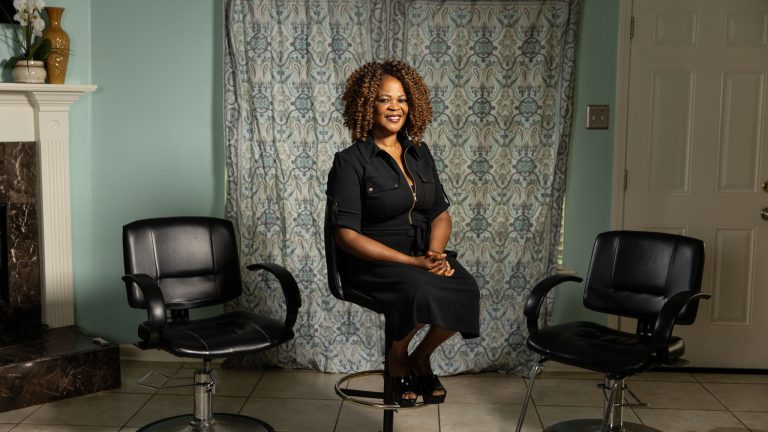
Louisiana Hair Braiding
Hair-braiders in Louisiana are required to complete 500 hours of unnecessary and irrelevant training, pass an exam and pay annual licensing fees just to do their job. Many hair braiders have moved to neighboring states,…