IJ’s Supreme Victory for Indiana School Choice

For almost two years, IJ was locked in a legal battle with national and Indiana teachers’ unions who tried to eliminate the Hoosier State’s statewide school choice program. On March 26, we—and the families we represented in the litigation—won a decisive victory that saved the program from the unions’ legal assault. In a unanimous decision, the Indiana Supreme Court held that the Choice Scholarship Program (CSP) does not violate the Indiana Constitution. Instead, that program is perfectly consistent with it.
Because the Indiana Supreme Court is the final arbiter of the meaning of the state’s constitution, the unions cannot appeal to the U.S. Supreme Court. Thus, no legal obstacles remain for the CSP, which allows low- and middle-income families all over the state to use publicly funded scholarships to pay for tuition at participating public or private schools. Because approximately 62 percent of Indiana families are eligible to receive scholarships for their children, the CSP has the potential to be the largest school choice program in the nation.
That is a big reason why the teachers’ unions opposed the CSP. Furthermore, they understood that a major successful school-choice program in Indiana would threaten their educational monopoly not just in that state, but also in others that may follow Indiana’s lead by enacting their own statewide scholarship programs.
Thus, the teachers’ unions rushed to court to try to get the program struck down. They employed the same tired, unsuccessful arguments they make nearly every time they challenge a school choice program: that because many parents in the program select religious schools for their children, the program violates a clause of the state constitution that forbids state expenditures made for the direct benefit of those schools. This type of clause is known as a Blaine Amendment because of its historical connection to a similar federal constitutional amendment proposed by Senator James Blaine in 1876. That amendment failed, but similar language appears in 39 state constitutions, including Indiana’s.
Fortunately, the Court ruled that Indiana’s Blaine Amendment does not bar the CSP. Grounding its decision in the text of the clause, its history and relevant case law, the Court instead agreed with us that the direct beneficiaries of the CSP are not schools, but rather families to whom the state is trying to give more choice in their children’s education.
According to the Court, the CSP “provide[s] lower-income Indiana families with the educational options generally available primarily to higher-income Indiana families. The result is a direct benefit to these lower-income families—the provision of a wider array of education options, a valid secular purpose. Any benefit to program-eligible schools, religious or non-religious, derives from the private, independent choice of the parents of program-eligible students, not the decree of the state, and is thus ancillary and incidental to the benefit conferred on these families.”
With those words, the Court slammed the door on the unions’ legal challenge, while simultaneously opening the door of educational opportunity to thousands of Indiana children whose parents are now empowered to pick schools that best suit their kids’ educational needs. Furthermore, by issuing a unanimous decision—indeed, the first unanimous decision by any state supreme court that has upheld a school choice program—the court created a persuasive legal precedent that we can, and will, use to defend school choice programs against union attacks in other states with Blaine Amendments.
The Indiana Supreme Court’s decision is a landmark legal victory for school choice—a victory that we will replicate in other state supreme courts all over the country.
Bert Gall is an IJ senior attorney.

Also in this Issue

Liberty & Law
Protecting Online Advice

Liberty & Law
IJ’s Washington Chapter Marks a Decade of Defiance

Liberty & Law
White Out: Dentists vs. Smiles

Liberty & Law
With New Report, IJ Takes on Dental Cartel

Liberty & Law
Monks Win Again!
Liberty & Law
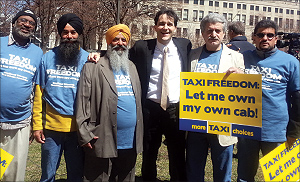
Judge Rules Milwaukee’s Taxi Cap Violates Right to Earn an Honest Living

Liberty & Law
Mile-High Victory for Taxicab Entrepreneurs

Liberty & Law
Chicago’s Food Entrepreneurs Were Hungry for What the IJ Clinic’s Recipe for Success Conference Served Up
Subscribe to get Liberty & Law magazine direct to your mailbox!
Sign up to receive IJ's bimonthly magazine, Liberty & Law, along with breaking news updates about the Institute for Justice's fight to protect the rights of all Americans.