

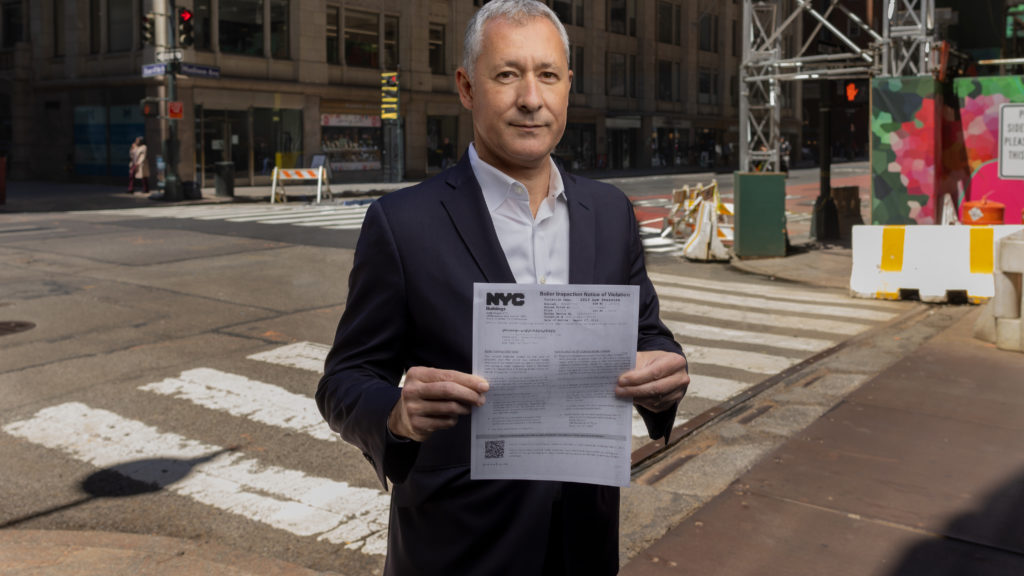
WASHINGTON—Today, an innocent New York property owner—who was fined for a code violation he did not commit and had no way to appeal—is asking the United States Supreme Court to revive his lawsuit challenging New York City’s system of issuing unreviewable fines for code violations. Serafim Katergaris and his attorneys from the Institute for Justice (IJ) first filed the putative class action lawsuit in August 2022.
“New York City’s scheme of issuing unreviewable fines for code violations and giving people no way to appeal in state courts a clear violation of basic due process rights enshrined in the Constitution,” said IJ Senior Attorney Diana Simpson. “On top of that, the city’s methods for informing owners of these fines are sloppy, leaving many without knowledge of them for years. By then, the city says it is too late to challenge the system in federal court. The city cannot insulate itself from the Constitution.”
In 2014, Serafim bought a home in Harlem and the title search came back clean. However, when Serafim went to sell the home in 2021, he learned for the first time that the City had issued him a $1,000 fine in 2015 for failing to submit a boiler inspection report in 2013. He never received the violation in 2015. And he had no way to know about it: Serafim didn’t own the home when the inspection should’ve been done, and by the time he bought the house, the boiler had been removed.
“Being punished for a violation I did not commit, never receiving notice of the violation, and having the city routinely ignore my pleas to prove my innocence was incredibly frustrating,” said Serafim. “What happened to me could happen to any New Yorker, which is why I’m asking the Supreme Court to hear this case.”
The Department of Buildings (DOB) claimed that it issued Serafim a notice of violation on March 3, 2015, but Serafim never received the notice. By the time he was selling the home in 2021, the violation now showed up the prospective buyers’ title search. Serafim explained the situation to DOB and asked for a waiver, but DOB refused to grant him one. He then requested a hearing with DOB but was ignored. Without any other legal options available, Serafim paid the fine so the sale could move forward, but submitted a letter to DOB explaining that he was paying under protest and that he wanted a refund. DOB refused. It rebuffed him at every turn.
“In America, you’re supposed to be innocent until proven guilty, but New York’s code enforcement system flips that principle on its head,” said IJ Senior Attorney William Maurer. “New Yorkers from all walks of life are issued fines for minor code violations every day, and they deserve a way to be able to contest these fines.”
In June 2024, the United States District Court for the Southern District of New York dismissed Serafim’s lawsuit, arguing that the statute of limitations expired in 2018, three years after the city purported to mail the notice of violation. It presumed that notice had been appropriately mailed and that Serafim received it despite the evidence that hundreds of people never received their notices for boiler violations that year and that Serafim himself swore he hadn’t received it. Serafim and IJ then appealed that ruling, but, in a decision that conflicts with the standards in thirteen other federal courts, the appeals court sided with the city and affirmed the district court’s misguided determination. Serafim’s case asks the Supreme Court to bring New York’s law regarding notice in line with that in the rest of the country.