

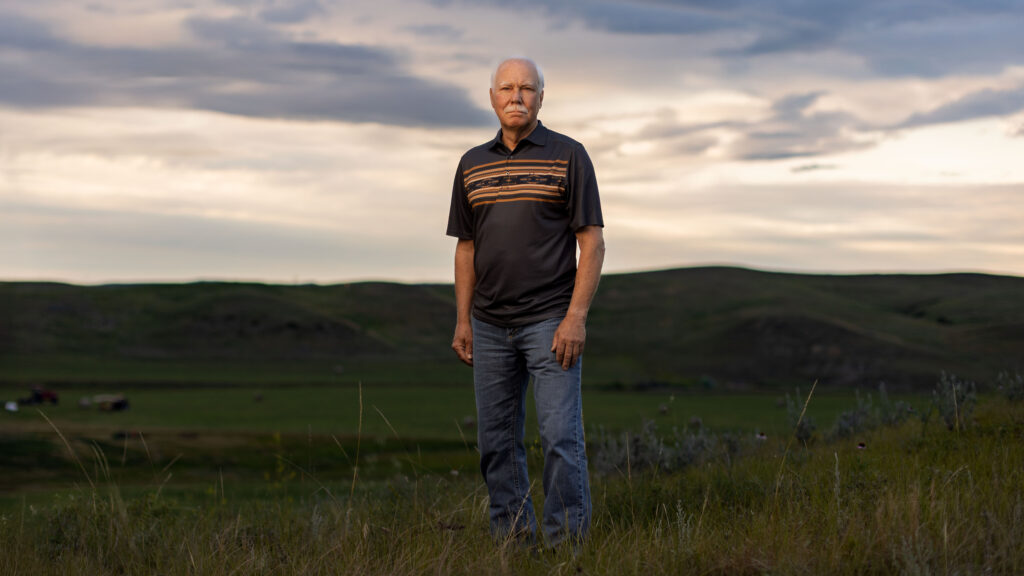
WASHINGTON—The U.S. Supreme Court has agreed to hear a case from a group of North Dakota ranchers who fought for years to obtain a fair price for land a pipeline company wanted to take through eminent domain. They won—but then a federal appeals court told them that they would have to pay the cost of that three-year legal fight themselves. The ranchers, who own property in McKenzie County, are represented by the Institute for Justice (IJ), a non-profit public interest law firm that defends property rights nationwide.
“This case is about whether private pipeline companies have to respect state law when they take private property for their own use through eminent domain,” said IJ Deputy Litigation Director Robert McNamara. “Logic, fairness, and the majority of the courts of appeals all say ‘yes,’ and we’re confident the Supreme Court will as well.”
When a natural gas pipeline company with federal eminent domain power demanded property from ranchers near Watford City, North Dakota, the offered price was shockingly low—just over half the market price. The property owners didn’t object to the pipeline in principle, but they knew exactly what a fair price was for a pipeline easement, since few pipeline companies have the power of eminent domain. The pipeline company said that didn’t matter—that it didn’t have to pay market rates because the government had given it the power to take the land—and so the ranchers went to federal court to determine the value.
“I am very excited that the US Supreme Court has decided to accept our case,” said Len Hoffman. “Our properties are an important heritage and, if the government is going to force us to give up land, we deserve a fair price.”
Three years later, a federal judge unsurprisingly determined that the ranchers could use market prices to show the value of their land. The judge also ruled that the company had to pay the costs of the proceeding: North Dakota law says property owners should walk away from a condemnation with the value of their land—not the value of their land minus legal fees. But then something unusual happened.
Other federal courts nationwide say that state law should apply when determining how much a private pipeline company owes for the land it takes. But the 8th U.S. Circuit Court of Appeals took a different view and said that the company only had to pay for the land, regardless of North Dakota law. To get a fair price in court, the ranchers spent hundreds of thousands of dollars.
The 8th Circuit puts property owners in a Catch-22: accept a low-ball offer for their property or fight for a fair price out of their own pocket. This lose-lose situation doesn’t square with basic ideas of fairness or with how property owners are treated in every other circuit.
“Eminent domain is among the government’s most dangerous powers and doubly so when it is used by private actors,” said IJ Attorney Matt Liles. “We’re asking the Supreme Court to make sure basic guardrails on that power stay in place.”
The Institute for Justice defends property rights nationwide and argued on behalf of homeowners in Kelo v. New London, a landmark U.S. Supreme Court case involving eminent domain abuse. Last year, IJ successfully argued at the Court on behalf of ranchers in DeVillier v. Texas. In that case, the state refused to compensate property owners after a transportation project flooded out their land. IJ is also currently defending property owners fighting abusive eminent domain actions in Missouri, Mississippi, and New Jersey.