Judicial Odysseys
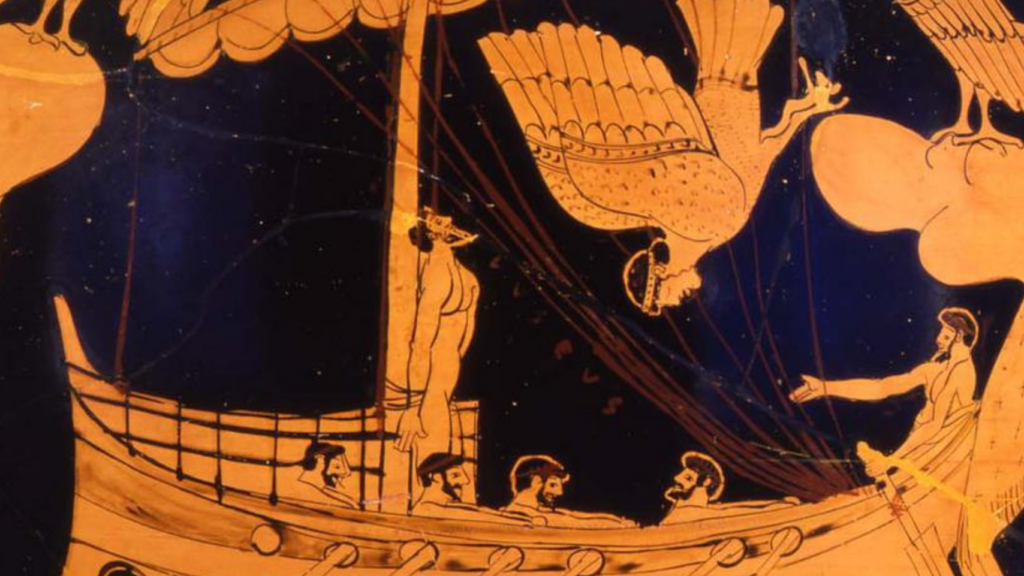
How have courts used Homer’s homecoming epic in their opinions?
With Odysseus’s voyages on everyone’s mind, I thought it would be fun to investigate how Homer’s Odyssey has intersected with the courts—including with judicial engagement itself. (I’m sure the same can be said of caselaw in other countries but I’ve focused on the text of judicial opinions in the United States.)
As classics of literature, judges can’t help themselves from periodically invoking Homer’s works, although the “blind bard” has no monopoly there. I could write similar posts on Shakespeare, the Bible, Dickens, Melville, etc. Not to mention more recent artists, such as The Beatles, Jerry Seinfeld, and Taylor Swift. See, e.g., House of Brides, Inc. v. Alfred Angelo, Inc., 163 F. Supp. 3d 534, 549 n.10 (N.D. Ill. 2016) (“Given the tenor of their filings and the history of this case, however, it appears likely that these parties are ‘never, ever getting back together.’”). We even devoted a Short Circuit podcast episode a few years ago, with our friend Raffi Melkonian, to the problem of judges going over the cringe line when employing pop culture.
But just because using art and literature in judicial decisions can be cringe or even disrespectful does not at all mean that it always is. Classics are classics for a reason, drawing on human universals to teach us something about both the world and ourselves. Just as we use metaphors in law to make powerful points in countless ways, invocations of time-honored stories can do the same.
With that, I’ll first detail when Odysseus and his fellow cast of characters have played a part in constitutional rulings. Then we’ll open it up to judicial decisions writ large. Also, fear not those afraid of spoilers: I’ll be keeping the commentary to ancient sources and modern opinions, not a certain Christopher Nolan film you may not have seen yet.
An unconstitutional Scylla and Charybdis
Overall, judges’ most frequent use of Homer’s Odyssey takes from the story of Scylla and Charybdis, where Odysseus is forced to sail either past the deadly whirlpool monster or the many-headed man-chomper. In the constitutional context, my favorite use of this “rock and a hard place” is in a federal district court opinion concerning a First Amendment challenge to a campaign finance law in Hawaii, Ancheta v. Watada (2001).
In that case, the state tried to regulate political speech in a number of different ways, including forcing candidates to either commit to adhering to a “Code of Fair Campaign Practices” or be branded as a candidate who did not sign the code. The code itself included mandates that would violate the First Amendment, such as nebulously banning “scurrilous personal attacks.” Those who didn’t sign the code were publicly identified, implying that they did not “uphold basic principles of decency, honesty and fair play.” In response, the court found the “artifice used by the State to regulate speech effectively places candidates for public office in the position of choosing between Scylla and Charybdis” and ruled it was an unconstitutional condition on the exercise of constitutional rights.
We at IJ frequently use variants of the unconstitutional conditions doctrine in our efforts to prevent governments from giving two monstrous options. Check out, for example, a cert petition my colleagues just filed at the Supreme Court, challenging conditions Massachusetts places on our clients’ attempts to exercise their right to direct the education of their children. “Unconstitutional conditions” comes up in many other areas we practice in, including the Fourth Amendment and property rights. And although it wasn’t styled in Homeric ways, the choices at issue in the Hawaii case were similar to those in one of our Supreme Court cases, Arizona Free Enterprise Club’s Freedom Club PAC v. Bennett, where those who spoke out in elections had the choice of limiting their speech or providing a benefit to a candidate they did not support.
A dog isn’t just man’s best friend generally but was Odysseus’s specifically. The love Argos had for his master kept him going for at least 20 years, far more than your average pup’s. The story of Argos waiting for Odysseus, and then remembering his scent, has been catnip for judges in dog sniffing cases. Readers may know that dog sniffs have high error rates and can lead to the ensnarement of innocent people with law enforcement. And they may also know that the U.S. Supreme Court has so far been unconcerned with this, even after careful demonstration of the perverse incentives of civil forfeiture and how they favor false alerts. This is all true, but when it comes to Argos, judges sometimes fall for the story’s siren song and give law enforcement the benefit of the doubt. For example, one Oregon appellate judge (in dissent) invoked it—and other impressive tales of dog forensics—to conclude a sniff is not a search. But dog sniffs are not all the Argos angle has been used for. I love this explanation of the incomprehensible world of Eleventh Amendment (state sovereign immunity) law from the Second Circuit in 1995:
The contrast between prospective relief, permitted under the Eleventh Amendment, and retroactive relief, barred by that Amendment, is far from that between day and night. It is more like examining a subject in that half-light called the gloaming, where to identify it accurately one needs to have the instincts of Argos, Odysseus’ dog, who recognized his master dressed as a beggar upon his return home after 20 years’ absence.
Finally, when it comes to judicial engagement, it’s not just men and dogs who make the Homeric law reporters. Some courts have instead turned to Penelope and her loom. For those who don’t remember, while waiting years for Odysseus she is beset by suitors pressuring her to remarry. She claims she will choose one when she finishes a shroud which she weaves during the day—but then unwinds at night. The D.C. Circuit has explained how one can’t simply restart an agency’s review of a record over and over again by submitting a new report each time. Otherwise, “parties could ‘behave like Penelope, unraveling each day’s work to start the web again the next day.’”
Calypso breakdown
There are well over one hundred—perhaps several hundred—uses of Homer, his poems, and his characters, in American caselaw. (If you expand even further to idioms from those poems that are so well known that the Homeric context isn’t even mentioned, the number is even greater. Search for “Trojan horse” and you’ll find hits everywhere.)
When it comes to invocations of the actual stories there’s much more Odyssey than Iliad. Perhaps that’s unsurprising, given that many cases “seem like an odyssey” and can last a full ten years or more. Indeed, that was on the mind of a New York trial judge, who said
Certainly, had Odysseus been required to deal with the court system rather than battle the Cyclops on his journey home, Penelope would have remarried, his dog would have died, and millions of students would have been spared having to read the Odyssey. Public policy demands that litigation be decided on the merits whenever possible and that tortfeasors bear the responsibility for their own wrongful acts. Technicalities should not be used to circumvent justice.
After Scylla and Charybdis, one of the most popular Odyssey stories for judges is the myth of Sisyphus. Sisyphus’s eternal rolling of a rock up a hill appears elsewhere in ancient literature but the Homeric version has been drawn upon in many a case. Surprisingly, I did not find one that compared Sisyphus’s task to the rational basis test, which, when interpreted in its extreme form, has a similar outcome for those trying to protect their constitutional rights. However, his rolling rock is used in other contexts, including turf wars between Chamber of Commerce chapters and, in dissent, environmental impact review.
Of course, the Sirens make their appearance many times, generally without a citation to Homer needed. There’s over one hundred court opinions using “siren song” and dozens of uses of being tied to a mast. For example, in 2023 a federal court in Missouri stated “Like Odysseus tied to the mast of his ship to resist the alluring call of the sirens, the Court binds itself to the text of the statute to determine the legislature’s intent and to avoid the alluring snare of statutory revisionism.”
One thing that surprised me is that several older cases draw upon a lesser-remembered detail from the Odyssey: when Telemachus hands over his treasures to his friend Peirocus before fighting the suitors. It’s sometimes been used while explaining the doctrine of donatio mortis causa—a gift given in contemplation of death, and therefore perhaps a gift that is void. The earliest I found was an 1867 New York case.
The two island-bound-goddesses Odysseus spends a few years shooting the breeze with, Circe and Calypso, haven’t been favorites of judges, although Circe is sometimes used in conjunction with the advice she gave Odysseus of how to deal with upcoming perils. One rare deployment of Calypso, though, is clever. In a 2005 case involving the source code of America Online (AOL), a federal district court said “AOL objects to the motion and conjures up images of a detention worthy of Calypso. AOL’s position is well-taken.”
There also have been some uses of the Cyclops and Odysseus’ clever wheeze of telling Poseidon’s son his name was “no one” and tying himself and his men underneath the giant’s sheep. But not many. And even then not in an always “pro-Odysseus” way. One dissenting Ninth Circuit judge frustratingly claimed “just as wily Odysseus pulled a fast one on the dreaded Cyclops, we fleece Congress by defying its statutes.”
Curiously, it seems no judge has ever stolen these lines describing Cyclopean society, which perhaps could concern a land of similar social simplicity: “Neither assemblies for council have they, nor appointed laws, but they dwell on the peaks of lofty mountains in hollow caves, and each one is lawgiver to his children and his wives, and they reck nothing one of another.” (Credit to my colleague John Wrench for alerting me to this one.)
Further, there is a line at the end of Book XII of the epic that a couple courts have appropriated for the task of recounting well-worn facts and law in a case they’ve seen before: “It is tedious to tell again tales already plainly told.”
A rosey-fingered Homeric dawn?
Let’s close by moving beyond the Odyssey with a nod to both its purported author and the future. Before Justice Souter died I (shamefully) had never heard the aphorism “Homer nodded.” The phrase (which appears to originally come from the Roman poet Horace) essentially means even the greatest among us sometimes err. Souter put the saying in a footnote in an opinion but it was taken out when the editor didn’t recognize the saying and thought it was a mistake. “Homer nodded” was only put back in years later when law professor Mark Tushnet noted the discrepancy. According to law professor Jonathan Adler it’s appeared in the U.S. reports three other times.
I did a search of “Homer w/5 nod!” and overall found 86 instances in American cases, including those four at SCOTUS, where some variant of that old saying made an appearance. The oldest was an 1819 North Carolina estate case. But it was an outlier. Surprisingly for an old saying, most of the cases were relatively recent, with well-over half issued in the last 60 years. Perhaps that indicates that while the saying is old, the employment of Homer in judicial opinions is not as “old” as one would think. Perhaps it is very much a modern practice. And with the success of Nolan’s film as Exhibit A, perhaps Homer will stay in judicial opinions, and judicial engagement, in the future. Indeed, as long as vindicating justice requires a epic voyage over wine-dark seas—one we at IJ are happy to embark on, whatever monsters or suitors may lurk before us—there’s no reason to think otherwise.
Anthony Sanders is the Direct of the Center for Judicial Engagement at the Institute for Justice.