Private Property
Global Coin Logistics v. DEA

- Case Name
- Global Coin Logistics v. DEA
- Issue Areas
- Status
- Active Cases
- Location
- San Diego, California
- Date Filed
- October 27, 2026
The Case
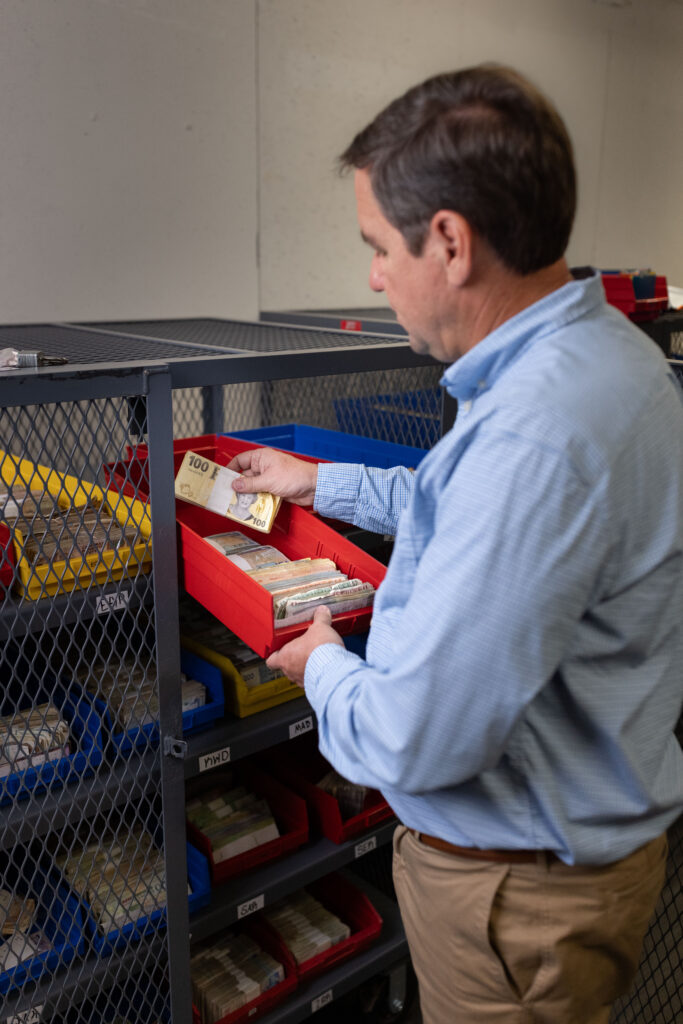
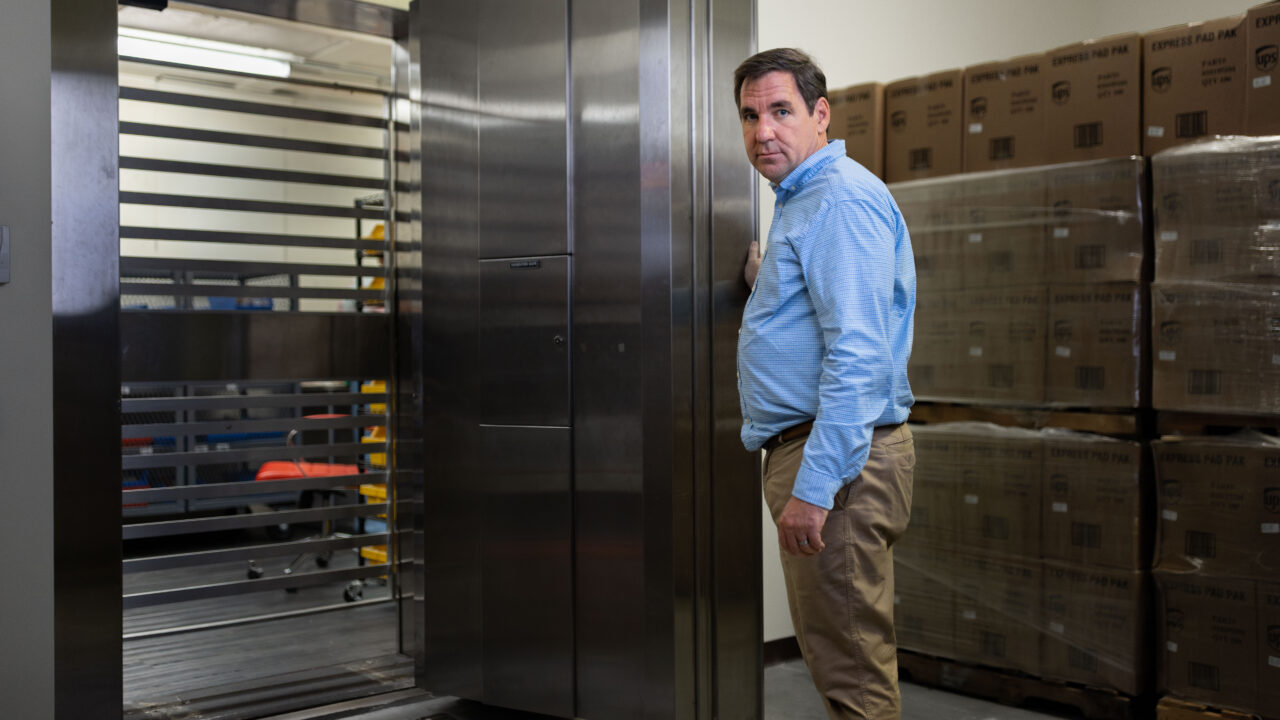
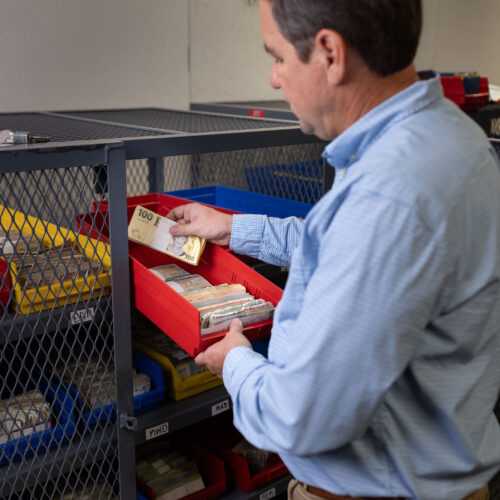
If you have ever pulled cash from an ATM or spent U.S. dollars in Mexico, you may have crossed paths with Steven Bailey’s business without knowing it. His company, Global Coin Logistics, LLC (GCL), based in Louisville, Kentucky, is a currency wholesaler. Its core trade is buying surplus U.S. dollars in Mexico and selling them to customers who need cash—ATM operators here at home and currency buyers overseas—but it buys and sells foreign currencies, too. It is an unglamorous, paperwork-heavy line of work. GCL is registered with the U.S. Treasury Department’s Financial Crimes Enforcement Network (FinCEN), runs a documented compliance program, and has passed a FinCEN compliance audit. Steven has been doing this work for roughly a decade.
Then, in the fall of 2025, the federal government took nearly $1.4 million of GCL’s money in two separate seizures, seven weeks apart, on opposite sides of the country. No one at GCL has been charged with a crime. It is perfectly legal to travel with cash, including internationally, and Steven follows all reporting requirements, And in the months since, neither federal agency that took GCL’s money—the Drug Enforcement Administration (DEA) and U.S. Customs and Border Protection (CBP)—has told Steven what law he or his company supposedly broke.
Now Steven has teamed up with the Institute for Justice (IJ) to file two federal lawsuits challenging these civil forfeitures. The Fifth Amendment says the government may not deprive anyone of property without due process of law. At a bare minimum, that means that when the government wants to take your property, it has to tell you why. And in Miami, GCL’s lawsuit also contends that CBP’s fact- and law-free notice violated its own regulations.
Case Team
Client

Steven Bailey
Client
Attorneys



Staff

Dan King
Assistant Director of Media Relations
Kyndra Griffin
Senior Paralegal

Rebekah Ramirez
Senior Paralegal
Media Resources
Get in touch with the media contact for image resources, press releases, and interview requests.
Media Images





Case Documents
Case Summary
A Legitimate Business in a Heavily Regulated Industry
Steven spent several years in the currency business working at Travelex before founding GCL in 2016. GCL’s core trade fills a real gap in the market. Mexican banks limit how many U.S. dollars their customers can deposit, which leaves Mexican currency exchanges holding surplus dollars. GCL buys that surplus at a discount, brings it into the United States—declaring it to customs on the way in—and resells it to businesses that need physical cash, like large independent ATM providers.
Every step is documented. GCL is registered with FinCEN as a money services business. It vets its counterparties through third-party database checks and in-person site visits. It declares every currency shipment to customs twice—once when the money leaves Mexico and again when it enters the United States—and it files the reports that federal law requires of currency businesses. It has passed a FinCEN audit. When federal agents in the past had asked GCL to explain where its money came from and where it was going, GCL had answered them—with paperwork.
But all of that changed one early September day.
San Diego: DEA Seizes $320,000 at the Airport
On Sept. 5, 2025, GCL imported $1.2 million in U.S. currency from a supplier in Tijuana, Mexico, clearing customs and moving the money to GCL’s Southern California vault. Two days later, one of GCL’s customers—an ATM operator on the East Coast—ordered $320,000 of it in $20 denominations.
So on Sept. 8, a GCL courier carried the $320,000 through security at San Diego International Airport for a flight to Philadelphia, where the customer would take delivery. Carrying cash on a domestic flight is legal, and GCL’s couriers do it as a matter of routine. But the Transportation Security Administration (TSA) flagged the cash at screening. Local police were called, then Homeland Security, then the DEA.
DEA agents questioned GCL’s courier at length. The courier showed them documentation explaining GCL’s business and proving the source and destination of the money. The DEA agents also called Steven directly, and he walked them through the business, where the money came from, and where it was going. GCL offered the agents additional documentation for all of it—proof of the money’s source and its destination.
But the agents did not bother to examine any of the documents. Instead, they took the cash out of the courier’s sight, into a separate room. When they came back, they said a drug-sniffing dog had alerted on it. No one from GCL saw the dog or the alert. And even taken at face value, a dog alert on a stack of bills is close to meaningless. It is well documented that a large share of the U.S. currency in circulation carries trace drug residue, so a dog reacting to cash that has passed through countless hands says almost nothing about the person holding it now.
Still, the DEA seized all $320,000 anyway. It arrested no one during or after the seizure, and no criminal charges were ever filed against Steven, GCL, or any of its employees.
Miami: Federal Agents Seize Another $1.06 Million From a GCL Aircraft
Seven weeks later, on Oct. 31, 2025, GCL’s company aircraft was preparing to depart a Miami airport carrying currency GCL had brought in from Mexico the day before. As the plane taxied toward the runway, several government vehicles blocked it on the tarmac. Immigration and Customs Enforcement agents boarded the plane and held the pilot for hours. The pilot got word to Steven, who offered over the phone to walk federal agents through GCL’s documentation for the currency on board. But the agents once again refused to listen or examine those documents. Instead, they seized $960,000 in U.S. currency and roughly 2 million Mexican pesos—which the government valued at $100,100—for a total of approximately $1,060,100.
Again, federal agents arrested no one during or after the seizure, and no criminal charges were ever filed against Steven, GCL, or any of its employees.
The Notices: A Statute Number and Nothing Else
Weeks after each seizure, DEA and CBP sent GCL forfeiture notices announcing that the agencies intended to keep GCL’s currency for themselves. Federal law gives agencies like DEA and CBP an extraordinary power. Through a process called administrative forfeiture they can take property and, if no one successfully fights back, keep it without a judge ever reviewing the case. The only thing standing between a property owner and permanent loss is a piece of paper: the agency’s notice. DEA’s is titled “Notice of Seizure of Property and Initiation of Administrative Forfeiture Proceedings,” and CBP’s is titled “Notice of Seizure and Information to Claimants.” Each is supposed to tell the owner what is happening and give them a fair chance to contest it.
Here is the entirety of what DEA’s notice, dated Oct. 27, 2025, says about why the government believes it can keep GCL’s $320,000:

That is it. The statutes after “21 U.S.C. 881” are procedural—they govern how forfeitures are processed, not why. And “21 U.S.C. 881” itself is not an accusation. It is the umbrella forfeiture provision of the Controlled Substances Act, the federal drug law that defines dozens of distinct offenses, from large-scale trafficking to recordkeeping violations. The provision lists 11 different categories of forfeitable property. The notice does not say which subsection applies. It does not name a drug. It does not identify a transaction, a person, or a single fact connecting GCL’s money to any crime. The rest of the two-page document is boilerplate language about deadlines and forms.
CBP’s notice for the Miami seizure, dated Dec. 29, 2025, is no better. Its statement of legal basis reads, in full:

The provision CBP’s notice cites—18 U.S.C. § 981(a)(1)—is the federal government’s general civil forfeiture statute, and it is even more sprawling than the drug provision DEA cited. Section 981(a)(1) reaches, among other things, any property “involved in” or traceable to a violation of the federal money-laundering laws, and those money-laundering laws in turn incorporate several hundred separate federal and state crimes, from drug trafficking to mail fraud to bribery. Citing “981(a)(1)” by itself tells a property owner nothing about which of those crimes is supposedly in play. No subsection. No offense. No facts. Then several pages of forms.
CBP once recognized the problem. In 1978, the U.S. Customs Service—CBP’s predecessor—rewrote its own forfeiture regulations to require more than a statute number. It did so because, months earlier, a House committee had reported a bill to overhaul the customs penalty system, noting that it had “come under attack from all segments of the importing public” over, among other things, “the lack of due process safeguards.” Customs said its rule change would fix notices that “occasionally have been unclear” and let people “make an informed response.”
Under those rules, a customs seizure notice is supposed to identify the provisions of law the agency believes were violated and describe the specific acts that form the basis of the alleged violation. In other words, nearly 50 years ago, the agency that would become CBP concluded on its own that a property owner is entitled to know what, exactly, the government thinks they did. Those rules are still on the books. CBP’s notice to GCL appears to violate them.
The Trap in the Paperwork
A person who receives one of these notices faces a choice, on a deadline, with almost no information. The notice offers two paths.
The first is to file a “petition for remission or mitigation.” DEA’s notice describes this as a request that “PARDONS ALL OR PART OF THE PROPERTY FROM THE FORFEITURE.” The word “pardons” is telling. A petition does not contest whether the government has any right to the money. It concedes the forfeiture and asks the agency to give the money back as a matter of grace. And the agency that seized the money is the one that decides. There is no neutral decisionmaker. There is no hearing. There is no standard the agency has to meet. The only check is a “request for reconsideration,” decided by another employee of the same agency. And at the end of it, there is no path to a judge.
The second path is to file a “claim,” which forces the government to either return the property or bring a forfeiture case in federal court, where a judge decides, and the government bears the burden of proof. But the claim deadline is short—35 days from the date of DEA’s letter—and the notice makes the choice sound like an either/or.
Steven responded to the San Diego seizure by filing a petition for remission with DEA on Nov.19, 2025, laying out the legitimate source and destination of the $320,000. DEA has never responded. So, the government has GCL’s money, GCL has no court date, and Steven still does not know what DEA thinks he did wrong.
The Miami seizure followed a similar course. GCL petitioned CBP in January 2026. CBP’s Miami office said the matter had been referred to Washington. GCL has heard nothing since.
The Legal Claims
The Fifth Amendment to the U.S. Constitution guarantees that no person shall be “deprived of life, liberty, or property, without due process of law.” For more than a century, courts have understood that guarantee to require, at a minimum, meaningful notice and a meaningful opportunity to be heard before the government takes what is yours. Notice is not meaningful if it does not tell you what you are accused of. And an opportunity to be heard is not meaningful if you have to guess what to say.
Federal courts have said so directly. A federal appeals court has held that government forfeiture notices that merely cited the seizure statute while giving no case-specific facts and no statement of the “exact reasons for the seizure” violated due process. The same court later held that the government must provide, at a minimum, “a terse and complete statement of reasons” before depriving someone of property. Both decisions apply the framework the Supreme Court has laid out for deciding how much process the Constitution requires: courts weigh the private interest at stake, the risk of error, and the government’s burden in providing more. That framework governs every federal court in the country, including the courts hearing both of GCL’s cases.
Applying that framework here is not difficult. The private interest is enormous: nearly $1.4 million in working capital belonging to a small business. The risk of error is obvious: an owner who is not told the accusation cannot rebut it, and the government’s own case is never tested. And the burden on the government is trivial: One would assume that DEA and CBP already know why they seized the money. Writing down the offense they suspect and the facts they are relying on would cost them a paragraph.
The Miami lawsuit makes one additional claim, under the Administrative Procedure Act (APA), which requires federal agencies to follow the law and their own rules. As noted above, CBP’s regulations for decades have required seizure notices to identify the provisions of law the agency believes were violated and to describe the specific acts that form the basis of the alleged violation. 19 C.F.R. § 162.31(b). Another CBP regulation extends that requirement to the notices CBP sends in civil forfeiture cases governed by the Civil Asset Forfeiture Reform Act of 2000, like this one. 19 C.F.R. § 162.92(a). But despite those requirements, CBP’s notice to GCL cites only 18 U.S.C. § 981(a)(1). An agency that disregards its own binding rules acts arbitrarily and contrary to law, and GCL asks the court to set the notice aside.
GCL’s lawsuits ask the courts to declare that the DEA and CBP notices violate the Due Process Clause, to bar the agencies from finalizing any forfeiture on the strength of those notices, and to require the government to state the specific factual and legal basis for any forfeiture it intends to pursue. In Miami, GCL also asks the court to set aside CBP’s notice for violating the agency’s own regulations.
This case is not only about Steven Bailey. A ruling that these notices are unconstitutional would change how the federal government takes property from thousands of people every year, most of whom—like Steven—are never charged with anything.
The Courts and Plaintiffs
GCL and Steven Bailey filed two related lawsuits on the same day. The first, in the U.S. District Court for the Southern District of California, challenges DEA’s notice for the San Diego seizure; the defendants are the Drug Enforcement Administration, its Administrator, Terrance C. Cole, and the Special Agent in Charge of its San Diego Division, James Nunnallee, each in his official capacity. The second, in the U.S. District Court for the Southern District of Florida, challenges CBP’s notice for the Miami seizure, on both constitutional and regulatory grounds; the defendants are U.S. Customs and Border Protection; its Commissioner, Rodney S. Scott; and the Director of Field Operations for CBP’s Miami/Tampa Field Office, Daniel Alonso, each in his official capacity.
The Litigation Team
Steven Bailey and Global Coin Logistics are represented by Institute for Justice Attorney Keith Neely, Litigation Fellow Wes Dodson, Attorney Jimmy Odell, and Senior Attorney Robert Frommer. Anna M. Barvir of Michel & Associates, P.C., is serving as local counsel in the San Diego case.
About the Institute for Justice
The Institute for Justice is the national law firm for liberty and the nation’s leading advocate for property rights. IJ has spent more than a decade fighting civil forfeiture—the practice by which the government takes property from people who have never been charged with, let alone convicted of, a crime—in courts, in legislatures, and in the court of public opinion. IJ’s forfeiture litigation has repeatedly targeted the federal government’s practice of seizing cash from travelers at airports and then leaving them in the dark, including on behalf of Terry Rolin, whose $82,373 life savings a DEA agent seized from his daughter at the Pittsburgh airport, and Kermit Warren, a New Orleans man whose nearly $30,000 the DEA seized at the Columbus, Ohio, airport while he was on his way to buy a tow truck. IJ also challenged the FBI’s bare-bones forfeiture notices on behalf of Linda Martin, whose $40,200 the FBI seized in a raid on U.S. Private Vaults in Beverly Hills. In each case, the government ultimately returned the money. IJ also publishes Policing for Profit, the most comprehensive national study of civil forfeiture laws and their abuse.