Fines and Fees
Listeners’ Guide to Jouppi v. Alaska
Explaining the legal fault lines in the case and the key legal terms that could come up during oral argument.

- Case Name
- Jouppi v. Alaska
- Issue Areas
- Location
- Fairbanks, Alaska
- Date Filed
- September 2, 2025
Oral Argument
Frequently Asked Questions
What happened to Ken Jouppi?
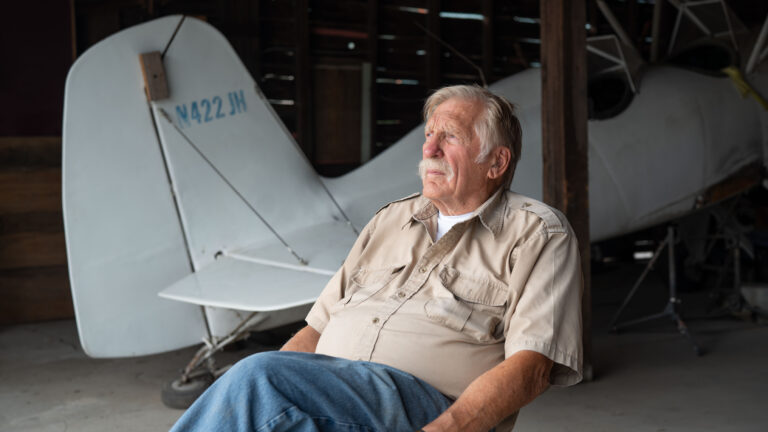
On the morning of April 3, 2012, Ken Jouppi was loading his 1969 Cessna 206 at a Fairbanks airstrip for a routine charter. Jouppi, an Air Force veteran who spent four years keeping B-52s in the air, had been flying in Alaska since the late 1970s. For years he ran a one-man air taxi, carrying tourists, locals, and their belongings (from groceries to gasoline) across the Alaskan bush.
That morning’s passenger was a repeat customer headed to the village of Beaver to spend her birthday with her husband, who worked there. Beaver is “dry”: Like many small Alaskan villages, it bans the sale, importation, and possession of alcohol. Among the passenger’s many groceries was beer for her husband. Jouppi didn’t search his passengers’ luggage; no law required him to, and he considered it invasive and demeaning to do so.
Before the plane took off, state troopers arrived, searched it, and found the beer. Jouppi said he had no idea it was there. The troopers maintained that at least one six-pack of Budweiser, in a grocery bag, would have been visible to him. On that basis, the State charged Jouppi with a misdemeanor: knowingly transporting alcohol into a dry community. A jury convicted him, and the judge imposed the minimum sentence the law allowed: three days in jail and a $1,500 fine. The judge noted that Jouppi, then 70, had a clean record.
But the State wasn’t finished. Alaska law makes forfeiture of an airplane used to import alcohol mandatory, even for a first-time misdemeanor. For fourteen years now, the State has been trying to take Ken’s plane, which the trial court valued at $95,000. Ken is now 83.
What is the Excessive Fines Clause?
The Eighth Amendment to the U.S. Constitution says: “Excessive bail shall not be required, nor excessive fines imposed, nor cruel and unusual punishments inflicted.”
The Excessive Fines Clause is the middle of those three protections, and its roots run deep. Magna Carta in 1215 promised that a “free man shall not be amerced for a small fault, but according to the measure thereof; and for a great crime according to its magnitude.” The English Bill of Rights of 1689 banned excessive fines after the Stuart kings used ruinous penalties to punish critics and fill the royal treasury. America’s founders carried that guarantee into the Bill of Rights.
The Clause covers more than fines in the ordinary sense. When the government takes property as punishment for a crime, that “forfeiture” is a fine too, and it must not be excessive. Alaska does not dispute that the forfeiture of Ken’s plane is a fine. The only question is whether it is excessive.
Fines get special constitutional attention for a reason that is as true today as it was in 1215. Most punishments cost the government money. Fines and forfeitures make the government money. That creates a standing temptation to punish too much.
What is the question presented?
The Supreme Court doesn’t decide cases in their entirety. It agrees to answer specific legal questions, called the “questions presented.” This case has one:
The “touchstone of the constitutional inquiry under the Excessive Fines Clause” is that the amount of the fine “must bear some relationship to the gravity of the offense that it is designed to punish.” Below, the Alaska Supreme Court upheld the forfeiture of petitioner’s $95,000 airplane because, the court reasoned, petitioner knew that one of his passenger’s grocery bags contained a six-pack of Budweiser.
In so holding, the court captured vividly a lower-court conflict over the standard for evaluating the gravity of a property owner’s offense under the Excessive Fines Clause. Aligning with the Eleventh Circuit, the Alaska Supreme Court examined the gravity of the defendant’s offense at a stratospheric level of abstraction. Meanwhile, the federal circuit in which Alaska sits—in line with many other state and federal courts—holds that “[i]t is critical” to “review the specific actions of the violator rather than by taking an abstract view of the violation.”
The question presented is whether, in determining whether a fine contravenes the Excessive Fines Clause, courts may consider the gravity of the underlying offense purely in the abstract or should consider the gravity of the specific defendant’s wrongdoing.
In plain terms: When a court decides whether a fine is too high, does it look at what a specific person did in a specific case? Or should it look only at the harm the crime causes society as a whole, across everyone who commits it?
Why does the level of abstraction matter so much?
The difference is enormous. Under Alaska’s approach, one person can be punished as if he were responsible for the harm caused by everyone who ever broke the same law. That is what happened to Ken. The Alaska Supreme Court accepted that his culpability extended to a single six-pack, with no connection to any other wrongdoing. Alaska’s briefing conceded as much. Then the court weighed his offense against the statewide toll of alcohol abuse: crime, alcoholism, fetal alcohol syndrome, and death. Measured that way, almost no punishment will ever look too large.
The approach Ken advocates is the correct one: Courts should account for the specific culpability of the specific person before them. It’s common sense that turning a blind eye to a single six-pack is much different from intentionally importing, say, sixty boxes of whiskey bottles. Yet Alaska’s approach views the offense as “alcohol importation,” period—thus allowing each of those people to be fined equally, regardless of the degree of their specific misconduct.
Indeed, viewed at Alaska’s level of abstraction, almost every offense is maximally grave.
IJ’s brief offers examples. In 2019, about 2,000 Americans died because they weren’t wearing seatbelts, at a societal cost estimated at $11 billion. Speeding is worse. If courts weigh a traffic ticket against the total harm of every unbuckled seatbelt or every speeding car in America, no fine or forfeiture would ever be too much—not even taking someone’s car for going one mile over the limit.
Justices have voiced concerns along these lines before. At the 2018 argument in Timbs v. Indiana, Justice Breyer asked whether the government could forfeit a Bugatti for driving five miles over the speed limit. (Indiana’s counsel argued that they could!) And under the Alaska Supreme Court’s approach, it’s hard to see why not.
History tells the same story. The most notorious fines in Anglo-American history were justified by describing minor offenses in sweeping terms. In the Star Chamber, the Crown’s lawyers inflated small infractions into threats to the monarchy itself. After the American Civil War, the Black Codes fined freed people to the full extent of the law for petty offences, and those who couldn’t pay were auctioned into forced labor. The Excessive Fines Clause exists to stop exactly this move.
What is United States v. Bajakajian?
United States v. Bajakajian, 524 U.S. 321 (1998), is the Supreme Court’s leading excessive-fines decision and a case you will hear about consistently on December 1.
What happened. In 1994, Hosep Bajakajian and his family were boarding a flight at Los Angeles International Airport, bound for Cyprus. He was carrying $357,144 in cash, money he had earned lawfully and planned to use to repay a debt. Federal law requires travelers to report when they take more than $10,000 into or out of the country. He didn’t. He pleaded guilty to the reporting offense, a felony, and the trial court sentenced him to three years of probation and a $5,000 fine. Yet the government also demanded forfeiture of every unreported dollar, as the reporting statute required
What the Court held. In a 5-4 opinion written by Justice Clarence Thomas, the Court held that forfeiting all $357,144 would violate the Excessive Fines Clause. The Court announced the test that governs today: a forfeiture is unconstitutional if it is “grossly disproportional to the gravity of a defendant’s offense.” The amount of the forfeiture, the Court said, “must bear some relationship to the gravity of the offense that it is designed to punish.”
Why it matters for Ken. Bajakajian also showed how to apply the test. And on the precise question in Ken’s case, the government in Bajakajian took the losing side. It argued that the gravity of the offense should be measured in the abstract: unreported cash flowing across borders fuels money laundering, drug trafficking, and tax evasion, with debilitating effects on the American economy. The four dissenting justices agreed.
The majority rejected that framing and looked at the gravity of Bajakajian’s specific misconduct. Relative to other potential violators of the reporting law, his culpability was “small indeed.” He wasn’t a money launderer, drug trafficker, or tax evader. His violation was unrelated to any other crime, which the Court called “highly relevant.” His money came from lawful activity and was thus “solely a reporting offense.” The harm he caused was minimal, affecting only the government, and costing the public nothing. And his lesser culpability showed into the (non-forfeiture) sentence he received: no active jail time and a monetary fine of $5,000, far below the statutory maximum.
That is the defendant-specific approach Ken is asking the Court to reaffirm.
Alaska and the federal government will likely try to distinguish Bajakajian by claiming that the Court struck down Bajakajian’s forfeiture because he fell outside the class of people Congress meant to target (money launderers, tax evaders, and drug kingpins), while a pilot flying alcohol to a dry village is exactly who Alaska’s legislature had in mind. The argument doesn’t hold up. The Bajakajian Court’s reference to money launderers, tax evaders, and drug kingpins was one of many proxies the Court used to place Bajakajian’s specific violation of the reporting provision along the broad spectrum of misconduct covered by the statute. By the same token, Ken’s single six-pack of misconduct is on the far minimal end of the vast degree of misconduct covered by the alcohol-importation ban. Alaska’s reasoning would make Bajakajian’s safeguards inapplicable to anyone who caused the category of harm that it can claim the legislature meant to target, no matter the degree. A test that gives every violator the same answer isn’t evaluating anyone’s offense.
Other arguments Alaska and the federal government will likely make
The other arguments for why Ken should lose on the question presented will likely fall into two buckets.
Instrumentality. First, Alaska and the federal government will likely argue that proportionality review should not apply at all because Ken’s airplane was the “instrumentality” of his offense, and forfeiting an “instrumentality” is never excessive. They will claim that early-American statutes called for the forfeiture of ships used for smuggling, piracy, and related offenses. In these cases, the government proceeded against the ship or other property itself—“in rem,” according to the legal terminology, rather than against the owner of the property “in personam”—under the legal fiction that the property itself was “guilty” of the offense. Based on this legal fiction (the argument goes), “instrumentalities” of smuggling offenses could always be forfeited, no matter how culpable the owner was—and Alaska and the federal government will argue that forfeiting Ken’s airplane is no different than forfeiting the late-18th-century smuggling ship.
The argument fails twice over. In two cases in 1993 called Austin and Alexander, the Supreme Court abandoned any reliance on the “guilty property” fiction. Today, everyone understands that forfeiting Ken’s plane punishes Ken, so Ken’s specific culpability matters in determining how much he can be punished. And more recent research shows that the government’s historical account is wrong in any event: While Founding-era statutes were broadly written to potentially allow for forfeiture of valuable ships for small customs violations, they were administered with strong proportionality considerations in mind, such that less-culpable owners often had their property returned.
Deference and the Cruel & Unusual Punishments Clause analogy. Second, Alaska and the federal government will likely invoke the Eighth Amendment’s neighboring Cruel and Unusual Punishments Clause, under which the Court typically defers to legislatures in challenges to statutes setting mandatory-minimum jail terms. For instance, in Ewing v. California (2003), the Court upheld a sentence of 25-years-to-life under California’s “three-felony-strikes law” for a man whose third felony conviction was for stealing several hundred dollars in golf clubs. Alaska and the federal government will likely argue that the same deferential standard should govern the Excessive Fines Clause.
But the Excessive Fines Clause is self-evidently different in its text, which makes proportionality central in a much more obvious way than the Cruel and Unusual Punishment’s Clause text does. And as Justice Scalia explained in a different Cruel and Unusual Punishments Clause case called Harmelin v. Michigan (1991), fines demand closer scrutiny precisely because they raise revenue for the government imposing them—unlike incarceration, which typically costs the government money. In a recent forfeiture case called Culley v. Marshall(2024), Justices Gorsuch and Thomas (in a concurrence) and Justices Sotomayor, Kagan, and Jackson (in a dissent) each likewise highlighted the profit motive inherent in governments’ attempts to forfeit property.
What did the courts below decide?
Ken’s case has traveled up and down Alaska’s court system for more than a decade.
- The trial court first held that the forfeiture statute didn’t apply at all, since the plane never left the ground. The Alaska Court of Appeals reversed, holding that the plane had to be forfeited regardless of whether it ever moved toward Beaver.
- Back in the trial court, the judge held a hearing and ruled the forfeiture an unconstitutionally excessive fine. Following Bajakajian, the court examined Ken’s actual conduct. It found his offense was a misdemeanor at the low end of the statute’s range. Even assuming he knew about all of the passenger’s beer, not just the visible six-pack, the amount was well within the misdemeanor tier and plausibly for personal or family use. The court found it “easy to imagine much more egregious” violations.
- The Alaska Court of Appeals agreed the analysis should focus on Ken’s specific culpability but sent the case back for more fact-finding.
- The Alaska Supreme Court reversed and upheld the forfeiture “as a matter of law.” It accepted that Ken’s culpability extended only to one six-pack with no related misconduct. Those facts didn’t ultimately matter because that court measured Ken’s offense in the abstract.
Why is the federal government involved?
The United States filed a brief supporting Alaska, and the Court granted the Solicitor General’s request to share Alaska’s argument time. The federal government regularly defends large fines and forfeitures under federal law, so it has a stake in how demanding the excessiveness test is.
Who else has weighed in?
More than two dozen organizations and individuals filed friend-of-the-court (“amicus”) briefs. Those filed in support of Ken span the ideological spectrum, including the Cato Institute, Pacific Legal Foundation, the National Taxpayers Union Foundation, the U.S. Chamber of Commerce, the National Association of Criminal Defense Lawyers, Fair and Just Prosecution, the MacArthur Justice Center, Oklahoma Governor Kevin Stitt, the National Air Transportation Association, legal historians, and Tyson Timbs himself.


