Portland Family Files Lawsuit After SWAT Team Arrested Innocent 16-Year-Old at Gunpoint
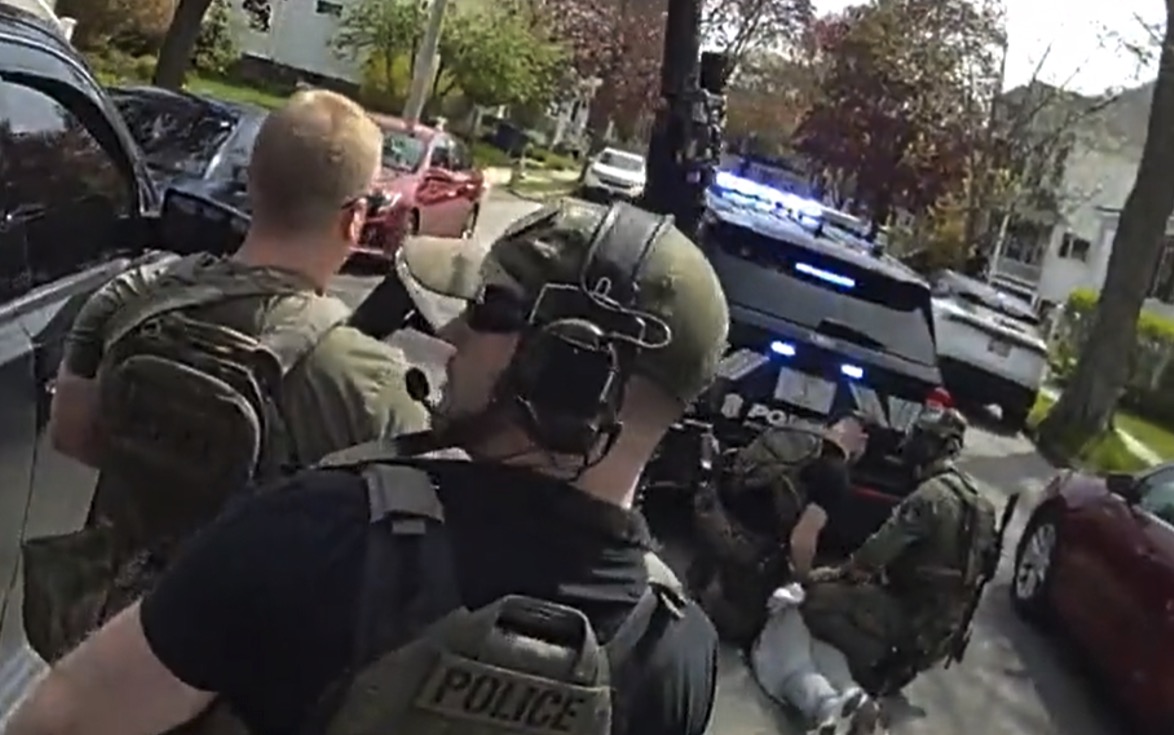
What began as an ordinary school day in Portland, Maine, spiraled into a terrifying and traumatic ordeal after a teenager was mistakenly identified by police, leaving him shaken and changed forever.
May 13, 2025, started like any ordinary day for Amber and Nathan Miller’s sixteen-year-old son L.M., whose name is withheld because he is a minor. L.M. attends Deering High School, where it’s common for students to leave campus to get lunch.
As he was walking down a sidewalk to join his friends to drive to McDonald’s for lunch, a team of police in SWAT tactical gear carrying rifles rounded the corner behind him.
The officers were after a different person: a man named Miles Hibbard, who lived in the neighborhood and was suspected of a minor burglary. Although Hibbard had never been accused of any crime before, much less one involving weapons, violence, or hostility toward police, South Portland police decided to send an entire SWAT team to arrest him—they came prepared for a shootout next to a high school in the middle of its open lunch period.
Before the officers saw anything more than the back of L.M.’s head, they drew their rifles, ordered him to stop and put up his hands. Terrified, L.M. immediately complied. He continued to comply as officers ordered him to walk toward them in the street, lie down on his stomach, and put his hands behind his back.
At that point, the police chief would later confirm that the officers knew they had the wrong guy. The officers had been briefed that Hibbard had a large tattoo on his forearm, but L.M.’s arms are tattoo-free. As L.M. pleads, “What did I do?”, one officer tells another, “I don’t love this.”

Despite this, the officers did not let L.M. go. They cuffed his hands behind his back, ordered him to his feet, walked him backwards toward the school, searched him, questioned him, moved him to the side of the road, and asked him more questions before releasing him.
Although the detention was not lengthy—it lasted little more than five minutes—its damaging effects were both long-lasting, and more fundamentally, unconstitutional. The Fourth Amendment requires that once officers realize they’ve detained the wrong person, they must let him go. Beyond that, officers should not use dangerous military tactics against nonviolent suspects of minor crimes.
The Miller family has teamed up with IJ to file a lawsuit to hold the officers responsible in court and to guard against this nightmare happening to another family.
Case Team
Attorneys

Marie Miller
Attorney

Jaba Tsitsuashvili
Attorney
Staff

J. Justin Wilson
Vice President for Communications
Case Documents
Media Resources
Get in touch with the media contact for image resources, press releases, and interview requests.
In May 2025, police in South Portland, Maine, were investigating the disappearance of a few bottles of cologne and several pairs of shoes. The apparent theft occurred during a house party, and among the suspects was a black 19-year-old named Miles Hibbard.
Hibbard worked at a nursing home and lived with his mom in a house near Deering High School. Hibbard had short hair, a relatively dark complexion, and a large tattoo on his arm. South Portland police officers obtained a warrant to search the house and Hibbard for evidence of burglary and theft. At this point, the Portland Police Chief later explained that the officers used a “scoring matrix … that did not consider it high risk but would require consultation with the SWAT Commander.” After consulting with the SWAT Commander, South Portland officers chose to recruit additional officers from the Portland Police Department and dawn SWAT tactical equipment to help execute the warrant.
Hibbard was at the party, but had never before been charged with a crime, let alone accused of using weapons or violence. And no one alleged that a weapon was used during the theft. Under those circumstances, police officers should have served the warrant wearing their regular uniforms and using standard equipment. But instead they chose to deploy a SWAT team with long rifles to serve a warrant on a 19-year-old suspected of a minor, nonviolent offense.
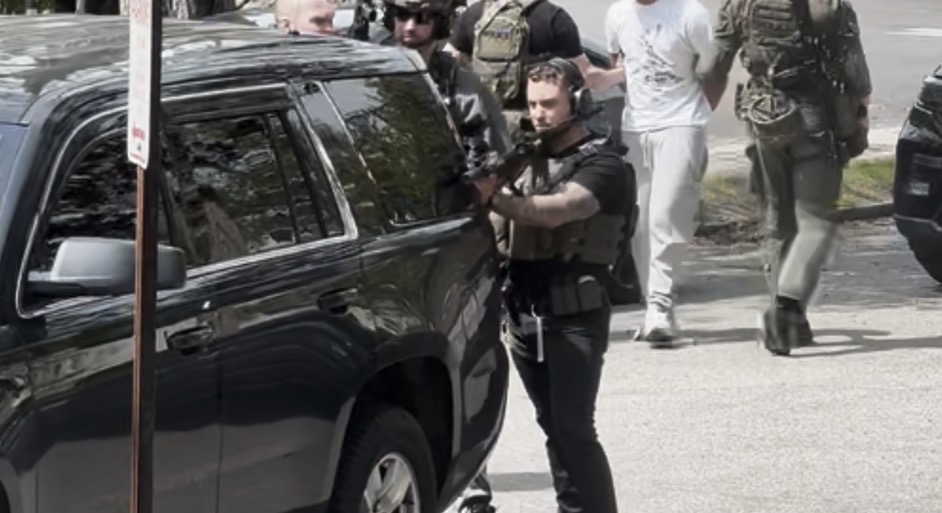
Officers hold L.M. at gunpoint and keep him detained after they realize he is not the suspect.
When officers turned their vehicles onto the street where Hibbard lived, they saw a young black man walking on the sidewalk alone. It was a black sixteen-year-old named L.M., not Hibbard. L.M. was on his lunch break from the high school less than a block away and stood just a few feet from his friend’s car, where they were waiting to give him a ride to McDonald’s.
The only characteristic connecting Hibbart and L.M. is that they were both black teenagers. And although L.M. had a complexion similar to Hibbard’s, L.M. was taller and heavier, and he had long hair and no tattoos. He was wearing a short-sleeved T-shirt, with his arms exposed. Other young men in the immediate vicinity had a similar complexion, too. In fact, about a quarter of the school population that had just been released from campus were the teenage boys with the same basic description as Hibbard.
Seeing little more than the back of L.M.’s head, officers jumped to conclusions, ordered him to stop and aimed rifles at him. L.M. immediately complied, put his hands up, and followed the officers’ other orders—walking toward them, kneeling down, lying on his stomach, putting his hands behind his back. He asked multiple times, “What did I do?” But they did not give him an answer. In the midst of this, one officer is heard on bodycam video telling another, “I don’t love this.”
The officers cuffed L.M.’s hands behind his back as he lay on the ground. At that point, the officers knew they had arrested the wrong guy, because L.M.’s arms had no tattoos. Despite this, the officers did not let him go. Instead, they ordered him to his feet, walked him back toward the school, questioned him, searched him, and questioned him some more.
Before the officers let L.M. go, a crowd of students—many matching the same basic description of the suspect—gathered to watch the arrest. L.M.’s classmates asked what he had done. L.M. was shocked, confused, scared, and humiliated; he had been treated like a violent criminal in front of his friends—even though he had done nothing wrong and was simply walking down the sidewalk on his way to lunch.
L.M.’s friends in the car were also detained and questioned. When the officers released everyone, the group all went back to school instead of getting food.
Officers searched Hibbard’s home and came up empty—none of the missing shoes or cologne were found.
Later that day, officers arrested Hibbard at his workplace, an elder care facility in a nearby town. The officers brought their long guns to the facility, and Hibbard went with them peacefully. He was released that afternoon on a $500 bond. While he was initially charged with burglary and theft, prosecutors are no longer pushing those charges forward.
Lawsuit for Accountability
The Miller family has partnered with the Institute for Justice to hold the responsible officers and cities accountable and to help ensure the same kind of dangerous, unconstitutional conduct does not threaten others in their community.
The Millers’ lawsuit asserts claims against both the individual officers and their city employers, under federal and state law. It argues that the officers’ seizure and search of L.M. violated L.M.’s Fourth Amendment rights in three basic ways.
First, the detention was unreasonable from the start because officers lacked a reasonable basis to believe L.M. was the suspect, and using military-style equipment and tactics was unreasonable, given that the officers were investigating a nonviolent crime and suspected someone who had no history of crime, violence, or possession of weapons.
Second, it was unreasonable to keep L.M. detained after the officers knew they had detained the wrong person. Instead of letting L.M. go, officers kept L.M. in handcuffs, questioned him, and searched him.
Third, frisking L.M. was unreasonable because the officers lacked reason to believe he was presently armed and dangerous. By the time the officers frisked him, they knew he was not the suspect and had no other reason to suspect him of a crime, much less that he was armed and dangerous then.
The lawsuit also claims that the officers or their city employers committed assault, battery, false arrest, false imprisonment, and negligence under Maine law.
The Millers’ case is not the first mistaken-identity case IJ has addressed. IJ represents James King, a college student mistaken for a suspected bottle-and-liquor thief; Penny McCarthy, a sixty-six-year-old grandmother mistaken for a nonviolent convict with no connection to Penny; and Jennifer Heath Box, a woman arrested and thrown in jail for three days because she shared parts of her name with the subject of an arrest warrant.
In some of these cases, the law-enforcement use of force or threat of force was unwarranted. James King was beaten severely. And like L.M., Penny McCarthy was held up by multiple officers with long guns.
All these cases are part of IJ’s larger Project on Immunity and Accountability, which seeks to hold government officials accountable for violations of constitutional rights.
The Litigation Team
The Millers are represented by IJ Attorneys Marie Miller and Jaba Tsitsuashvili, who are assisted by local counsel Nealy Fleming and Michael Rogers.
About the Institute for Justice
The Institute for Justice is a national nonprofit law firm that litigates to protect Americans’ liberty. As part of IJ’s Project on Immunity and Accountability, IJ works to uphold the Fourth Amendment and to combat qualified immunity—a court-created doctrine that frustrates government accountability and bars the vindication of constitutional rights.