
Portland Family Files Lawsuit After SWAT Team Arrested Innocent 16-Year-Old at Gunpoint
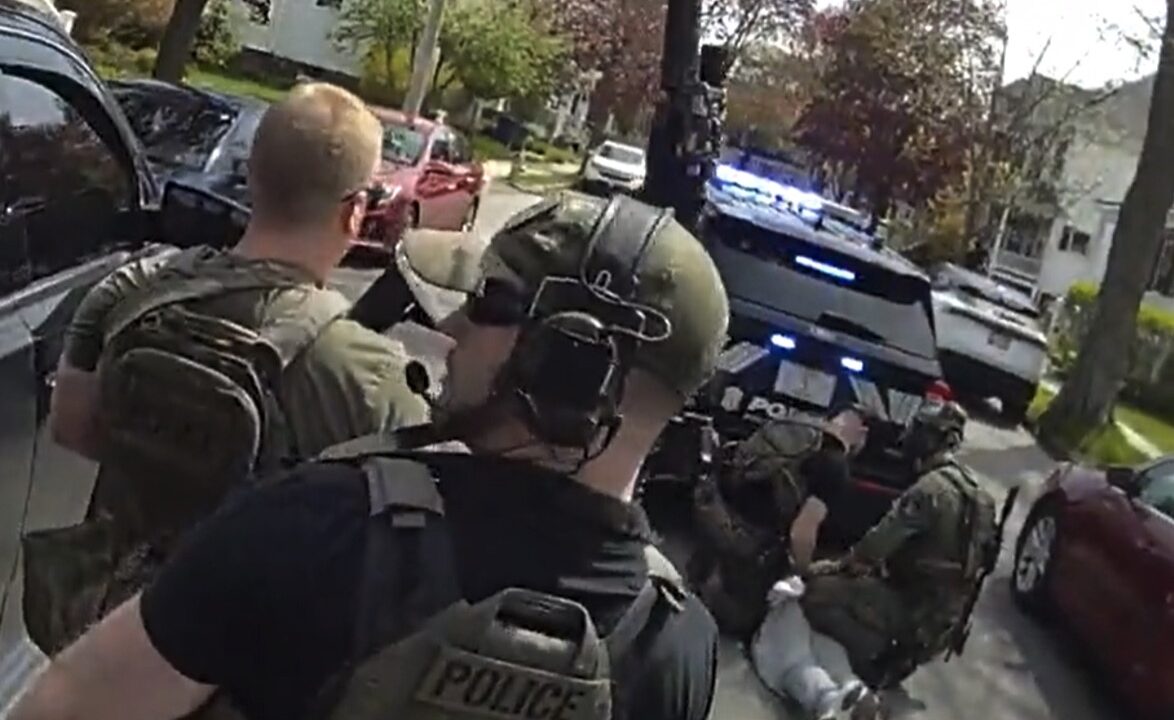
Today, the Institute for Justice (IJ) announced it has partnered with a Portland, Maine, family to file a federal civil-rights lawsuit seeking accountability. The lawsuit comes after police officers, backed by a SWAT team carrying rifles, mistakenly detained an innocent 16-year-old boy at gunpoint because he allegedly resembled a different person: a nonviolent burglary suspect.
The lawsuit argues that officers unreasonably arrested the 16-year-old from the start and should have ended the arrest the moment they realized they had the wrong person. Instead, they kept the teenager in handcuffs, questioned and searched him, and publicly humiliated him in front of his friends.
“In America, police can’t treat an innocent teenager walking near school like an armed threat over a minor theft—and once officers realize they’ve detained the wrong person, the Constitution requires them to let him go immediately,” said Marie Miller, an attorney at the Institute for Justice which represents the Miller family (who are unrelated). “This case is about a basic Fourth Amendment principle: the government doesn’t get to keep holding you just because the government already started detaining you.”
On May 13, 2025, sixteen-year-old L.M.—identified by his initials because he is a minor—left Deering High School during the open lunch period. Like many students, he stepped off campus to meet friends for a quick lunch run.
As L.M. walked along the sidewalk, officers in tactical gear carrying assault rifles rounded the corner behind him. Without seeing more than the back of his head, they aimed their rifles at him and ordered him to stop and raise his hands. Terrified, L.M. immediately complied as officers directed him into the street, ordered him to the ground, and handcuffed him.
The officers were looking for someone else: a different teenager suspected of a minor, nonviolent burglary and theft of several pairs of shoes and a bottle of cologne. L.M. and the suspect had little in common beyond being Black teenagers—and even that similarity was vague, because there were obvious differences, including L.M.’s height, build, hairstyle, and the absence of a prominent tattoo on the suspect’s arm. Yet even after it became clear that L.M. was not the person they were after, the officers kept him cuffed, questioned him, and searched him—while students gathered and his friends watched in disbelief.
“What happened to my son should have never happened,” said L.M.’s mother, Amber Miller. “Our community is traumatized. The time has come for police to stop dressing up like soldiers and pretending that every suspect warrants semi-automatic rifles and bulletproof vests. We need to rebuild trust—and trust starts with accountability. They can’t undo the trauma my son has gone through, but we’re hopeful the courts will hold the officers and the cities accountable and ensure this never happens to another family.”
The incident drew intense community concern and questions about why a SWAT team was used near a high school over a routine, nonviolent investigation. In response, the police chief defended the officers in a letter to city leadership, explaining that the officers used a “scoring matrix … that did not consider it high risk but would require consultation with the SWAT Commander.”
But the lawsuit alleges the letter included factual errors and offered after-the-fact justifications—while never fully acknowledging the core failure: an egregious mistaken-identity detention that could have been avoided had officers not escalated an ordinary warrant service into a rifle-point stop.
“A SWAT team is supposed to be for a rare, truly dangerous scenario—not a default setting for everyday policing,” said IJ Attorney Jaba Tsitsuashvili. “And once officers know they have the wrong person, the Constitution doesn’t allow them to keep holding the person without any reason to believe they’ve committed a crime. They must stop. The Constitution may not require an apology, but rebuilding trust demands accountability, along with a commitment to do better.”
Mistaken-identity detentions and arrests are a nationwide problem, and IJ is working to combat them through its Project on Immunity and Accountability and Project on the Fourth Amendment, which seek to hold government officials responsible when they violate constitutional rights. IJ has represented other innocent people arrested because officers latched onto vague matches—sometimes with devastating consequences. IJ’s work aims to ensure that constitutional protections are real in practice, not only theoretical promises.
More News

Freeport, Texas, Family to Appeal in Case to Keep Their Land From Port’s Eminent Domain Abuse

Other Property Rights Abuses
Connecticut Couple Demands Clarity After Town Threatens to Ban Them From Allowing Hikers on Their Property
Eminent Domain