Victory for Political Speech

In December, following a three-year battle in the trial court, a federal district court struck down Arizona’s definition of political committee, thereby allowing Arizonans—and IJ client Dina Galassini in particular—to speak about core political issues without the worry of the heavy hand of government censoring such speech.
In almost every state, a political committee is, essentially, a group of two or more people joining together to speak about politics. In Arizona, the definition of political committee is an incomprehensible 183-word monstrosity that triggers numerous ongoing and burdensome requirements. Groups that fail to comply with those requirements can face potentially huge fines, so knowing whether you are a political committee is critical. Unfortunately, it is remarkably easy to unwittingly become a political committee.
Dina sent an email to 23 of her friends and neighbors to join her in two sign-waving protests against a bond issue in the town of Fountain Hills. This act—sending an email before she registered with the government as a political committee—violated the law, and town officials wasted no time in telling her so.
Dina teamed up with IJ following this blatant First Amendment violation; with an early ruling from the court, she was able to hold one of her rallies.
Dina had no idea that she would become a political committee by sending an email. And she’s not alone: Arizona’s campaign finance laws were so complicated that not even the government lawyers tasked with enforcing them could understand when someone became a political committee. This meant that everyone in Arizona was at risk of arbitrary prosecution because the government could pick and choose the speakers who “violated” the law based on nothing more than disapproval of someone’s speech.
A federal judge saw the grave First Amendment problems and ruled that Arizona’s definition of political committee was unconstitutional. First, that definition was unconstitutionally vague, because people had to guess what it meant. According to the ruling, it was “not clear that even a campaign finance attorney would be able to ascertain how to interpret” the law. Moreover, the law was overbroad and unduly burdensome because people—like Dina—could unknowingly create political committees and be subject to penalties simply by joining with friends to engage in grassroots political activity.
This ruling protects everyone in Arizona, not just Dina. Moreover, because the definition of political committee is unconstitutional and thus unenforceable, laws that apply to political committees—most of Arizona’s campaign finance laws—cannot be constitutionally enforced. Hopefully this decision will encourage courts in other states to take an honest look behind the rhetoric of similar laws and see the reality: These laws are nothing more than heavy burdens placed on the most humble of speakers with no benefit to the public.
Arizona is appealing the decision. If the 9th U.S. Circuit Court of Appeals agrees with this victory, then eight other states will have to take a long, hard look at their definitions of political committee to make sure that ordinary people can understand the law. And IJ will continue to litigate to restore full protection to the political speech of Dina, Arizonans and, ultimately, all Americans.

Also in this Issue

Liberty & Law
Victories Build Momentum to End Civil Forfeiture
Liberty & Law
IJ’s School Choice Team Defends Programs in Three State Supreme Courts
Liberty & Law
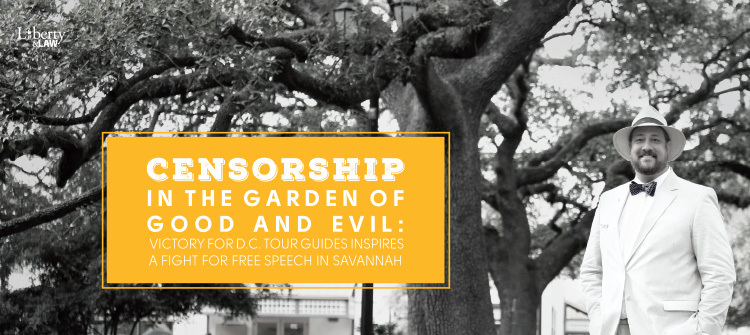
Censorship in the Garden of Good and Evil

Liberty & Law
Remembering IJ Client Trisha Eck

Liberty & Law
Crafting a Case to Protect Property Rights in Texas

Liberty & Law
Nation’s Largest Land Grab Defeated
Liberty & Law
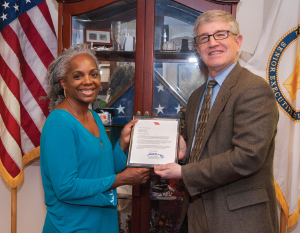
U.S. Army Honors IJ’s First Client

Liberty & Law
IJ Challenges Florida’s Skim Milk Labeling Ban
Liberty & Law
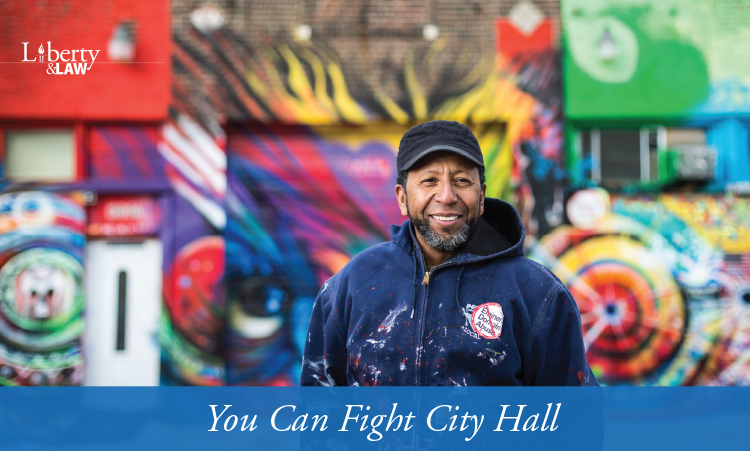
You Can Fight City Hall
Subscribe to get Liberty & Law magazine direct to your mailbox!
Sign up to receive IJ's bimonthly magazine, Liberty & Law, along with breaking news updates about the Institute for Justice's fight to protect the rights of all Americans.