
Institute for Justice Warns Kalispell Not to Strip Property Rights from Every Permit Holder
Letter on behalf of Flathead Warming Center says proposed zoning amendment violates Warming Center settlement and constitutional rights of every conditional use permit holder
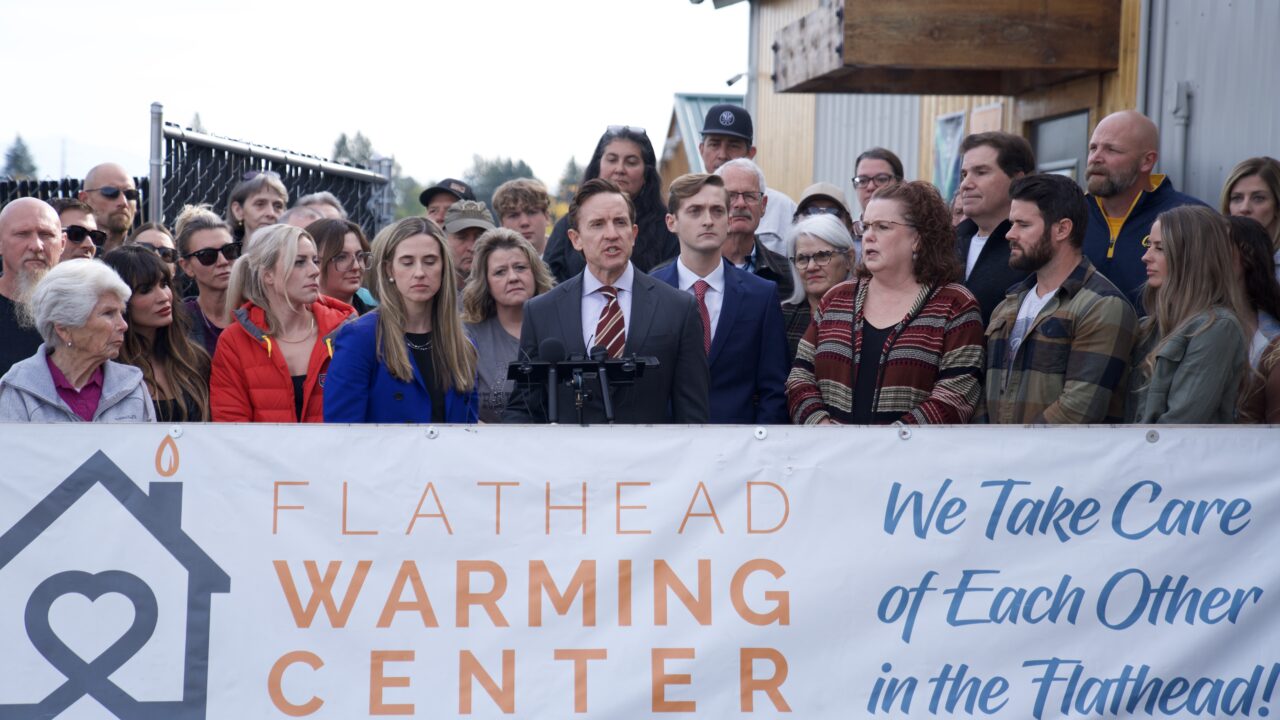
The city of Kalispell, Montana is considering a zoning amendment that would jeopardize not only the Flathead Warming Center, but every homeowner, business, church, and nonprofit that relies on a conditional use permit (CUP). Today, the Institute for Justice (IJ) sent a detailed letter to the city of Kalispell on behalf of the Flathead Warming Center, strongly urging city officials not to adopt the amendment in its current form and warning that the city’s proposal would violate the city’s settlement agreement with the Warming Center and retroactively strip long-standing property rights from all CUP holders.
The city’s plan to make all CUPs revocable and eliminate the promise that CUPs “run with” the land would destroy a core property right that has allowed hundreds of Kalispell property owners to invest in their land with confidence. IJ’s letter explains that the proposed changes would not only violate the Constitution and destabilize property rights citywide, but fail to honor the city’s promise in the settlement agreement that the Center’s CUP is a vested right.
“Every business and nonprofit in Kalispell that depends on a conditional use permit should be up in arms about these changes,” said IJ Attorney Christie Hebert. “If this ordinance passes, a CUP will no longer be a stable property right—it will be a fragile permission that makes your property worth less and can be taken away years later based on allegations of an unintentional mistake. That kind of sweeping change violates the constitutional rights of every CUP holder, including the Warming Center’s.”
“Not everything in the proposed amendment is bad,” said IJ Senior Attorney Jeff Rowes. “It includes important protections for property owners, which the city should retain, such as the right to notice and a process based on evidence in the event the city wants to revoke a CUP. But the problematic parts should not be passed and will create serious legal problems for the city if it proceeds.”
IJ’s letter explains that the proposed ordinance changes would:
- Retroactively destroy existing property rights. The ordinance would erase the rule that CUPs run with the land and instead declare them personal privileges that do not attach to the property. And every time a property changes hands—through sale, under a lease, or with new management—the City would reconsider the CUP.
- Allow the city to revoke permits over innocent mistakes. The change would allow the city to revoke, suspend, or reconsider CUPs based on any “inaccurate” information in an application—even if the inaccuracy was unintentional and even if the current owner has fully complied with all conditions for years. That invites politically motivated efforts to dig through old paperwork to shut down unpopular, but lawful uses.
- Treat permits as a matter of “grace,” not law. The amendment repeatedly describes CUPs as matters of “grace,” as if permission to use property depends on the city’s goodwill instead of clear standards and constitutional limits. IJ’s letter explains that this grace framing is outdated, legally wrong, and incompatible with due process protections that require decisions to be based on facts, law, and judicial review—not raw political power.
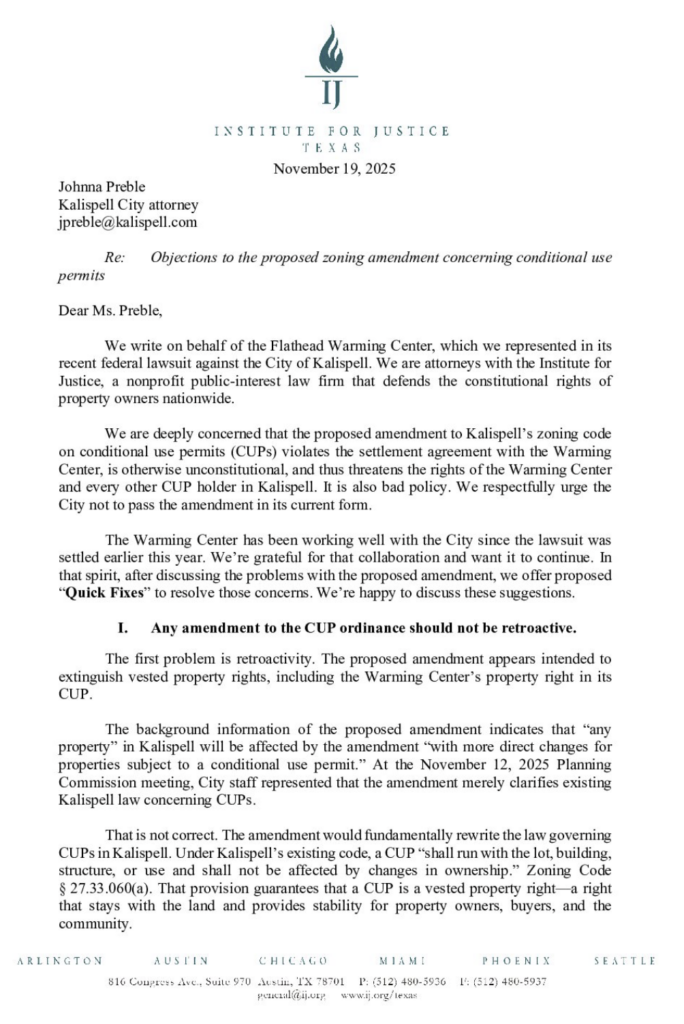
Read the Letter
Re: Objections to the proposed zoning amendment concerning conditional use permits
We are deeply concerned that the proposed amendment to Kalispell’s zoning code on conditional use permits (CUPs) violates the settlement agreement with the Warming Center, is otherwise unconstitutional, and thus threatens the rights of the Warming Center and every other CUP holder in Kalispell. It is also bad policy. We respectfully urge the City not to pass the amendment in its current form.
Last year, Kalispell revoked the Flathead Warming Center’s CUP even though the shelter had never been cited for violating any law or condition. The Warming Center partnered with the Institute for Justice and filed a federal lawsuit, arguing that the city’s ad hoc revocation process violated due process, equal protection, and its vested property rights. A federal judge granted a preliminary injunction allowing the shelter to remain open. The case later settled on terms that required the city to permanently reinstate the Warming Center’s permit, pay attorneys’ fees, and publicly apologize to Horn for falsely accusing her of lying in the permit process.
“The city’s attempt to ‘fix’ what it did to the Warming Center puts it back on a collision course with the Constitution,” added Rowes. “Rewriting the code so the Warming Center’s permit can be treated as a revocable favor doesn’t just pose grave constitutional issues—it breaks the settlement agreement between the city and the Warming Center, which we will not allow. Another legal dispute is the last thing the Warming Center wants, and the last thing the city needs, but we will not stand by while the city tries to undo what it promised in court.”
“Over the past year, we’ve made real progress with the city, and I’m hopeful we can keep moving in that direction,” said Flathead Warming Center Executive Director Tonya Horn. “This isn’t just about the Warming Center—every business, nonprofit, and homeowner who depends on a conditional use permit deserves stability and fairness. No one should have to go through what we went through. We all rely on clear rules we can trust. My hope is that the city will choose a path that protects everyone’s ability to serve this community, so we can focus on building solutions together rather than returning to conflict.”
More News

Economic Liberty
Innovative Hybrid Homeschool Program Fights for the Right to Teach After Being Wrongly Labeled as a Childcare Center
4th Amendment Project
FinCEN Renews Financial Surveillance Order Declared Illegal in 9th Circuit

4th Amendment Project