Jacksonville, North Carolina City Council Repeals Ordinance Preventing Food Truck Operations But Still Faces Legal Claims From Vendors
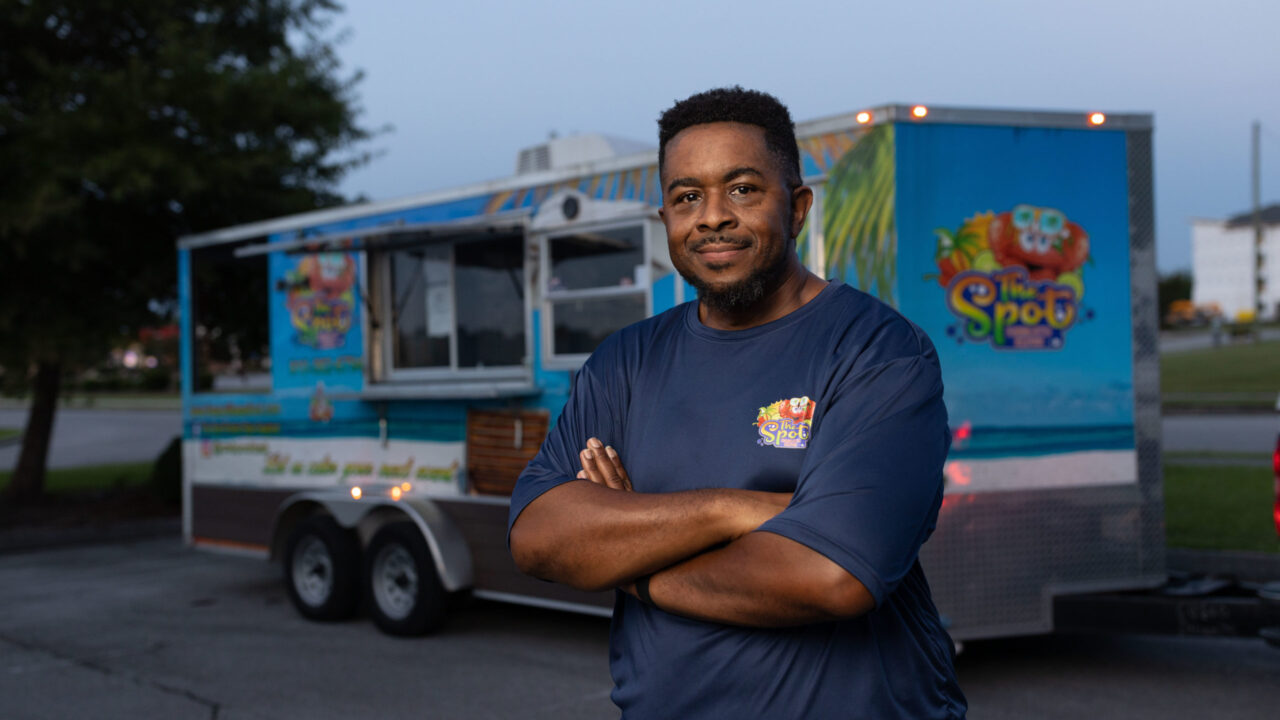
ARLINGTON, VA—Last night, the Jacksonville, North Carolina City Council unanimously voted to repeal three uniquely harsh and restrictive provisions of its food truck ordinance. Under Jacksonville’s burdensome zoning rules, food trucks were effectively banned in nearly 90 percent of the city, which includes numerous pieces of private, commercially-zoned property where all other food businesses were allowed to operate. The repeal comes in the midst of a years-long legal effort filed by the Institute for Justice (IJ) on behalf of Nicole Gonzalez, who seeks to host food trucks on her property, and food truck operators Tony Proctor and Octavius (“Ray”) Raymond. However, while the offending provisions have been removed, the lawsuit will continue in order to provide a legal record to prevent these unconstitutional restrictions from happening again. A motion for summary judgement is scheduled for Monday, March 23 before the Onslow County Superior Court in Jacksonville.
“The restrictions Jacksonville’s City Council put on food trucks served no legitimate purpose and we are happy for our clients that the city council decided to remove these burdensome restrictions,” said IJ Attorney Bob Belden. “However, this lawsuit was never just about Nicole, Tony, and Ray. It was about making sure that North Carolinians won’t have their rights violated under similar circumstances in the future. We look forward to establishing that record before the court.”
The previous, excessive restrictions surrounding food truck operations included:
- 1) Forbidding food truck from operating on private, commercial or industrial-zoned property if the property was within 250 feet of any restaurant, food truck, or residentially-zoned property. The combined effect of this ban made nearly 90 percent of Jacksonville off limits to food trucks, including the most popular commercial areas where many restaurants, including restaurants with outdoor seating, are allowed to operate.
- 2) Forbidding food truck operators from using commercial signage the city allowed all other businesses to use, including a tall, feathered flag sign that Jacksonville otherwise allows for general commercial use for businesses other than food trucks.
- 3) All food trucks had to pay an arbitrary annual permit fee of $300 (for residents) or $500 (for non-residents), even though almost all food truck oversight comes from the county and state, not the city. This is much higher than neighboring towns, some of which do not charge any fee at all.
As even one member of Jacksonville’s Planning Advisory Board has since admitted, these were “protectionist” measures meant to prevent food trucks from competing with restaurants. But under the North Carolina Constitution, people have a fundamental right to earn an honest living, as well as the right to use their private property in safe and reasonable ways, free from arbitrary, irrational and protectionist government regulations. They also have a right to equal treatment under the law, meaning the city can’t prohibit food trucks in areas where it allows similar restaurants unless it has a good and legitimate reason for singling food trucks out.
“The government is not allowed to restrict food trucks just because they might compete with their friends’ restaurants,” said IJ Attorney Robert Fellner. “These laws don’t just hurt food truck owners, but they also restrict people from the freedom to choose where they can eat.”
IJ is a public interest law firm with a mission to protect individual’s constitutional rights. In the past, IJ has stood up for the rights of food truck owners to earn an honest living all over the country by defeating similar ordinances that limit where food trucks may operate. Nearby, in Carolina Beach, IJ’s lawsuit led town officials to repeal an unconstitutional law which required food truck owners to also own a brick-and-mortar store; in Fort Pierce, Florida, IJ helped defeat a law that banned food trucks within 500 feet of an established restaurant; and in Louisville, IJ beat a law that blocked food trucks from serving within 150 feet of any establishment that serves food.
# # #
To arrange interviews on this subject, journalists may contact Phillip Suderman, IJ’s Communications Project Manager, at [email protected] or (850) 376-4110. More information on the subject is available at: https://ij.org/case/north-carolina-food-trucks/
More News

Economic Liberty
Proposed Vendor Ordinance “Would Open Up Opportunities” Says Chicago Entrepreneur Advocate

Education Entrepreneurship
National Law Firm Stands with Pinal County Education Entrepreneur to Protect Microschool

Private Property
