
Do Flock cameras actually reduce crime? The jury is still out.
A recent study on how Flock cameras influence crime rates has limitations that prevent firm conclusions from being drawn.
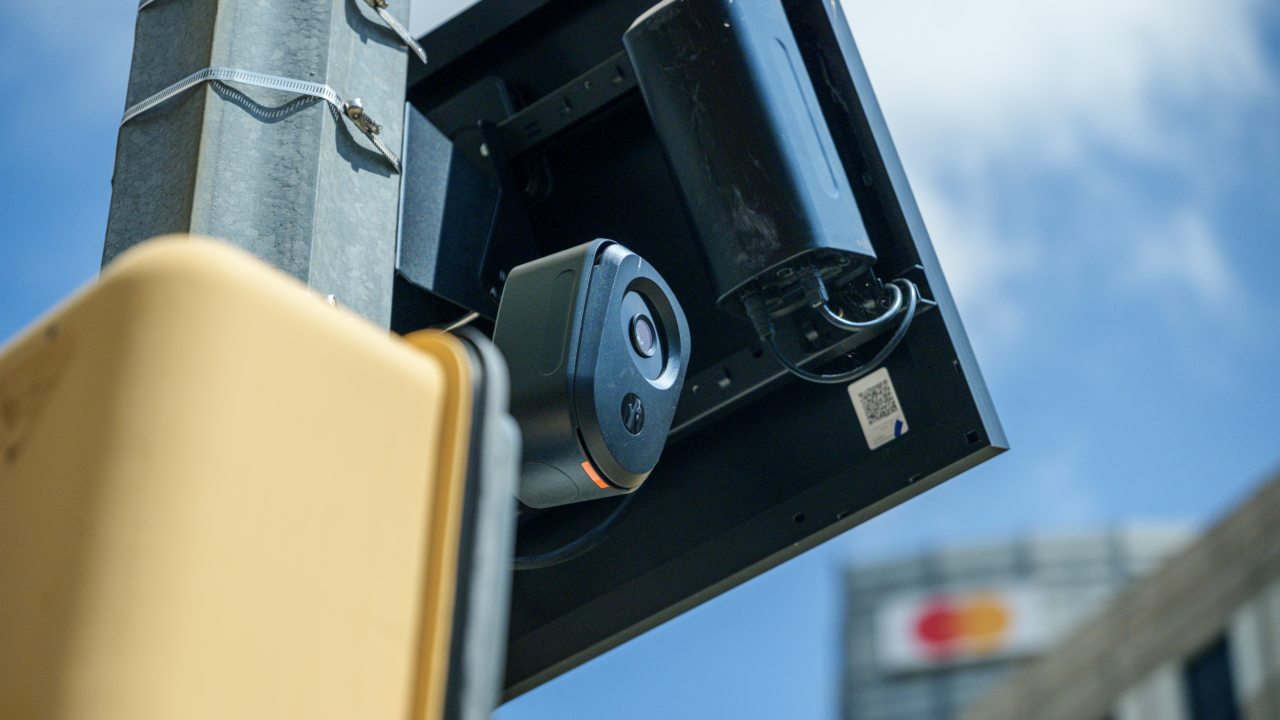
A recent working paper by scholars at the University of South Carolina examined the impact of Flock Safety’s automated license plate readers (ALPRs) on car theft and car theft clearance rates. The study—the first of its kind—purports to show a reduction in car thefts and an increase in the clearance rate after Flock deployment. Flock issued a statement latching on to these findings as a validation of the technology at a time of massive public backlash.
A closer look, however, reveals limitations in the study that suggest those claims are too strong. To add context and further inform public debate on the issue, the Institute for Justice (IJ) is releasing a new explainer on why the results should not be interpreted as showing that Flock ALPRs caused a decline in car thefts and increase in arrests.
Clearance rates for car theft were increasing and car thefts were decreasing before ALPR deployment
The working paper compares car theft and clearance rates in cities that deployed Flock ALPRs (the “treatment group”) with those that did not (the “control group”). It finds that ALPR deployment is associated with an 11% reduction in car theft and a 16% increase in car theft clearance rates.
The problem is that trends in the treatment group were already heading in the right direction for both thefts and clearance rates before Flock deployment, when compared to the control group. The study uses a design that can show causal effects, but only if trends are similar in both groups. In this case, the trends differed significantly. That makes it hard to tell if changes after deployment resulted from Flock or something else.
“Because there were already differences in arrests and theft trends before ALPR deployment, we don’t know if the differences after ALPR deployment were caused by ALPR deployment,” said IJ Senior Research Analyst Matthew West. The study’s authors acknowledge that the clearance rate result may be due to a “broader anti-theft initiative that included camera purchase”, among other possibilities. They note that the rise in clearance rates before ALPR deployment “prevents precise attribution to the cameras.”
The headline result on car theft depends heavily on how the data are weighted
The study only achieves its topline finding of an 11% reduction in car theft by weighting the results to favor agencies that had higher amounts of car theft before they installed ALPRs. If the data are instead averaged across all agencies (or weighted by population), the study finds no statistically significant change. This suggests, as the authors put it, that “the decline is concentrated in the jurisdictions” with more car thefts “rather than representing a uniform effect across adopting agencies”.
Further muddying the picture, any effects are not even uniform among agencies that had high levels of car theft before Flock deployment—as most agencies that adopted Flock ALPRs did. On average, this group actually saw a statistically significant increase in thefts after Flock deployment.
The upshot is that the topline 11% figure, even if causal, does not describe what happened in many if not most agencies that deployed Flock ALPRs.
Social factors further complicate the analysis
The study period included both the COVID-19 pandemic and the viral trend of Kia and Hyundai thefts. Both phenomena affected crime at different times, in different places, and in different ways, so it is difficult to isolate the effects of any given factor on car theft at a local level. If agencies adopted Flock when car theft was peaking locally, then a decline in cart theft could in part reflect things returning to normal instead of a drop in car theft from the installation of Flock ALPRs.
“Flock and its supporters are trying to exploit fear of crime to convince people to give up their rights,” said IJ Attorney Michael Soyfer. “Notably absent from the conversation is the cost to civil liberties through mass surveillance, wrongful detentions, and widespread abuse. Only by reaffirming our commitment to Fourth Amendment principles like a warrant requirement can we ensure that we are not giving up more than we are getting in return.”
The lack of those protections means ALPR technology can be easily abused, as IJ has documented hundreds of times. Our Plate Privacy Project is challenging the government’s arbitrary power to use ALPRs to surveil the entire driving public in court, with federal lawsuits filed against Norfolk and San Jose. We’ve drafted model legislation for policymakers aiming to reign in ALPR abuse and are tracking the hundreds of communities that have canceled their ALPR contracts in recent months.
To dig deeper into the limitations of the data on ALPR deployment and crime, read the full explainer prepared by IJ’s Strategic Research team.
Is Government Tracking Your Every Move?
IJ is fighting to restore constitutional limits on surveillance — for every American.
More on 4th Amendment Project

4th Amendment Project
Institute for Justice Promises to Continue Fight for Privacy Rights After Legislation on Automated License Plate Readers Fails to Advance

4th Amendment Project
Atlanta Woman Sues Officers, U.S. Government for Wrongly Raiding Her Home in Search of Man Already in Jail

4th Amendment Project