She Spent Her Life Savings to Open a New Salon, Zoning is Dashing Her Dreams
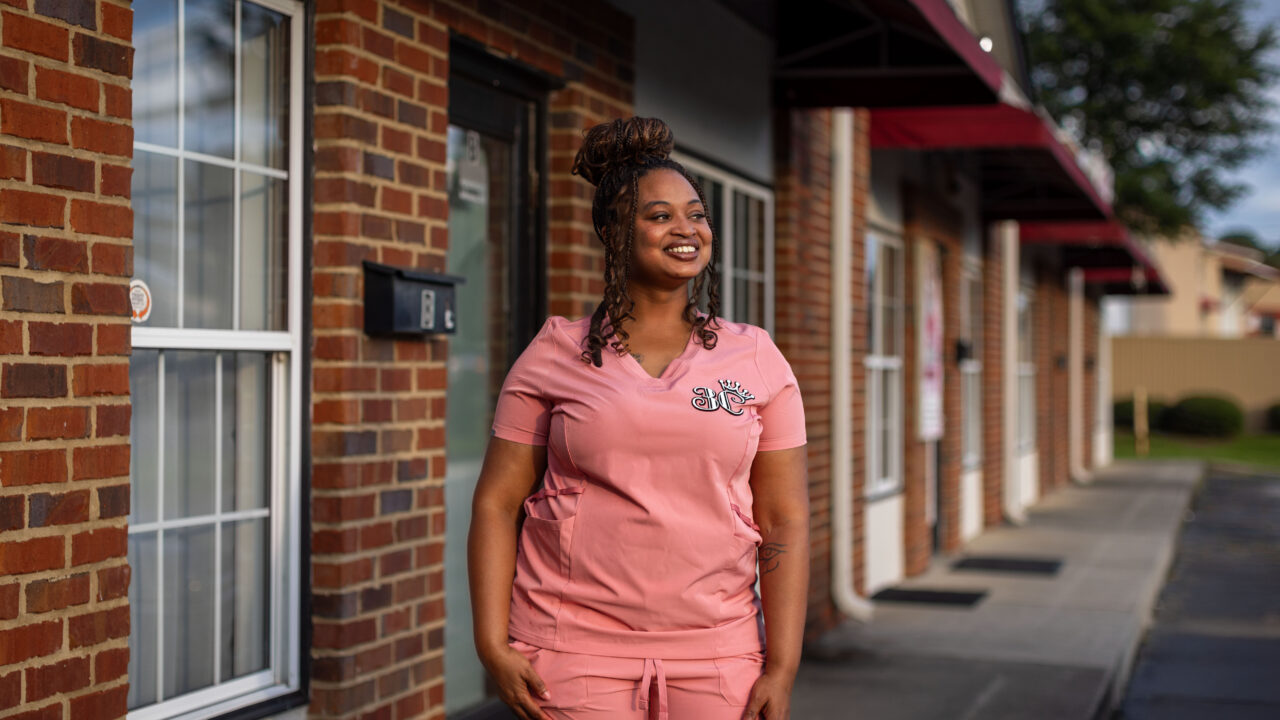
Clayton County, Ga.—Khalilah Few invested her life savings in a dream: opening a hair salon in Clayton County, Georgia. There was no reason for her to think the county would stop her from opening in the long-empty retail space she rented and renovated. But the county claimed the area was already “saturated” with hair salons and so would not fit in with their “smart growth” plan. That’s not just wrong—it’s blatantly unconstitutional. The denial comes from a first-come-first-protected mentality that favors existing businesses just because they happened to open first. The Georgia Constitution protects people’s right to practice a lawful occupation, and Clayton County has violated that right. That is why Khalilah and the Institute for Justice (IJ) have teamed up to fight for the rights of all potential business owners in Georgia.
“Government shouldn’t be able to stop legitimate businesses from opening simply because other businesses in the area might also offer similar services.” said IJ Attorney Jessica Bigbie. “This is America, where the government doesn’t get to decide who is and who isn’t able to compete in an industry. Khalilah has every right to open her business.”
Khalilah has spent the last 30 years living in Georgia and over 20 years building up her business as an hair braider and natural hair stylist. She views her business, Creative Crowns Collective, as more than just a salon. It’s a place for people to come and relax and educate themselves about the history of hair braiding as not only does she provide African-American hair services she also teaches it to new stylists .
This model proved popular with the community, so much so that she needed to expand her business and move into a larger space to accommodate the demand. So Khalilah toured vacant shops up for lease before finding the perfect location in Clayton County. She poured more than $20,000 into renovations and rent.
But the county had other plans. Under what they call a “smart growth” plan, it put hair salon into a category that requires a conditional use permit (CUP). Getting a CUP requires months of dealing with various bureaucrats and boards and a meeting with community residents, all before a vote can actually take place to decide if the business can open.
It took some time, but Khalilah diligently went through the process.
But just hours before her final scheduled Zoning Advisory Group hearing—Khalilah received a copy of the county’s staff report recommending denial of her CUP application. The report cited “saturation” of similar businesses, based on the existence of three other salons within a one- to five-mile radius. The report concluded that the salon would not fit into the county’s Comprehensive Plan for future growth. That evening, Khalilah presented her case to the Zoning Advisory Group. The advisory group voted 3-2 to recommend denial.
Following her presentation, Commissioner Davis even acknowledged the quality of Khalilah’s business and her contributions to the community but nevertheless stated:
“I want to say thank you. You did a fabulous job. And you’re right, [the business plan] does align. Unfortunately, to what we are going, this is just in the wrong area. And we’ve got to begin to grow Clayton County smartly. I think you have a fabulous business. You have a fabulous personality and I love what you bring. And you actually hurt my heart right now, but we have got to deny.”
Months of work and tens of thousands of dollars were now set to be wasted. There was no issue with the business plan, no issue with health and safety, no issue at all except the government thought there were already enough hair salons.
“I did everything I was asked and was even told I had a wonderful vision for my business and to help the community,” said Khalilah. “To hear that and still be denied is devastating.”
“The Georgia Constitution protects everyone’s right to earn a living,” said IJ Senior Attorney Will Aronin. “This is an affront to everyone who has ever dreamed of opening their own business. The government shouldn’t pick winners and losers, customers should.”
Governments often violate entrepreneurs’ rights through irrational zoning laws. IJ has fought these abuses for over 30 years and launched its Zoning Justice Project in 2024 to expand that work. As part of the project, IJ won a case for Awa Diagne after Fulton County, Georgia, tried to block her hair braiding salon to protect a nearby competitor. The court ruled in Awa’s favor and ordered the County to let her open.
IJ has also successfully fought for the rights of a Florida food truck owner against a zoning law that banned food trucks within 500 feet of an established restaurant, and a Texas home daycare owner denied a zoning permit after the mayor and other local golfers complained about the sight of children. This case is part of IJ’s Zoning Justice Project, which aims to knock down these barriers to entrepreneurship by returning basic decision-making about sensible property use to entrepreneurs themselves and protect small businesses.
# # #
To arrange interviews on this subject, journalists may contact Phillip Suderman, IJ’s Communications Project Manager, at [email protected] or (850) 376-4110. More information on the case is available at: https://ij.org/case/ga-clayton-protectionist-zoning/
More News
Immunity and Accountability
Supreme Court Declines to Hear Denver Man’s Case to Revive Fourth Amendment’s Warrant Requirements

Victory! Court Allows East Cleveland Resident to Pursue First Amendment Political Retaliation Claims Against City and Officials
Fines and Fees