
Private Property Research Reports
Civil Forfeiture | Private Property
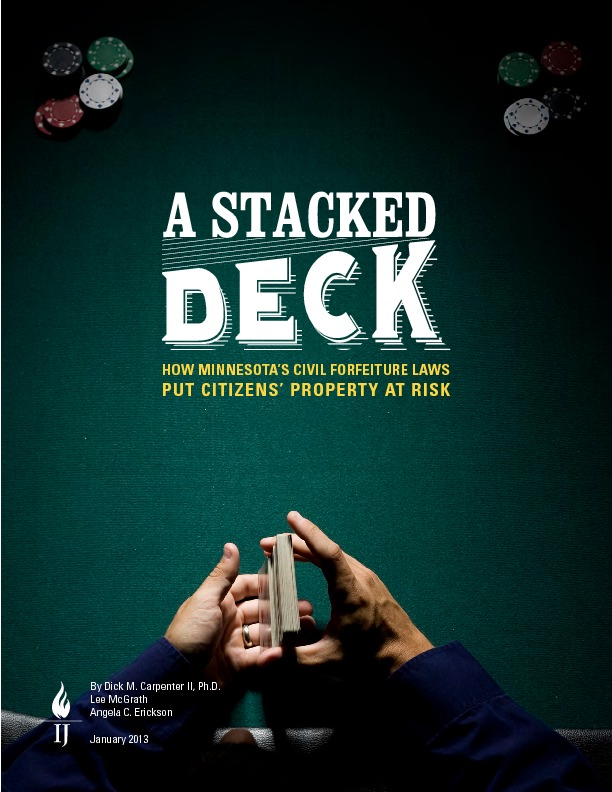
A Stacked Deck
State data show that from 2003 to 2010, forfeiture revenue in Minnesota jumped 75 percent, even as crime rates declined, and the average value of forfeited property was only $1,000.

Civil Forfeiture | Private Property
Arizona’s Profit Incentive in Civil Forfeiture
Arizona’s civil forfeiture laws need to be reformed. In the upside-down world of civil forfeiture, police and prosecutors can seize and keep cash and property that was allegedly involved in criminal activity—without ever proving a…
Eminent Domain | Private Property
Comment on Carpenter and Ross (2009): Eminent Domain and Equity—A Reply
In this report, Director of Strategic Research Dick Carpenter responds to commentary on his article about the effects of eminent domain on poor and minority communities. Suggested citation: Carpenter, D. M.
Civil Forfeiture | Private Property
Inequitable Justice
This report examines a federal law enforcement practice known as “equitable sharing.” It enables—indeed, encourages—state and local police and prosecutors to circumvent the civil forfeiture laws of their states for financial gain. Civil…
Civil Forfeiture | Private Property
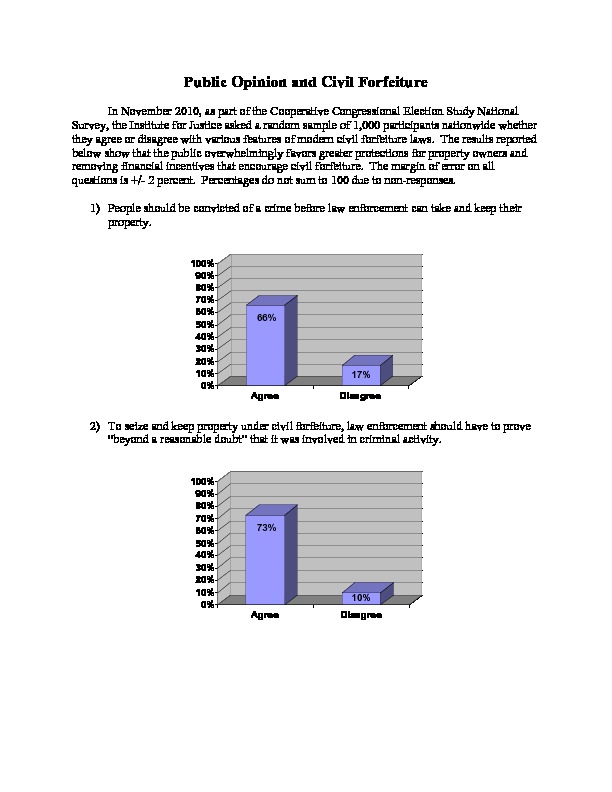
Public Opinion and Civil Forfeiture
In November 2010, as part of the Cooperative Congressional Election Study National Survey, the Institute for Justice asked a random sample of 1,000 participants nationwide whether they support various features of modern civil forfeiture laws.
Civil Forfeiture | Private Property
Civil Asset Forfeiture, Equitable Sharing, and Policing for Profit in the United States
Purpose Critics of asset forfeiture claim that forfeiture laws create financial incentives that inappropriately influence police behavior. The present study examines the relationship between measures of the financial incentive and legal burdens for…
Civil Forfeiture | Private Property
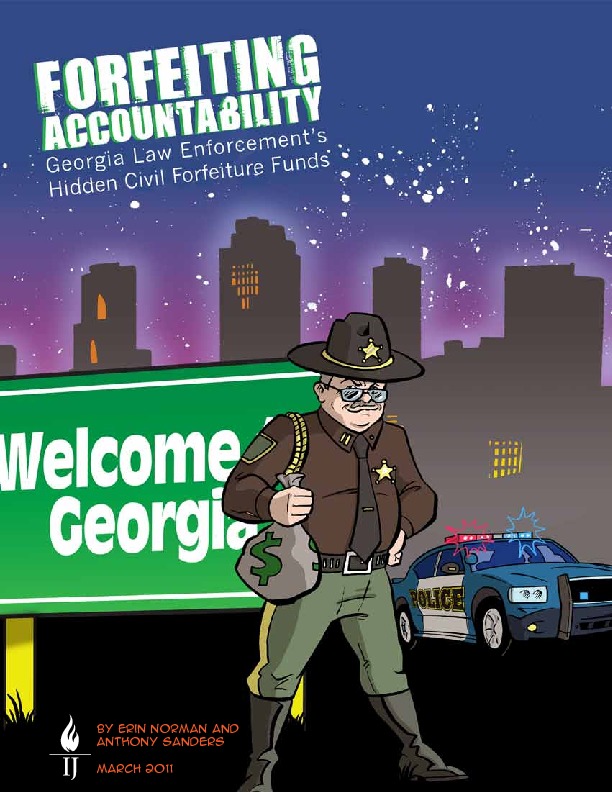
Forfeiting Accountability
Georgia has some of the worst civil forfeiture laws in the country. But at least state law requires law enforcement to publicly report annual forfeiture proceeds and expenditures. Public reporting ought to help check abuse…
Eminent Domain | Private Property
Analysis of the West End Redevelopment in the Township of Mount Holly
This paper reviews a fiscal impact study of the proposed West End Redevelopment in Mount Holly, N.J. A September 2008 study by Richard B. Reading Associates predicts that the redevelopment project will bring a…
Civil Forfeiture | Private Property
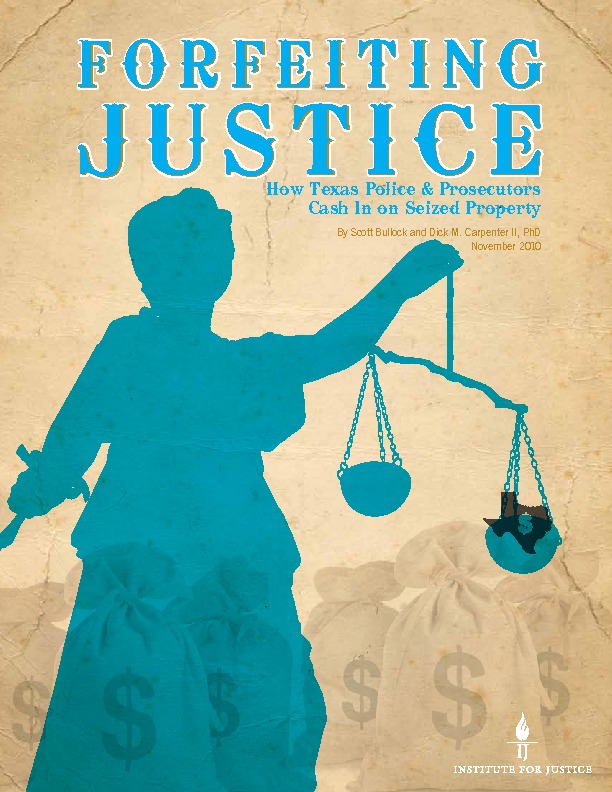
Forfeiting Justice
Texas law gives police and prosecutors generous rewards for seizing people’s property—without even having to prove the owner committed any crime. And the law makes it so hard for owners to fight for the return…
Eminent Domain | Private Property
Do restrictions on eminent domain harm economic development?
After the U.S. Supreme Court upheld in the Kelo decision the use of eminent domain for private-to-private transfer of property for economic development, public outrage was followed by attempts to restrict such use of eminent domain. Opponents…
Eminent Domain | Private Property
Five Years After Kelo
On June 23, 2005, the U.S. Supreme Court, in a 5-4 decision called Kelo v. City of New London,[1] ruled that private economic development is a public use under the Fifth Amendment…

Eminent Domain | Private Property
Little Pink House
Before there were Tea Parties, there was Kelo. Susette Kelo’s name turned into a movement. Her loss of her property was the final straw for Americans in 2005. When they heard about the Kelo decision,…

Civil Forfeiture | Private Property
Policing for Profit: First Edition
Policing for Profit, 1st Edition Published in 2010, this is an older edition of IJ’s landmark Policing for Profit report. You can download the report here, but please see the fourth and current edition for the most…
Eminent Domain | Private Property
Robin Hood in Reverse
In November, New York’s Court of Appeals, the state’s highest court, upheld the use of eminent domain to take homes and small businesses to make way for wealthy developer Bruce Ratner’s so-called “Atlantic Yards”…
Eminent Domain | Private Property
Empire State Eminent Domain
An analysis of the populations living in areas of New York City under threat of condemnation for private development finds that such eminent domain abuse disproportionately targets those who are less well-off and less educated,…
Eminent Domain | Private Property
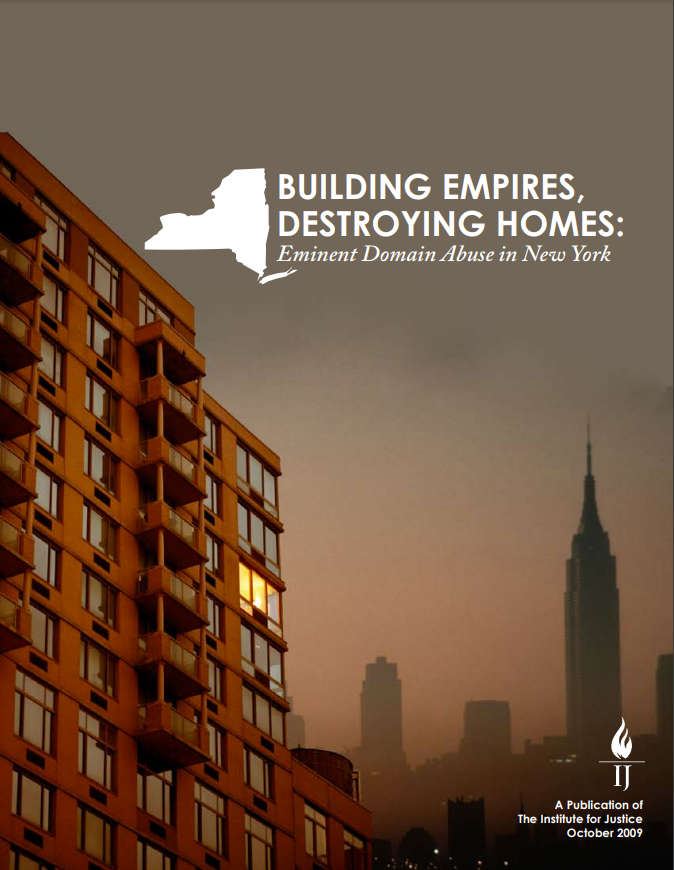
Building Empires, Destroying Homes
New York is perhaps the worst state in the nation when it comes to eminent domain abuse. Government jurisdictions and agencies statewide have condemned or threatened to condemn homes and small businesses for the New…
Eminent Domain | Private Property
Testing O’Connor and Thomas: Does eminent domain target poor and minority communities?
In dissenting from the US Supreme Court’s 2005 Kelo decision upholding the use of eminent domain for private-to-private transfers of property, Justices O’Connor and Thomas asserted, based on the history of urban renewal, that eminent domain for…
Eminent Domain | Private Property
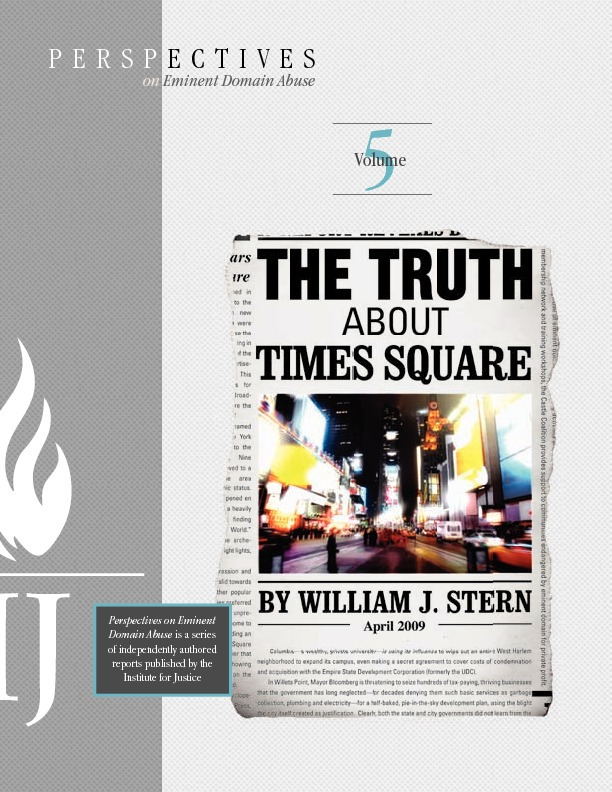
The Truth About Times Square
The former chairman and chief executive of New York state’s Urban Development Corporation reveals how Times Square succeeded for reasons that had little to do with government condemnation schemes and everything to do with public…
Eminent Domain | Private Property
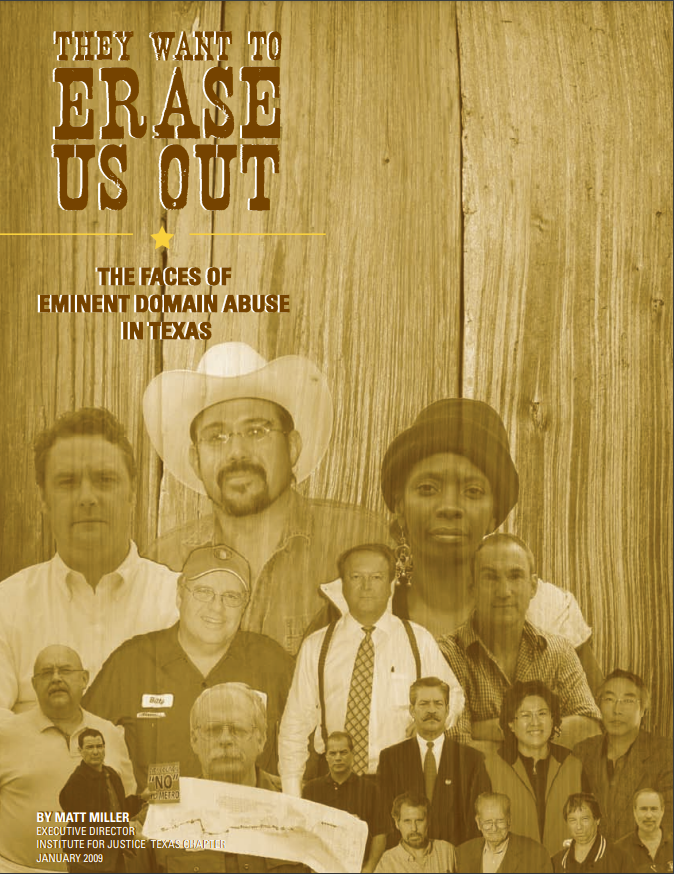
They Want to Erase Us Out
This report documents how homes, farms and small businesses across Texas have been threatened by eminent domain for private gain.
Eminent Domain | Private Property
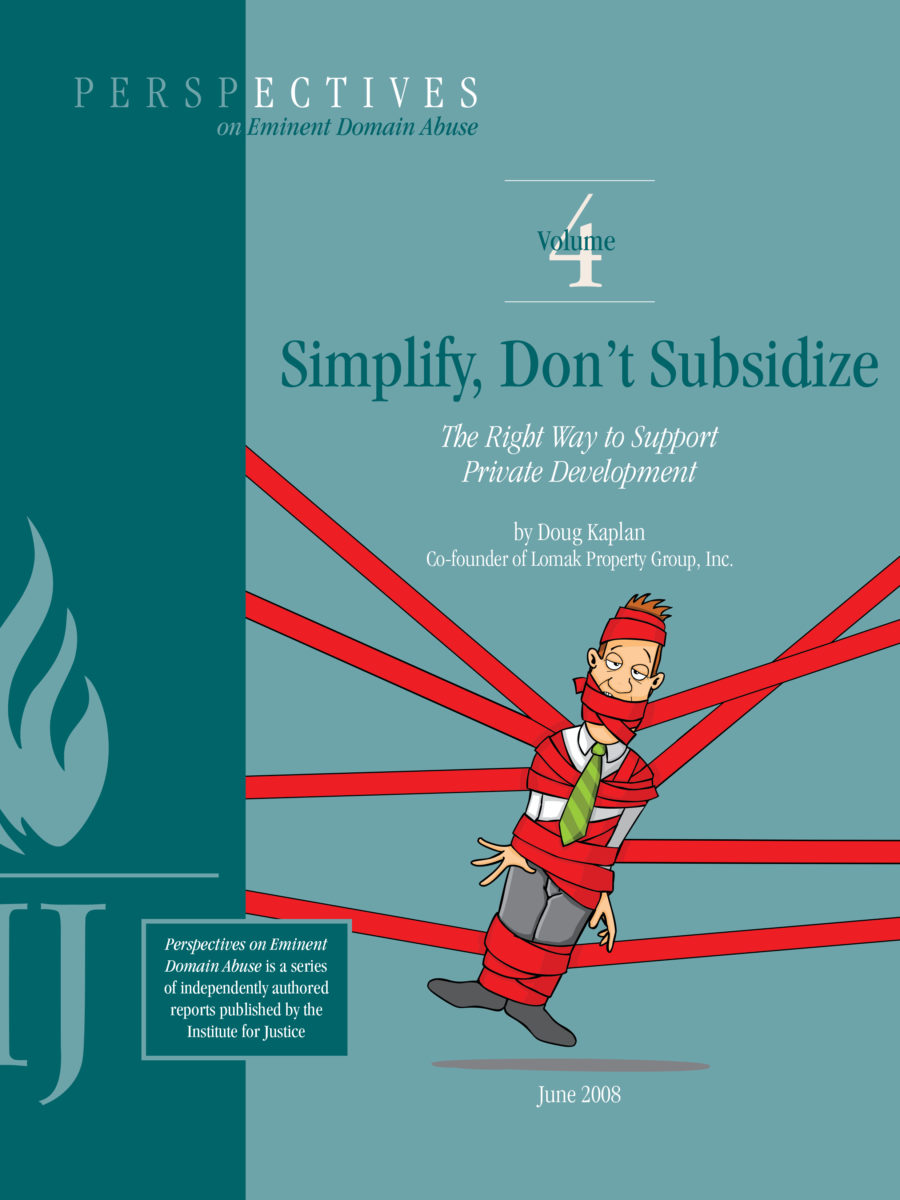
Simplify, Don’t Subsidize
An independent developer details the outrageous bureaucratic and regulatory hurdles small developers must pass in order to build private projects.

Eminent Domain | Private Property
Baltimore’s Flawed Renaissance
Baltimore’s redevelopment strategy has long been deeply flawed and eminent domain has negatively impacted the city’s renewal.
Eminent Domain | Private Property
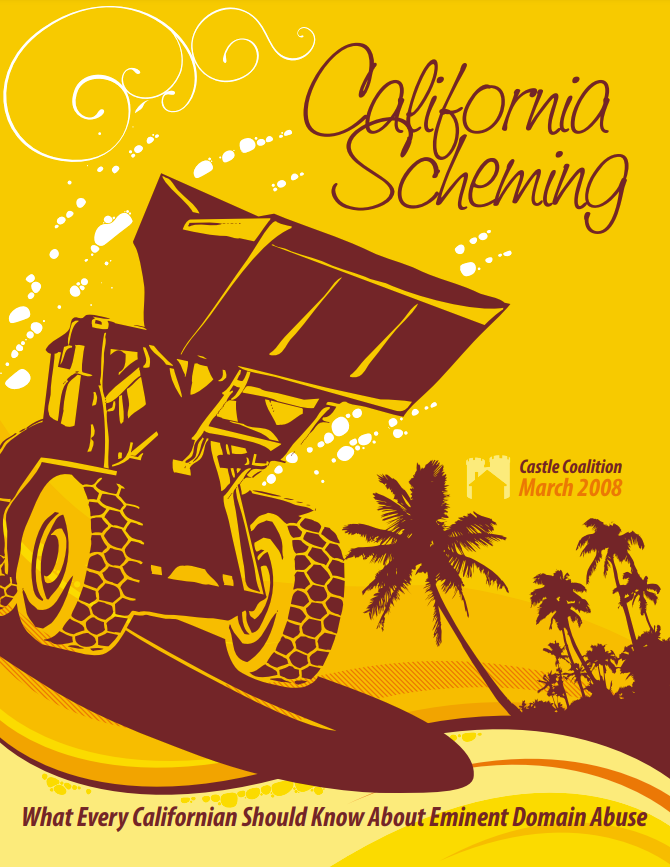
California Scheming
The report summarizes the legal history and areas of contention behind eminent domain for private development in California.

Eminent Domain | Private Property
Doomsday? No Way
When the U.S. Supreme Court upheld eminent domain for private development in the 2005 Kelo case, the public reacted with shock and outrage, leading to a nationwide movement to reform state laws and curb the…
Eminent Domain | Private Property
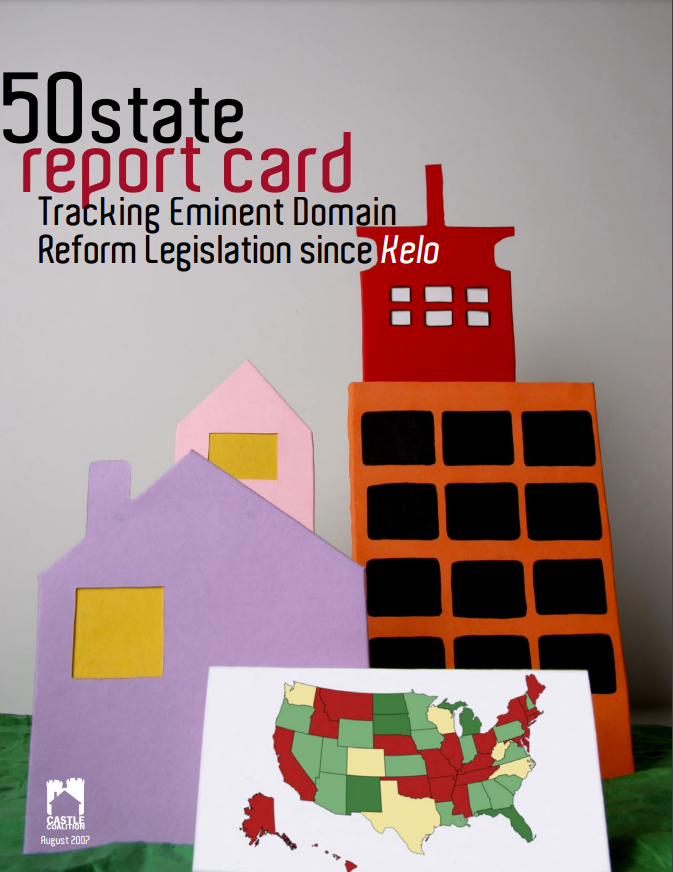
50 State Report Card
Since the U.S. Supreme Court’s now-infamous decision in Kelo v. New London, 44 states have passed new laws aimed at curbing the abuse of eminent domain for private use.
Eminent Domain | Private Property
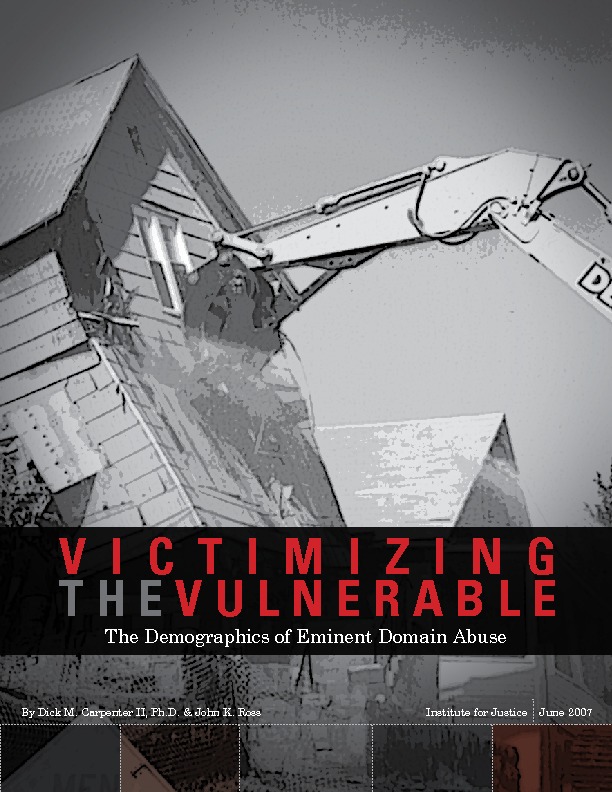
Victimizing the Vulnerable
In Kelo v. City of New London—one of the most reviled U.S. Supreme Court decisions in history—the Court upheld the use of eminent domain by governments to take someone’s private property and give it to…
Eminent Domain | Private Property
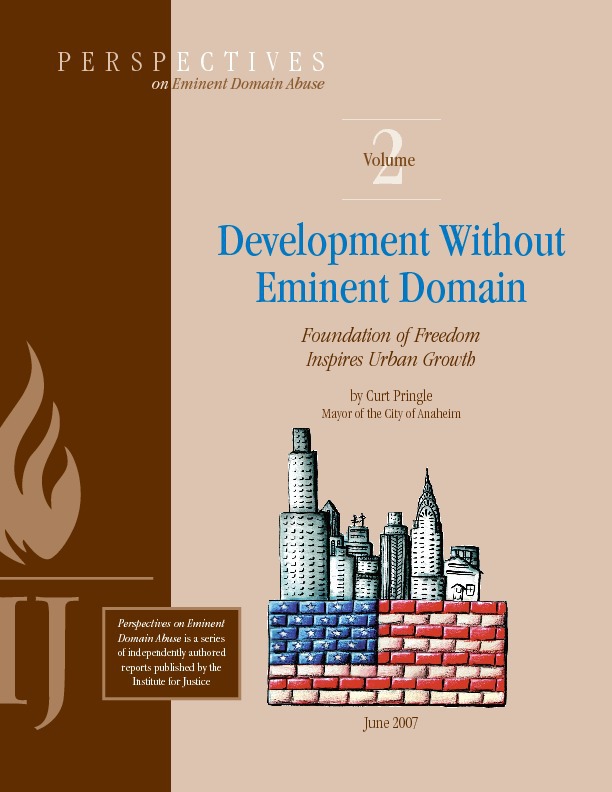
Development Without Eminent Domain
The former mayor of Anaheim, Calif., describes how that city’s leadership brought economic vibrancy to one neighborhood without resorting to any takings of private property. He also explores the successes and failures of other cities…
Eminent Domain | Private Property
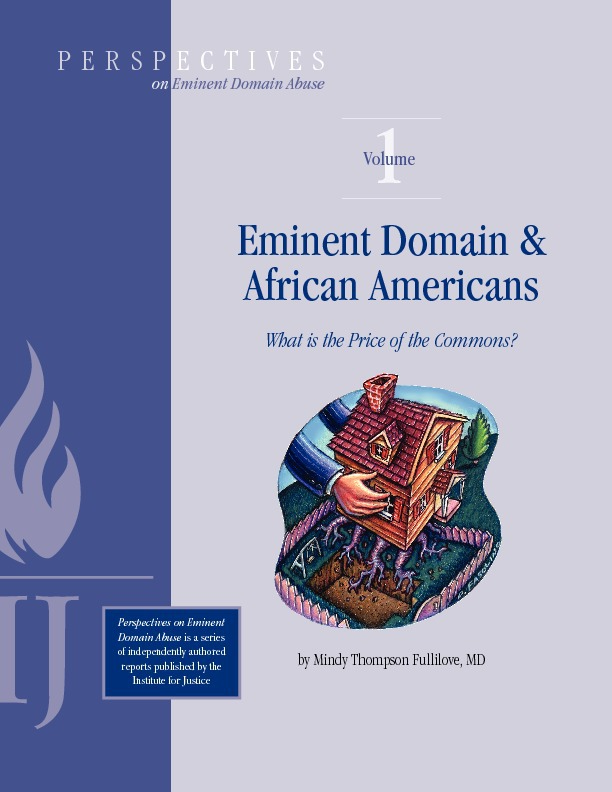
Eminent Domain & African Americans
Eminent domain has become what the Founding Fathers sought to prevent: a tool that takes from the poor and the politically weak to give to the rich and the politically powerful.
Eminent Domain | Private Property
Dreher and Echeverria
In the fight to protect home and small business owners from the government’s abuse of eminent domain, it was only a matter of time until the apologists of the practice—taking property from one private individual…

Eminent Domain | Private Property
A False Sense of Security
Washington state law is rife with opportunities for eminent domain abuse.
Eminent Domain | Private Property
Myths and Realities of Eminent Domain Abuse
The report debunks several of the most prevalent myths about eminent domain for private gain.