
Indiana’s Poor Forfeiture Reporting Masks Weak Forfeiture Cases
Although the causes of Indiana’s poor forfeiture reporting practices are unclear, the consequences are striking. The widespread inaccuracies call into question the entire reporting enterprise, reducing trust in numbers meant to help lawmakers better understand a complicated and often criticized state forfeiture system. Furthermore, the inaccuracies create a false impression of how the forfeiture system works in Indiana. Someone taking Indiana’s forfeiture reporting at face value may come away with the impression that seizures are nearly always justified—that forfeiture cases are slam dunks for law enforcement and hopeless causes for property owners. A closer look at my random sample of 415 reported cases from fiscal years 2019 through 2023 suggests otherwise.
The inaccuracies create a false impression of how the forfeiture system works in Indiana.
First, property owners contested forfeitures far more often than the state’s reporting indicates. In my random sample, I counted 140 instances of property owners contesting forfeiture of their property, a contested rate of 34%. Yet in its annual aggregate reports to the legislature covering more than 4,000 closed forfeiture cases over the same period, IPAC reported that only six cases were contested, a contested rate of 0.2%.
Second, when property owners contested forfeiture of their property, the most common outcome was that prosecutors settled the case—and this happened far more often than the state’s reporting indicates. Indeed, 86% of the 140 contested forfeiture cases in my random sample ended in a settlement. That translates to about 29% of the 415 cases overall. Yet prosecutors’ reports indicate that fewer than 4% of those same 415 cases ended in a settlement. 1
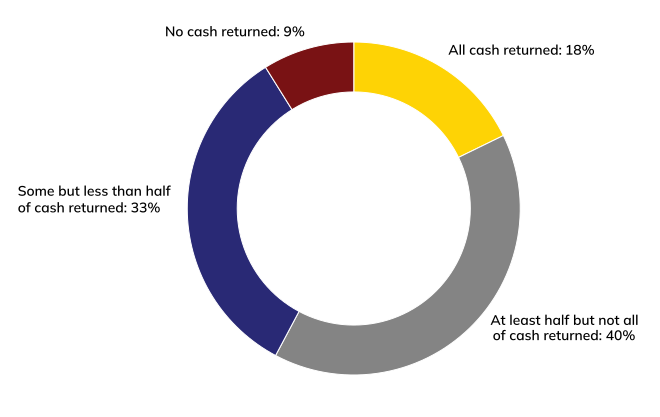
Third, and relatedly, when prosecutors settled a case, they most often returned some or even all of the seized property to claimants. Among the 121 settlements in my random sample, 92% returned at least some of the seized property. Looking at the 90 settlements in cash-only cases, prosecutors gave back at least some of the seized cash 91% of the time and at least half 58% of the time. As shown in Figure 9, this includes some cases where owners received all their cash back. The fact that prosecutors so often return some or all property when forfeitures are challenged calls into question whether forfeiture is being used to disrupt crime or simply to increase agencies’ revenues.
Figure 9: In most cash-only settlements, at least half of seized cash was returned to owners, 2019–2023
While a return of property is a better outcome than the alternative of forfeiture, the substantially higher-than-reported frequency of these settlements raises another question: Are prosecutors returning property to people they believe are actually guilty of a crime, or are they relenting after putting innocent people through a stressful and unjust process? The perverse monetary incentives of civil forfeiture combined with its much lower standard of proof unfortunately may push the odds in favor of the latter.
The substantially higher-than-reported frequency of settlements raises a question: Are prosecutors returning property to people they believe are actually guilty of a crime, or are they relenting after putting innocent people through a stressful and unjust process?
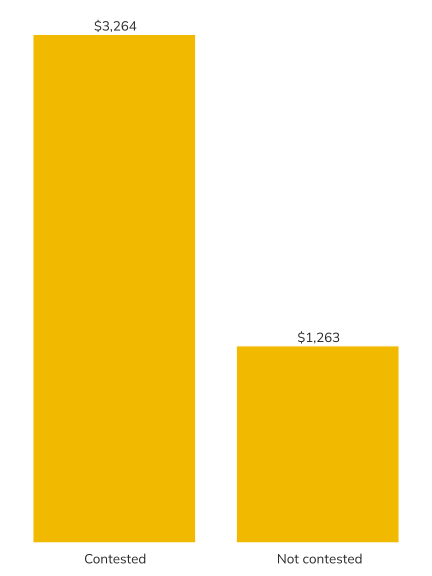
My analysis also reveals that Indiana property owners were more likely to fight forfeiture when more money was at stake. 2 In fact, the median cash seizure in contested cases was $3,264, about 2.5 times more than the $1,263 median cash seizure in uncontested cases. (See Figure 10.) This suggests owners may be making an economically rational decision to walk away when the amount at stake is likely less than what they would have to pay in legal fees to fight for their property.
Figure 10: The median value of seized currency was higher in contested cases, 340-case cash-only sample, 2019–2023
Even the Indiana Attorney General’s Office has acknowledged this possibility. In Abbott v. State, a case involving about $9,000 in cash, the Attorney General’s Office wrote: “Based on the relatively-small amount of money at issue and the low probability of success … it is unlikely that even a litigant of significant means would hire counsel to defend” against the forfeiture. 3 But while the decision to walk away may be correct from a simple cost-benefit perspective, it raises an important question of justice: How many lower-value properties would ultimately not be forfeited if litigation costs did not preclude a challenge?
Forfeiture defenders frequently argue owners fail to fight for their property because they are guilty, but a plausible and perhaps likely alternative, especially where lower-value properties are at issue, is that many owners decide it is not worth the legal fight.
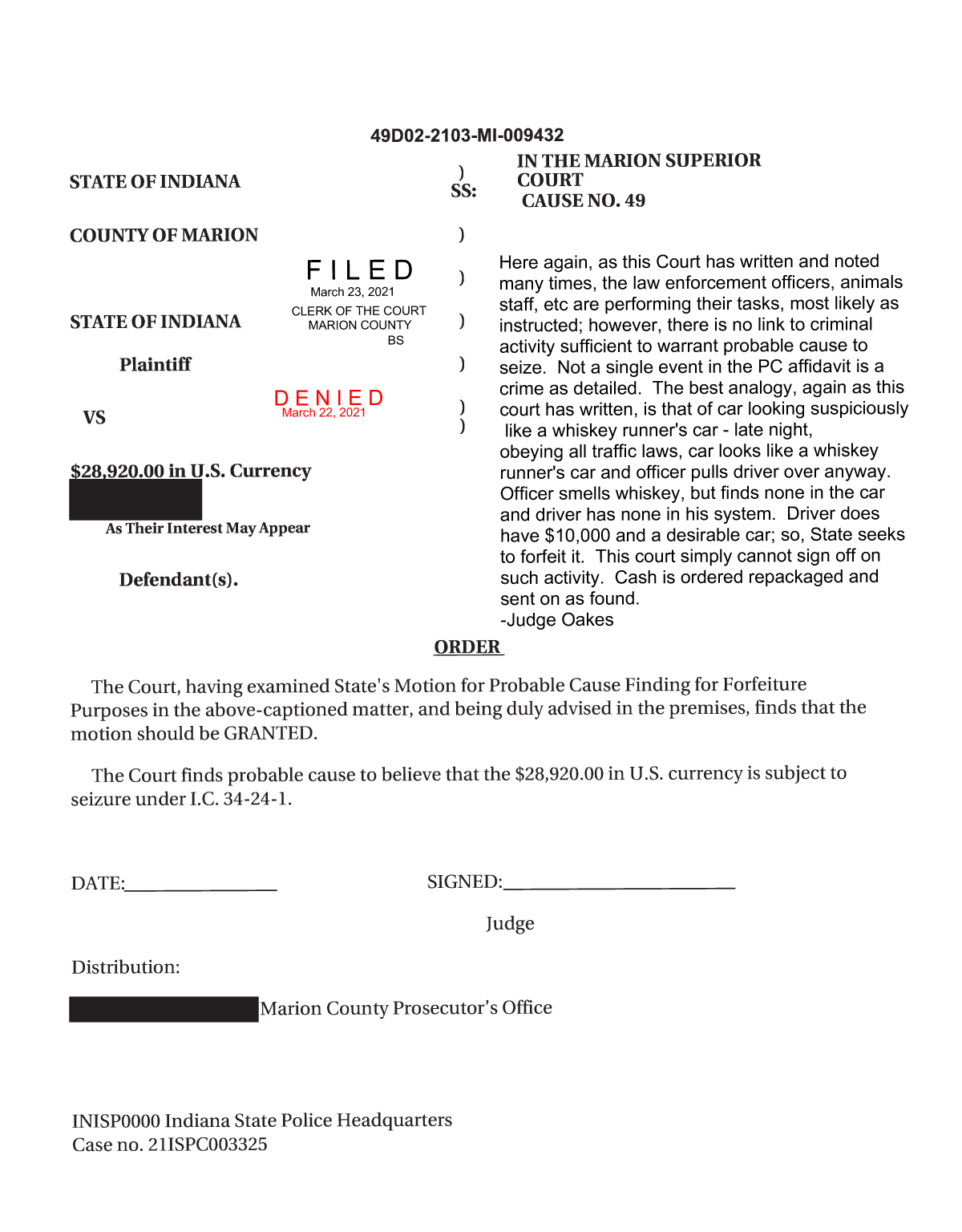
The impracticality of contesting the forfeiture of less valuable properties may explain why so many cases end in default judgments for the state: In my random sample of 415 cases, 66% were not contested. All but 17 of these cases resulted in default judgments awarding all the seized property to the government. 4 Fourteen were voluntary dismissals by the state, while in the remaining three cases, a judge ruled there had been no probable cause for the initial seizure, a finding that by law requires the property’s return. Incidentally, one of those three cases involved cash seized at the Indianapolis FedEx hub. Of that seizure, the judge wrote: “Not a single event in the [probable cause] affidavit is a crime as detailed.” (See Figure 11.) Forfeiture defenders frequently argue owners fail to fight for their property because they are guilty, but a plausible and perhaps likely alternative, especially where lower-value properties are at issue, is that many owners decide it is not worth the legal fight.
Figure 11: Court order denying probable cause for a seizure from the Indianapolis FedEx hub
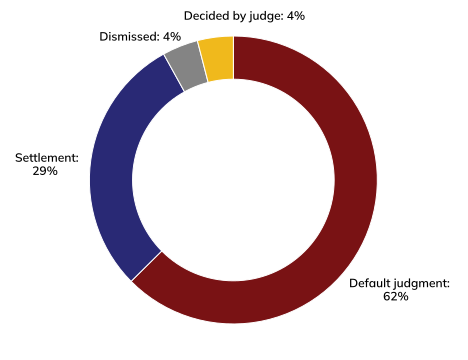
All told, more than 90% of the cases in my random sample ended in either a default judgment or a settlement. 5 Another 4% ended in voluntary dismissals—that is, the state dropped the cases and returned property to its owners. Just 4%—a mere 18 cases—were ultimately decided by a judge. 6 (See Figure 12.) This is hardly the picture of forfeiture targeting the guilty that Indiana’s forfeiture reporting paints. As worrisome, the vast majority of forfeitures happen with limited judicial oversight. Together with my various other findings, these results raise the question of just how many forfeitures are carried out with little evidence of property’s connection to any crime.
Figure 12: Few forfeiture cases were decided by a judge, 415-case sample, 2019–2023
In 2015, when the General Assembly was considering instituting forfeiture reporting requirements, IPAC’s executive director welcomed the reform, but he also noted that “the question is how do we do that and be accurate within our current system. I don’t have the answer to that question yet.” 7 A decade later, the substantial amount of nonreporting and inaccurate reporting I found in my analysis makes it clear that Indiana is still looking for answers when it comes to accurate forfeiture case data. Meanwhile, prosecutors continue to present an incomplete—and incorrect—picture of forfeiture to Indiana lawmakers, courts, and the public.