A History of “Serious Concerns” With Forfeiture
Indiana lawmakers have good reasons to want to know how forfeiture operates, as the state’s civil forfeiture system has come under harsh criticism. The Indiana Supreme Court has called it “punitive for those whose property is confiscated … and profitable for the government.” 1 In addition, individual members of the state high court have raised “serious concerns with the way Indiana carries out civil forfeitures,” with some criticizing the “overreach” of forfeiture and likening it to a “law enforcement Weapon[] of Mass Destruction.” 2
The problem in Indiana starts with civil forfeiture laws that provide poor protections for property owners and generous financial incentives for police and prosecutors to take property. And as several high-profile cases have shown, police and prosecutors often take full advantage.
First, no person needs to be convicted, charged, or even arrested to lose property forever. This is because civil forfeiture involves a civil in rem proceeding, not a criminal in personam one—in other words, a civil proceeding against things rather than a criminal proceeding against people. With civil forfeiture, prosecutors bring civil cases against cars, cash, homes, and other property as though the property itself did something wrong. In addition, the standard of proof for tying property to an alleged crime in Indiana’s civil courts is far lower than the proof required in a criminal case. While criminal cases require proof beyond a reasonable doubt to convict a person of a crime, Indiana civil forfeiture cases require a preponderance of the evidence to take property for an alleged crime—a standard that translates to “more likely than not.” 3
Indiana’s contingency-fee forfeiture scheme allows private prosecutors to receive up to a third of the proceeds from any forfeiture cases they win, even in cases where owners do not respond in time and lose by default.
Second, Indiana provides limited protection for property owners like Jeana and Jack Horner who may be swept up in forfeiture proceedings because someone else allegedly used their property to commit a crime. Indiana provides an “innocent owner defense” for such third-party owners, but in most cases, Indiana forces such owners to prove their own innocence to recover their property. The only exceptions are for vehicles and (with odd specificity) equipment allegedly used to record sex crimes. In these cases, the government bears the burden of proving that third-party owners knew or should have known about the criminal use of their property. 4 As construed by some Indiana courts, however, the standard the government must meet is relatively low. 5
Third, Indiana gives law enforcement agencies a large financial stake in forfeitures, allowing them to keep and spend up to 93% of forfeiture proceeds with little legislative oversight. 6 This creates perverse incentives for agencies to use forfeiture to raise revenue rather than to fight crime or pursue justice.
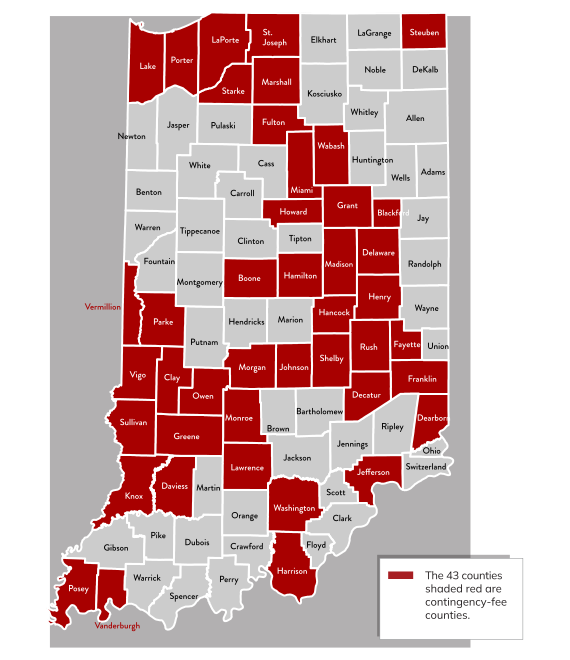
These three features of Indiana’s civil forfeiture laws earned the state a D in the third edition of the Institute for Justice’s Policing for Profit report—an indication of laws that make forfeiture easy and lucrative for the government while putting property owners at risk. 7 But Indiana’s laws make matters worse with the state’s unique contingency-fee arrangements. This scheme, used in 43 of the state’s 92 counties, allows private prosecutors to receive up to a third of the proceeds from any forfeiture cases they win, even in cases where owners do not respond in time and lose by default. 8 (See Figure 1.) Ordinarily, prosecutors are expected to recuse themselves in cases where a financial or other interest creates a conflict or even the appearance of a conflict. 9 This is because prosecutors have a duty not to maximize punishment but to ensure that justice is done. Making a prosecutor’s personal compensation directly depend on whether they win a particular case subverts that duty. Indiana’s contingency-fee forfeiture scheme has earned derision inside and outside the legal arena and is currently the subject of an IJ class action lawsuit. 10
Figure 1: Indiana counties that use private prosecutors working on contingency for forfeiture cases
In short, Indiana offers meager legal protections for owners and generous financial incentives for the government and private prosecutors. And several cases illustrate that police and prosecutors have a history of pushing the state’s civil forfeiture laws to their limits, giving lawmakers good reason for continued concern about how forfeiture is used and whether the state’s system needs reform.
In a recent example, police in Indianapolis have become frequent visitors to the city’s FedEx hub, America’s second largest. 11 They subject in-transit packages to K-9 inspection. If a dog alerts, police obtain warrants to open the packages. Officers often then hold on to the contents for forfeiture—even if no drugs or other contraband are found (and despite the known problems with dog alerts). 12 Since 2022, Marion County prosecutors have brought forfeiture cases to keep at least $2.5 million from 130 cash seizures at the Indianapolis FedEx hub. 13
Making matters worse, all the seized packages were from out-of-state senders, who must navigate a complicated court process from afar. Owners must respond in court within 23 days or give up their rights to the property. 14 Not only that, but they typically do not know why their property was seized in the first place. This is because Marion County forfeiture complaints typically fail to specify what Indiana crime supports the forfeiture, simply claiming that seized cash is linked to “a violation of a criminal statute.” 15
Police and prosecutors have a history of pushing the state’s civil forfeiture laws to their limits, giving lawmakers good reason for continued concern about how forfeiture is used and whether the state’s system needs reform.
In another prominent example, Indiana prosecutors spent seven years trying to forfeit Tyson Timbs’ $42,000 Land Rover, bought with proceeds from his late father’s life insurance, because he happened to be driving it when he was arrested for a first-time, nonviolent drug offense. Tyson pleaded guilty, served a year on house arrest, and paid $1,200 in court fees. But prosecutors insisted on also taking his car—worth more than four times the maximum allowable fine for his offense. It took a ruling from the U.S. Supreme Court, applying the Constitution’s Excessive Fines Clause to the states, followed by still more litigation in state courts, before Tyson won his Land Rover back for good. 16
Even the current financial incentive in Indiana’s civil forfeiture laws provides an example of how police and prosecutors have pushed the limits of state law. The state constitution explicitly requires that “all forfeitures which may accrue” be directed to the state’s Common School Fund for the benefit of Indiana public schools. 17 But for years, agencies sidestepped this requirement by deducting nearly all proceeds as “law enforcement costs,” with virtually nothing going to the school fund. 18 Despite a legal challenge to the practice, agencies ultimately succeeded in undermining the state constitution’s provision by successfully advocating for a statute, upheld by the Indiana Supreme Court, automatically granting up to 93% of proceeds to police and prosecutors. 19
