Results
Despite state law requiring prosecutors to report on their forfeiture cases, my results indicate that Indiana’s forfeiture reporting provides little in the way of true transparency or accountability. Instead, a substantial number of forfeiture cases go unreported and those that are reported often contain errors that present an inaccurate accounting of Indiana’s forfeiture system.
Key Finding #1: Many forfeiture cases in Indiana go unreported—especially in counties with contingency-fee prosecutors.
Indiana prosecutors fail to report a substantial number of forfeiture cases each year. Not only does this mask the true number of forfeiture cases occurring throughout the state, but it also means decision-makers and the public lack a full accounting of the total amount of property forfeited or transferred to the federal government each year.
Over a six-year period, at least 1,967 forfeiture cases—or nearly 30% of all known forfeiture cases—went unreported in Indiana. 1 These unreported cases involved 144 vehicles and more than $6.2 million in currency forfeited under state law, as well as more than $3.8 million in seized currency transferred to the federal government for forfeiture. In other words, over six years, prosecutors failed to report more than $10 million worth of seizures and forfeitures. (See Figure 3.)
Figure 3: From 2016 to 2021, Indiana agencies failed to report …
1,967 cases
$10 million in currency
144 vehicles
To put the scale of nonreporting in perspective, IPAC’s annual aggregate reports to the legislature report $23.4 million in proceeds from forfeitures under state law from fiscal years 2016 through 2021, roughly the same period for which I identified unreported forfeiture cases. 2 That total includes both forfeited currency and proceeds from the auction of forfeited property, which means the $6.2 million in unreported state-law currency forfeitures I identified is equal to more than a quarter of the value of all reported state-law forfeitures.
The nonreporting problem is widespread but varied in terms of its severity. (See Figure 4.) Of the state’s 92 counties, 77 had at least one unreported forfeiture case. However, the problem is much worse in some counties than in others. Among counties with at least 10 known forfeiture cases, four—Elkhart, Clark, Warrick, and Franklin—failed to report any cases. Six others reported fewer than 10% of their forfeiture cases, and another seven reported fewer than 50%.
Figure 4: 20 worst counties for reporting forfeiture cases, 2016–2021*
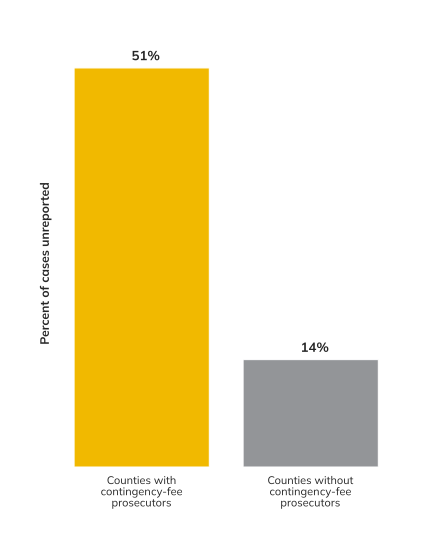
Counties that contract out forfeiture cases to private attorneys working on contingency are particularly lax with reporting. As shown in Figure 5, they failed to report more than half their forfeiture cases, while counties that do not contract out forfeiture cases failed to report 14%. Of the 1,967 unreported cases we found, 72% came from contingency-fee counties.
Two of the lax contingency-fee counties, Vanderburgh and Vigo, were also among the most active in pursuing forfeitures. 3 Together, they accounted for more than a tenth of forfeiture cases overall—and more than a third of unreported forfeiture cases. This is particularly troubling given that Indiana’s contingency-fee forfeiture scheme already carries inherent problems for accountability.
Figure 5: Percent of known forfeiture cases unreported in counties with contingency-fee prosecutors versus in counties without, 2016–2021
Key Finding #2: When forfeiture cases are reported, they are often riddled with errors.
The forfeiture cases that are reported to IPAC contain frequent errors in all directions that undercut transparency and trust in the reporting process while clouding how the state’s forfeiture system plays out for law enforcement and property owners. The prevalence of errors suggests that even if all prosecutors reported 100% of their forfeiture cases, decision-makers and the public would still lack trustworthy, actionable information.
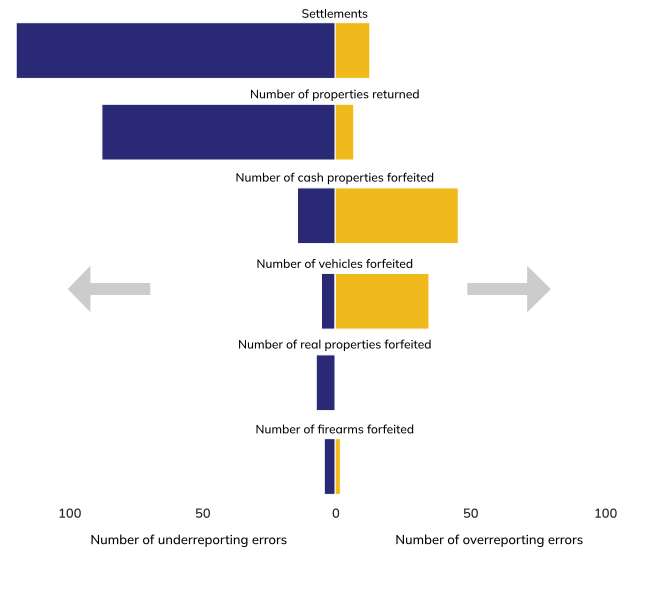
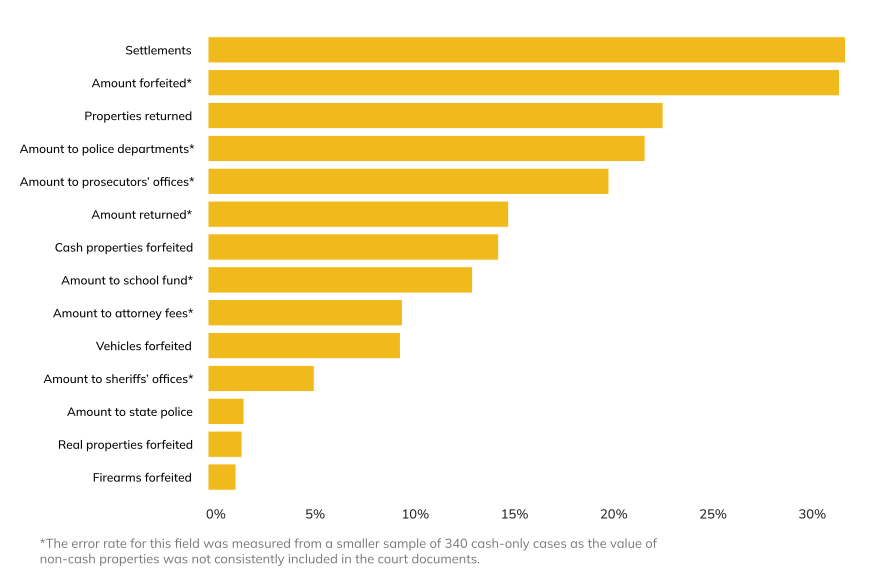
In IPAC’s data, 43% of reported cases from my random sample of 415 contained at least one error when compared to court documents on the following six items: number of cash properties forfeited; number of vehicles forfeited; number of firearms forfeited; number of real properties forfeited; number of properties returned to claimants; and whether the case involved a settlement. 4 The most commonly incorrect items were whether the case involved a settlement (incorrect 32% of the time), the number of properties returned to claimants (23%), and the number of cash properties forfeited (15%). Figure 6 shows the directionality of errors.
Figure 6: IPAC reporting errors, 415-case sample, 2019–2023
Unfortunately, the values of non-cash properties are not consistently present in the court documents. 5 To examine the accuracy of dollar amounts in reported forfeiture cases—things like the value of the forfeited property, amounts returned to property owners, and amounts distributed to different types of agencies—I therefore limited this part of my analysis to the 340 cases in my random sample that involved only cash.
Looking more closely at those 340 cash-only cases revealed that 64% contained an error on at least one of the six items above or at least one of the following eight items: total amount forfeited; total amount returned to claimants; proceeds distributed to the Common School Fund; proceeds that went to pay attorney fees; proceeds distributed to prosecutors’ offices; proceeds distributed to the Indiana State Police; proceeds distributed to sheriffs’ offices; and proceeds distributed to police departments. 6 The dollar-amount items that were incorrect most frequently were the total amount forfeited (incorrect 32% of the time), the amount of proceeds distributed to police departments (22%), and the amount of proceeds distributed to prosecutors’ offices (20%).
The dollar-amount errors in individual cash-only cases vary, and overreporting is more common than underreporting. (See Figure 7.) It is difficult to identify patterns or determine why values were entered incorrectly. The overall impression created is one of widespread carelessness. Even the few discernible patterns suggest nothing more than simple sloppiness. For instance, 161 of the dollar-amount errors involved reported values that were exactly two, three, four, five, six, or even 10 times the actual amount, suggesting prosecutors or other recordkeepers entered the same amount multiple times in one or more fields, perhaps at various points during the reporting process. Other times, prosecutors recorded zeros instead of positive values—an error that occurred 101 times for dollar-amount entries, including 42 times for the total amount of cash returned to claimants.
Figure 7: IPAC reporting errors, 340-case cash-only sample, 2019–2023
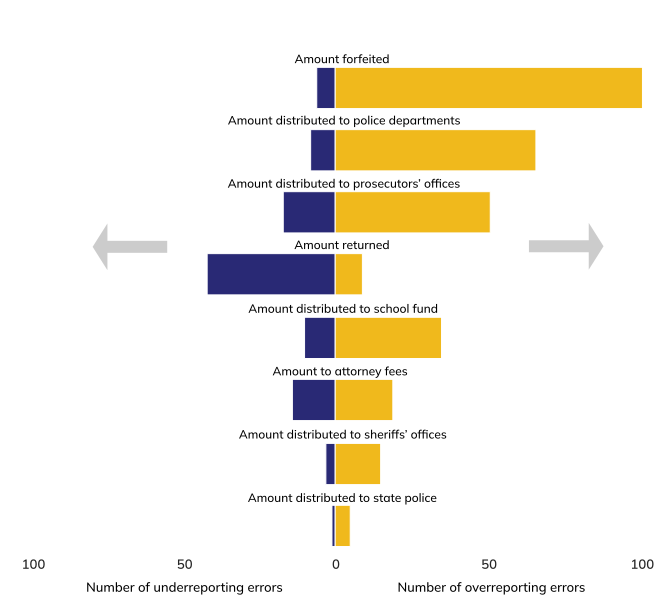
Regardless of the reasons for them, the many individual errors compound into wildly inaccurate total amounts for dollar amounts forfeited, distributed to agencies, and returned to claimants. Total forfeiture proceeds from the 340 cash-only cases examined were overreported by 55%. Proceeds that went to pay attorney fees, including fees for private prosecutors working on contingency, were overreported by 430%. 7 Meanwhile, the amount of money returned to claimants was underreported by 53%. This last finding, combined with the underreporting of whether a settlement occurred and whether property was returned to claimants, means that prosecutors’ forfeiture reports create the impression that forfeiture cases end less favorably for property owners than they actually do.
The frequency of errors varied by field, as Figure 8 shows, but all told, about two-thirds of the 415 cases in my random sample contained an error on at least one of the 14 items examined. This is a conservative estimate of the total error rate, as it assumes all the dollar amounts prosecutors entered for the 75 cases that included non-cash properties are correct.
Figure 8: Frequency of errors in the IPAC data for sampled cases, 2019–2023
We can only speculate as to why the IPAC data are so frequently mistaken. The electronic reporting system prosecutors’ offices use, known as the Indiana Prosecutor Case Management System, may not be designed to ensure records are internally consistent, leading to errors like multiple entries of the same value for a given case. Individuals entering data into the system may not fully understand how data are supposed to be reported, or they may simply make mistakes while entering data. And once data are entered, IPAC officials may make mistakes compiling the data and organizing it into spreadsheets and reports to share with lawmakers and the public.
