Methods
The Institute for Justice has long had reason to question the quality of Indiana’s forfeiture reporting. During the course of multiple lawsuits against Indiana’s civil forfeiture system, some of them still ongoing, IJ attorneys have noticed peculiar errors or omissions in the state’s reporting. Numbers would not add up, and known forfeiture cases would be absent in the data. These problems prompted a closer look. Specifically, I examined two apparent problems with IPAC forfeiture reports: (1) cases that went entirely unreported and (2) cases whose data in the IPAC reports did not match those in court records.
The Institute for Justice has long had reason to question the quality of Indiana’s forfeiture reporting.
Identifying unreported forfeiture cases
To identify unreported Indiana forfeiture cases, I obtained a database of nonconfidential civil court cases from the Indiana Office of Court Services and searched it for forfeiture cases opened between January 1, 2016, and December 31, 2021, and closed by October 31, 2022. 1 This resulted in a list of all known completed forfeiture cases in the state for calendar years 2016 through 2021. I then used case numbers to compare that list against the forfeiture cases reported to the Indiana Prosecuting Attorneys Council. To do that, I used annual forfeiture case reporting spreadsheets provided to IJ by IPAC for fiscal years 2016 through 2023, which ended on June 30, 2023, eight months after the most recent cases in the IOCS database had closed. 2 I considered any cases not present in the IPAC datasets as unreported. 3 My team then downloaded the final orders for all unreported cases using “MyCase,” an online search engine operated by the Indiana Supreme Court’s Office of Judicial Administration, and recorded key information from those orders, including the amounts of any currency forfeitures, the number of vehicles forfeited, and whether seized property was transferred to the federal government. 4 Recording that information allowed me to identify the total amount of unreported currency forfeitures, vehicle forfeitures, and federal transfers. And because forfeiture case numbers include a county code, I was also able to observe how nonreporting varied across counties, including counties that contract out forfeiture cases to private attorneys working on contingency.
Identifying errors in reported cases
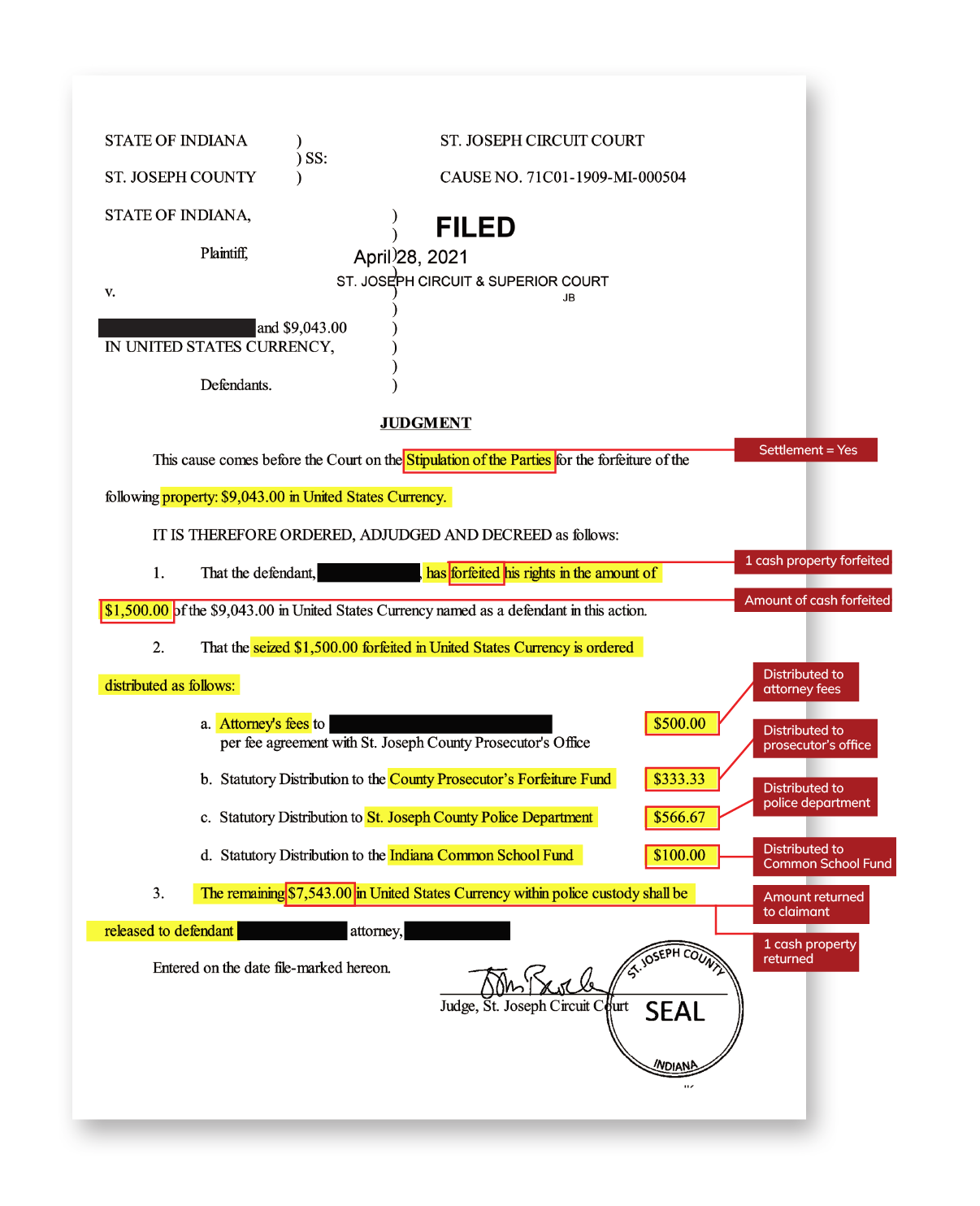
To examine how accurately forfeiture case data are recorded when cases are reported as required, I first selected a simple random sample of 415 forfeiture cases from the 3,982 appearing in the IPAC datasets for fiscal years 2019 through 2023. I then used court records in MyCase to independently record the same types of information captured in the IPAC data, a process depicted in Figure 2 using one of the random forfeiture cases included in the accuracy analysis. I excluded earlier years from this analysis because MyCase records for those years were often missing court orders, while later years were more consistently complete. I then compared the values I recorded to those in the IPAC data. When there were close calls, I gave the benefit of the doubt to the IPAC data so that results would be conservative. For instance, I considered an amount in the IPAC data incorrect only if it differed by more than one dollar from the amount I recorded from MyCase. 5 I then calculated error rates.
Figure 2: Sample court record showing information recorded for comparison to information captured in the IPAC data
Additional details on my methods and results are available in the appendix.
