Sunshine State Shakedown: IJ Challenges Miami’s Extortionate Land-Use Permitting Scheme
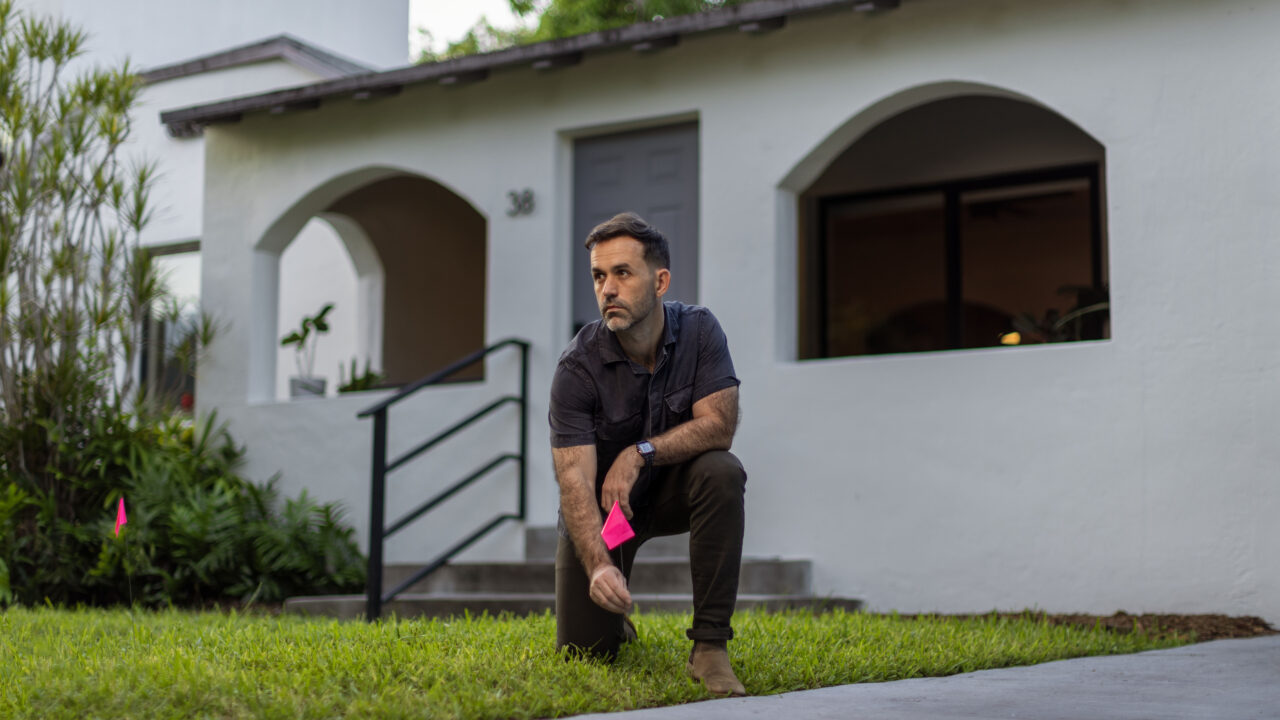
A soon-to-be father named Chad
Just wanted to be a good dad
So he asked for permission to build an addition
But Miami’s land grab was quite mad.
This Liberty & Law Limerick™ tells the story of Chad Trausch—a new IJ client—whose life was turned upside down when he found himself in the crosshairs of Miami’s extortionate and unconstitutional land-use permitting scheme. Chad’s story began when he and his wife, Stephanie, learned they would be having a baby. Realizing that their two-bedroom, one-bathroom home would soon become too small for their growing family, they decided to build an addition to create more livable space—both for themselves and for their parents to stay for extended periods and assist with child care.
Chad, an Navy veteran, wanted to do things by the book. But when he submitted his permit application, the city demanded that—in exchange for a permit—he hand over a deed to 500 square feet of his property. That meant taking away half of Chad’s front yard! And the city gave no reason for this demand. Indeed, the city offered no explanation for how acquiring half of Chad’s yard was necessary to mitigate any supposed harm resulting from adding a few rooms to the back of his home.
Normally, the city would have to pay to acquire that land. It could potentially do so here: The city could offer to purchase Chad’s land. Or the city could try to acquire it through eminent domain (which would still require paying just compensation). But the city wants the land for free, and it is abusing the land-use permitting process to get it.
And Chad is not the first victim of the city’s scheme. Miami has demanded land from hundreds of its residents already, with thousands more potentially at risk.
When the government imposes conditions on your ability to use your own property, it is the government’s burden to show that the conditions are both directly related to its interest in your land and roughly proportional to an identified harm that it seeks to mitigate. In Chad’s case, Miami fails twice over because officials have no concrete plan for the land and cannot identify any harm. Instead, Miami’s theory is that maybe the road will eventually need expanding, so it might as well take half of Chad’s yard today (and not pay for it) … just in case.
If this all sounds familiar, that’s because it is. Miami is engaged in “land banking,” the same unconstitutional practice that Pam Tilley faced—and IJ recently defeated—in Freeport, Texas. Only here, Miami isn’t using eminent domain to bank land; it is instead holding unrelated building permits hostage to accomplish the same goal.
Chad’s situation shows why it is so important that we hold governments accountable for meeting constitutional burdens, especially because land grabs often target people who cannot afford to challenge them on their own. Not only would victory in this case secure freedom from extortionate permitting demands for thousands of Miami residents, but it would also force governments across the country to think long and hard before treating property owners the same way Miami has treated Chad.
Benjamin Marsh is an IJ attorney.
Also in this Issue

Liberty & Law
Victory! Texas Couple Wins Round Two In Forfeiture Fight

Liberty & Law
Red Tape Sinks Backyard Swim Lesson
Liberty & Law
Lighthouse Will Continue To Shine For Washington Community
Liberty & Law
Freeing The New York City Housing Market

Liberty & Law
Counsel Unbound: IJ’s New Initiative To Liberate Legal Help
Liberty & Law
Why IJ Is Suing ICE
Liberty & Law
Landmark Victory For Renters’ Privacy And Property Rights

Liberty & Law
IJ Engineers A Trip To The Arizona Supreme Court To Expand Economic Liberty
Liberty & Law
New IJ Study Finds Bad Data In Indiana Forfeiture Reports
Liberty & Law
IJ Makes Headlines
Subscribe to get Liberty & Law magazine direct to your mailbox!
Sign up to receive IJ's bimonthly magazine, Liberty & Law, along with breaking news updates about the Institute for Justice's fight to protect the rights of all Americans.