Support From Across the Ideological Spectrum Pours in for Family Seeking Justice at the Supreme Court Over FBI Wrong House Raid
Amicus briefs from Members of Congress, a prominent law professor, gun rights groups, the ACLU, and more urge the Court to allow IJ clients’ lawsuit to move forward.
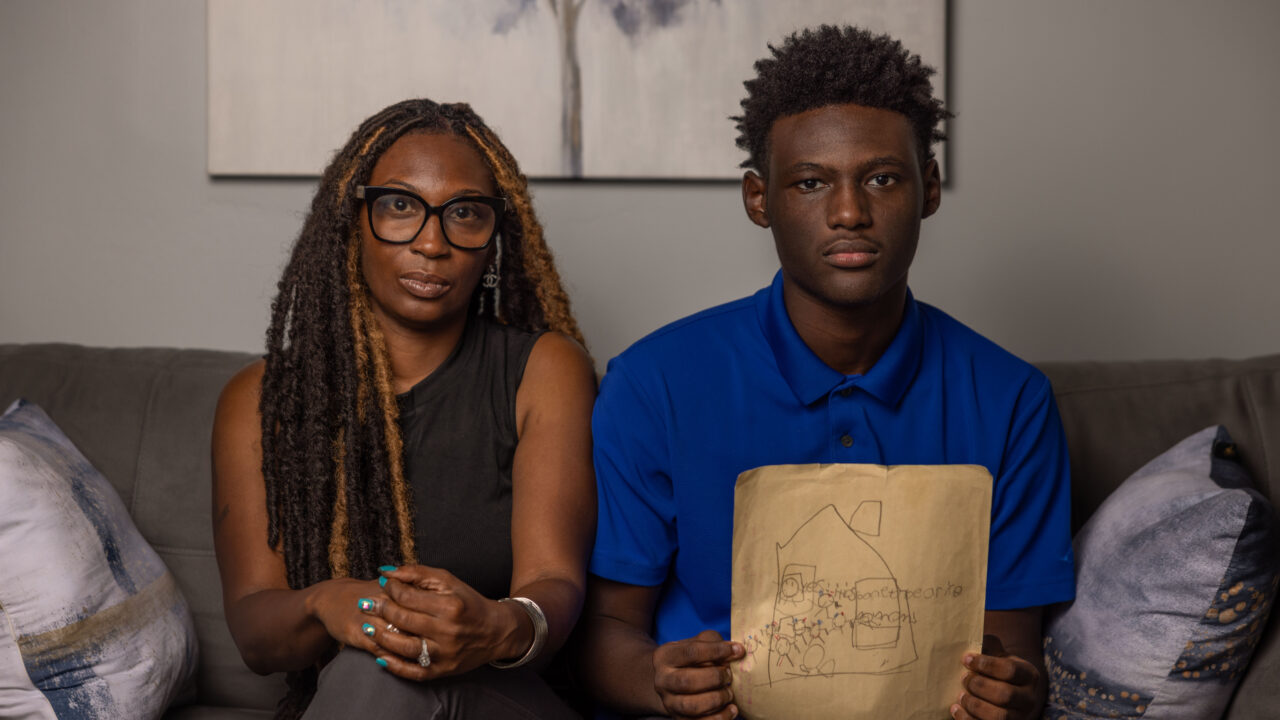
WASHINGTON—Before the sun rose over their Atlanta home one morning in 2017, Trina Martin, her son Gabe, and her partner Toi Cliatt were jolted awake when an FBI SWAT team rammed in their front door. The officers—who had stormed the wrong house—held the innocent family at gunpoint until they realized their mistake. Now, eight years later, the Supreme Court will hear oral argument in the family’s case against the federal government for the blundered raid.
As the argument approaches, supporters from across the ideological spectrum have filed briefs supporting Trina, Gabe, and Toi.
Most notably, a bipartisan, bicameral group of members of Congress called on the Supreme Court to correct lower courts’ misreading of the Federal Tort Claims Act (FTCA), the law under which the family sued the United States. Congress passed the FTCA to waive the federal government’s immunity from being sued whenever one of its employees causes harm. But the 11th U.S. Circuit Court of Appeals twisted certain exceptions to the FTCA and invented new ones out of whole cloth to rule that the family’s claims were barred.
As Senators Rand Paul (R-Ky.), Ron Wyden (D-Ore.), Cynthia Lummis (R-Wyo.), and Raphael Warnock (D-Ga.), alongside Representatives Harriet Hageman (R-Wyo.), Nikema Williams (D-Ga.), and Thomas Massie (R-Ky.) point out, this was wrong—Congress expressly amended the FTCA in the 1970s to ensure that victims of federal wrong-house raids can be made whole. The 11th Circuit’s ruling, the members explain, nullified Congress’ amendment “in the exact scenario that it was enacted to address.”
“Such unequivocal support from an ideologically diverse group of sitting legislators shows that this case cuts across party lines,” said Institute for Justice Attorney Dylan Moore. “All Americans have the right to feel secure in their homes. The Members’ brief sends a clear signal to the Supreme Court: When the federal government breaches that security, it has the responsibility to make things right.”
Alongside the brief from members of Congress, eight other briefs have been filed by nonprofit organizations and a prominent law professor. Each asks the Supreme Court to reverse the ruling below.
Professor Gregory Sisk, who wrote the only law school casebook on the subject of civil litigation with the federal government, encourages the Court to “return to the plain text of the” FTCA and put an end to judge-made rules that can make it impossible for victims to sue.
Public Accountability, a nonprofit organization that promotes access to civil justice for people harmed by the government, teamed up with the ACLU and the Cato Institute to point out that the FTCA was “tailor-made to address the problem in this case.”
New Civil Liberties Alliance, a public-interest law firm that focuses on administrative law, writes in its brief that the 11th Circuit’s ruling “reimposes immunity where Congress explicitly removed it.” If that ruling is allowed to stand, NCLA explains, it would “render wrong-house raids, excessive force, and other egregious abuses committed by federal law enforcement officers all but unchallengeable in court[.]”
The National Police Accountability Project and Rutherford Institute document the real-world impact of wrong-house raids. They write that “such raids, which occur with alarming frequency, may turn into nightmarish assaults on unsuspecting families who are often asleep when heavily armed federal agents storm their homes. For the victims, the experience causes serious damage and leaves lasting scars.”
Other briefs make clear that the support for Trina, Gabe, and Toi’s case transcends partisan politics. Progressive groups like the Constitutional Accountability Center and Public Citizen decried the 11th Circuit’s decision in individual briefs, while various groups supporting gun rights united in a single brief that asks the Supreme Court to make things right.
Additional information on Martin v. U.S., including photos, links to video interviews, and body cam footage from outside the home are available at: https://ij.org/case/martin-v-united-states/.
More on Private Property
Private Property
South Bend Mom’s Fight for Compensation After Police Wrecked Her Home Heads to State Court After Supreme Court Turns Down Appeal

Private Property
Supreme Court Declines to Hear Los Angeles Business Owner’s Case Seeking Compensation After SWAT Team Destroyed Shop

Private Property
