
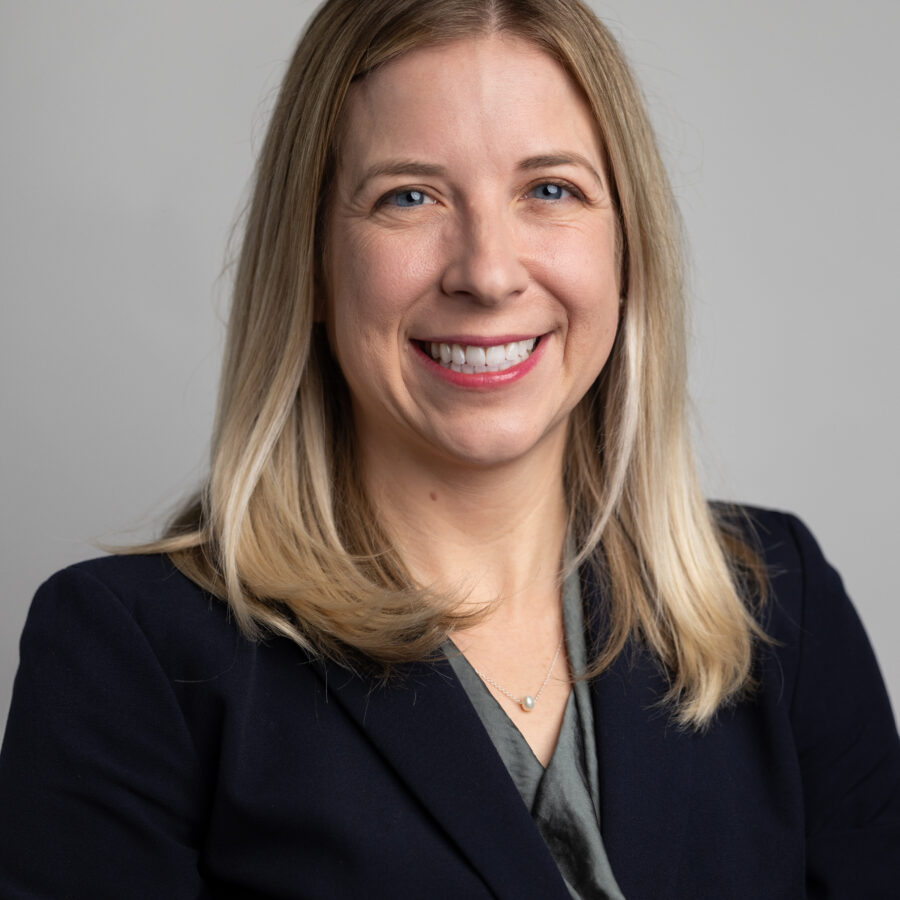
Meagan Forbes serves as the Institute for Justice’s Director of Legislation and Senior Legislative Counsel. Meagan advocates for legislative reform across the country in the areas of economic liberty, free speech, property rights and other civil liberties.
Meagan works with policymakers nationwide to lift regulatory barriers to work and to reduce the breadth of occupational licensing. She focuses on reducing licensing barriers that prevent people from accessing lower-income occupations and from working with a criminal record. Meagan also has been instrumental in reforming restrictive cottage food laws in several states, including Arkansas, Iowa, Minnesota and Oklahoma, and simplifying laws for food trucks in Georgia.
Before turning to legislative work, Meagan litigated constitutional cases in federal and state courts. She was the lead attorney in a lawsuit brought by a group of African hair braiders in Iowa that resulted in the state repealing its burdensome licensing requirements for hair braiding. She also was part of a team that helped defend the City of Milwaukee against a lawsuit seeking millions of dollars in damages after the city lifted its protectionist cap on taxi permits. Her work has been featured by MSNBC, The Wall Street Journal, The Washington Post, USA Today and other print, radio and television outlets.
Prior to joining the Institute, Meagan served as a judicial law clerk in the Minnesota Fourth Judicial District.
Meagan received her law degree from Louisiana State University’s Law Center in 2012. While in law school, she was a member of the Louisiana Law Review and worked on a variety of policy issues at the Louisiana State Capitol.
Meagan earned a Bachelor of Arts in Mass Communication from Louisiana State University in 2009. She is originally from New Orleans, La.
Meagan's Amicus Briefs
Milewski et al. v. Town of Dover et al.
Wisconsin Supreme Court
Grienpentrog v. Minnesota Department of Health
Minnesota Court of Appeals
Meagan's Legislation

Economic Liberty | Private Property | Zoning Justice Project
Restoring Options in Occupancy Models (ROOM) Act
Co-living or single-room occupancy (SRO) housing was once a common and lawful part of America’s housing landscape, from spare bedrooms and small boarding houses to large residential hotels in the city. Together, these rooms provided…
4th Amendment Project | License Plate Readers
The Protecting Everyone from Excessive Police Surveillance (PEEPS) Act
George Orwell’s vision of an all-seeing state isn’t fiction anymore. Modern surveillance technology enables the government to track your everyday movements, store your location history, and watch your life unfold in real time. Abuses are…
Cosmetology | Economic Liberty
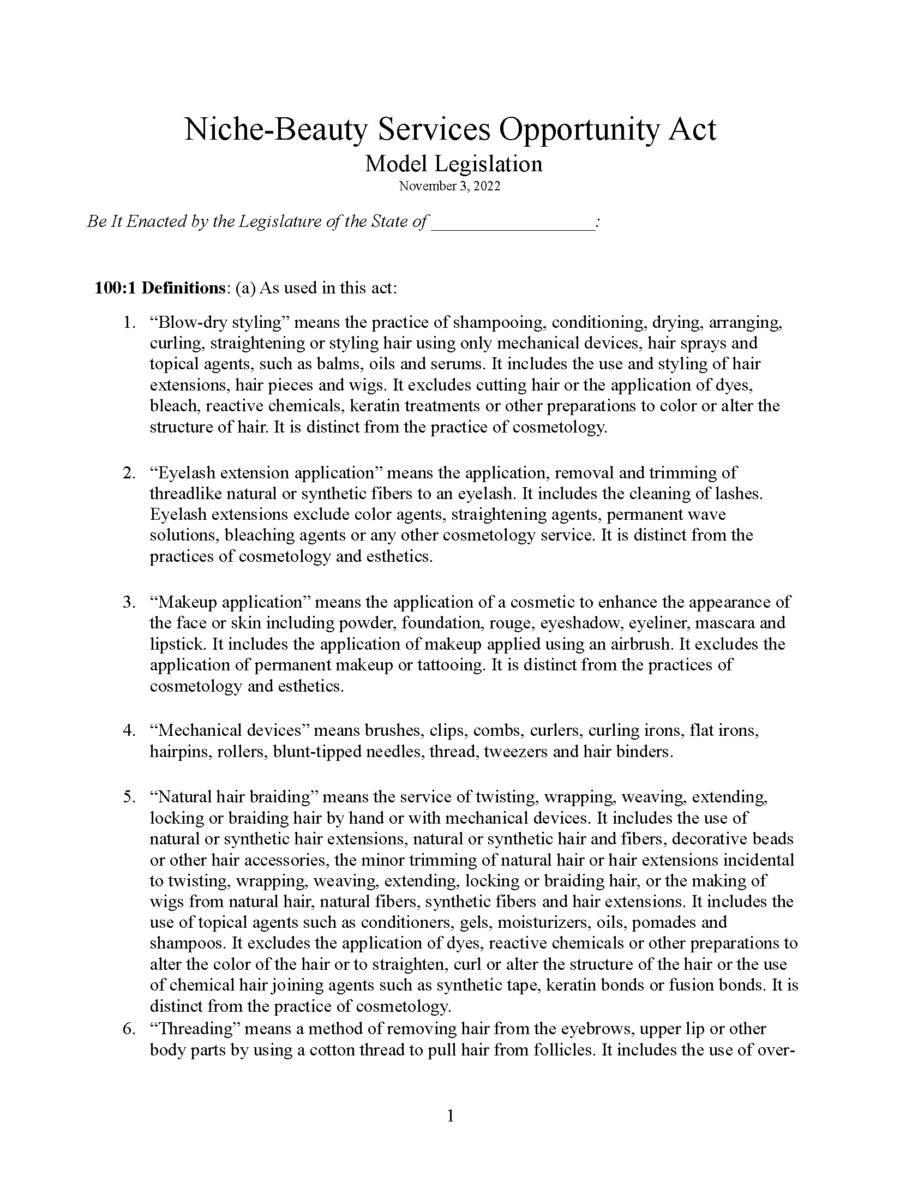
Niche-Beauty Services Opportunity Act
Styling hair and applying makeup are simple and safe beauty practices that many people do every day. They also offer opportunities for people to start businesses—such as bridal hair and makeup businesses and blow-dry bars, which are growing in popularity. Unfortunately, states often create needless obstacles before people can provide…
Economic Liberty | Hair Braiding
Natural Hair Braiding Opportunity and Freedom Act
African-style hair braiding has been a safe and natural practice for centuries. Today, it provides opportunities for entrepreneurship, especially in African American and African immigrant communities, allowing people to share their cultural heritage, start businesses, and realize the American Dream. Natural hair braiding is different…
Economic Liberty | Private Property | Zoning Justice Project
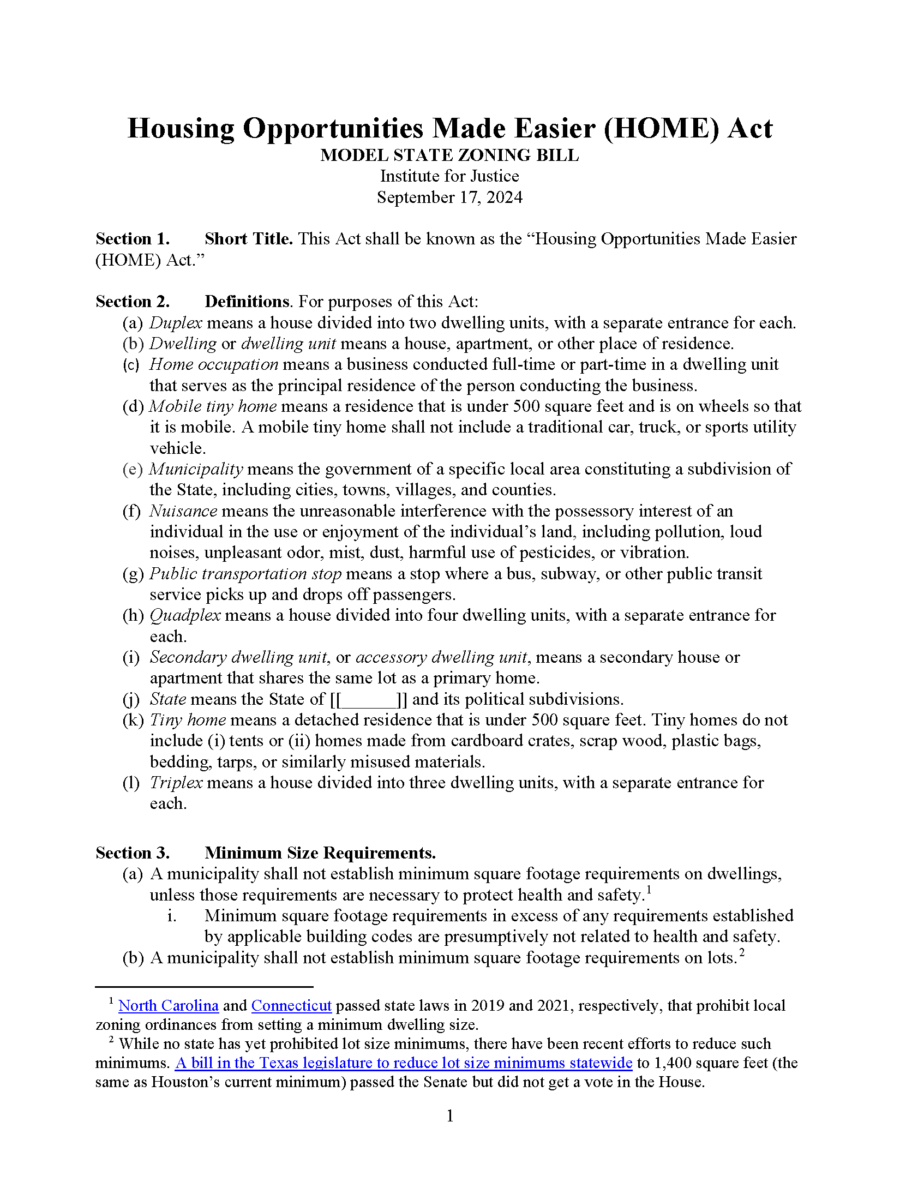
Housing Opportunities Made Easier (HOME) Act
The housing shortage is problem that can be significantly solved with one change. Scholars, state legislators and municipal officials from different backgrounds agree that a crucial component to increasing supply is to reform zoning laws.
Immunity and Accountability
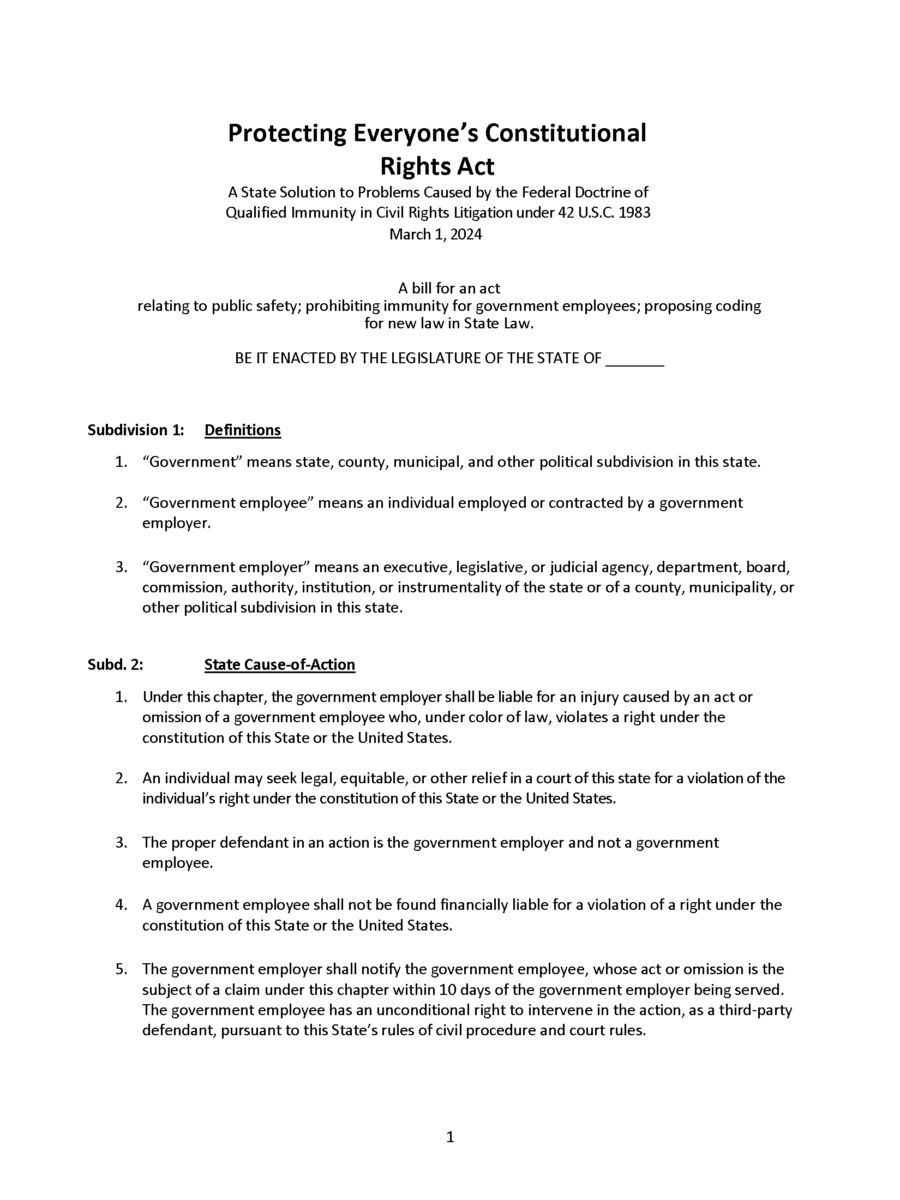
Protecting Everyone’s Constitutional Rights Act–(Q.I. Reform)
This model bill guarantees that if citizens must follow the law, state and local government officials must follow the Constitution.
Economic Liberty | Occupational Licensing
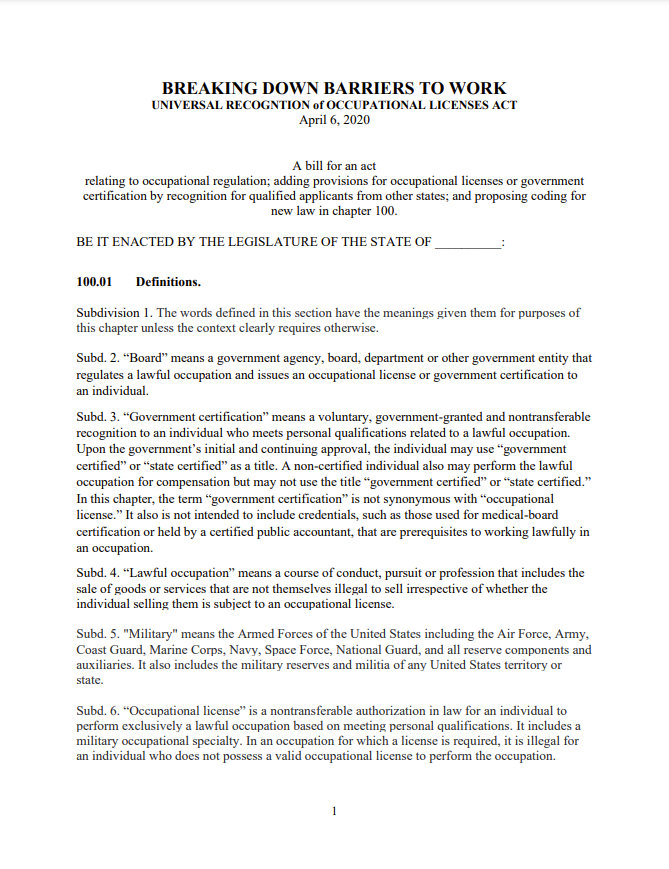
Universal Recognition
Occupational licensing affects nearly 1 in 5 American workers and can be a substantial barrier to interstate mobility. Workers do not lose their skills or experience when they cross state lines, but licensing laws…
Economic Liberty | Occupational Licensing
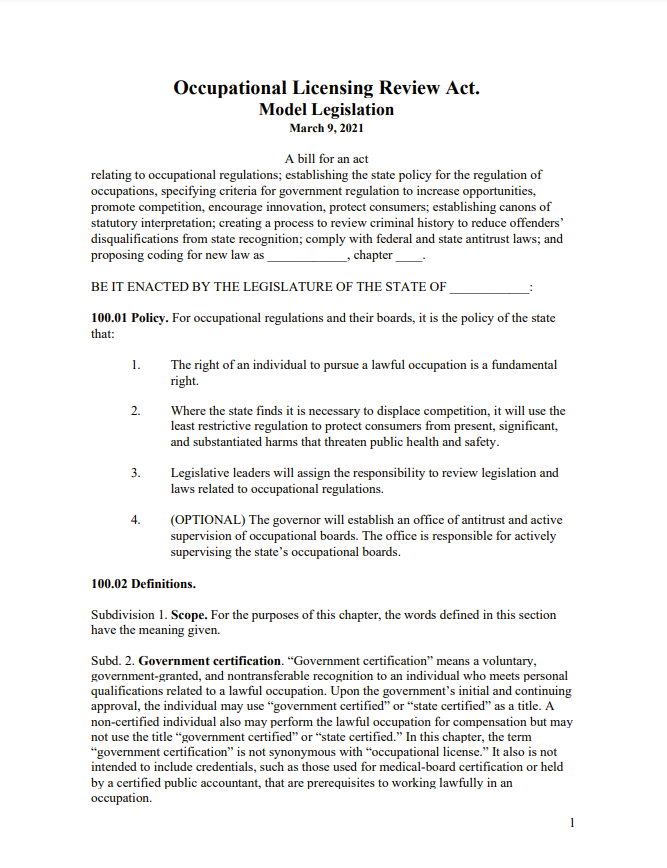
Sunrise & Sunset Occupational Licensing Review Act
Occupational licensing is one of the biggest issues in labor economics today. About 25% of workers need a government-issued license to work. That represents a five-fold increase since the 1950s, when only about 5% of workers were licensed. Licensing also dwarfs the…
Economic Liberty | Occupational Licensing
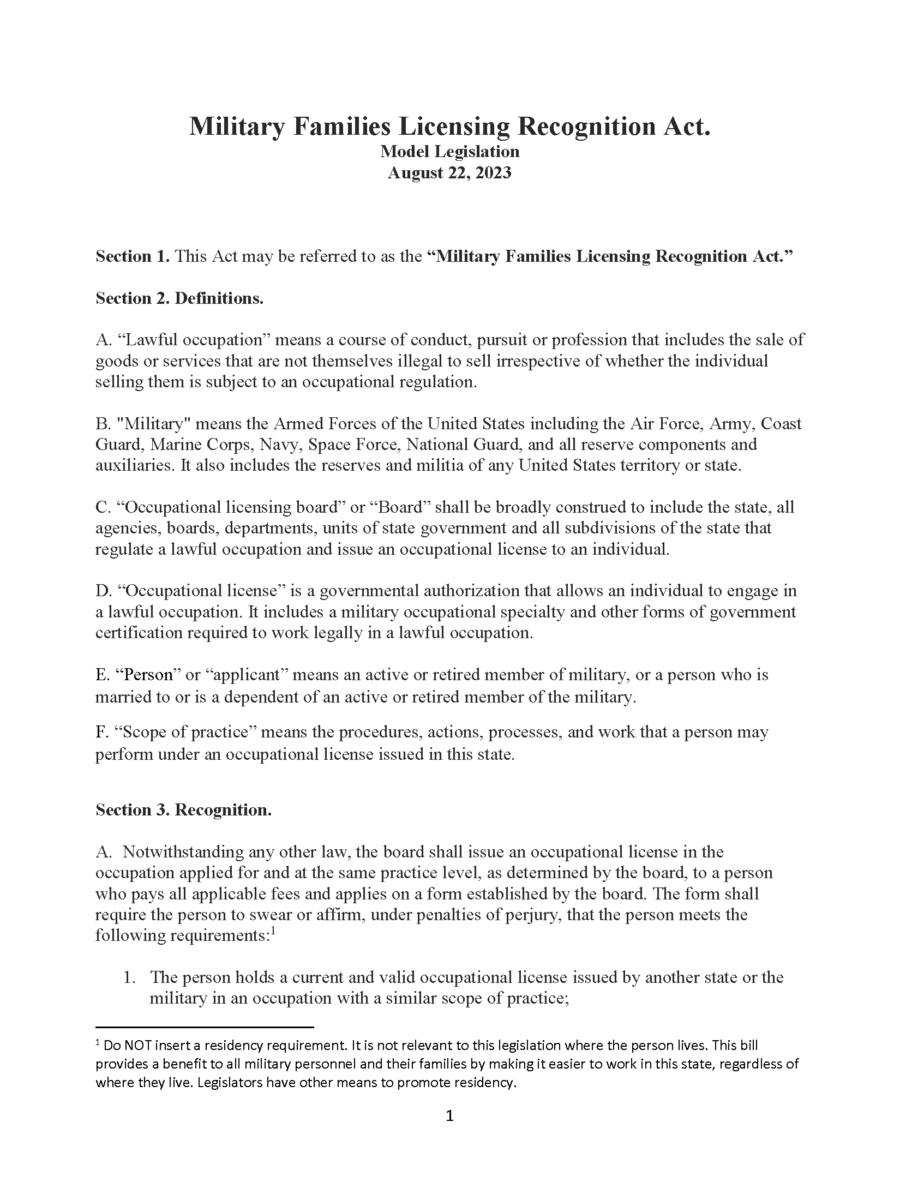
Military Families Licensing Recognition Act
The process of transferring an occupational license from one state to another can be daunting, time-consuming, and frustrating. This is especially true for military service members, who frequently relocate due to deployments. It’s not just the service members who…
Immunity and Accountability
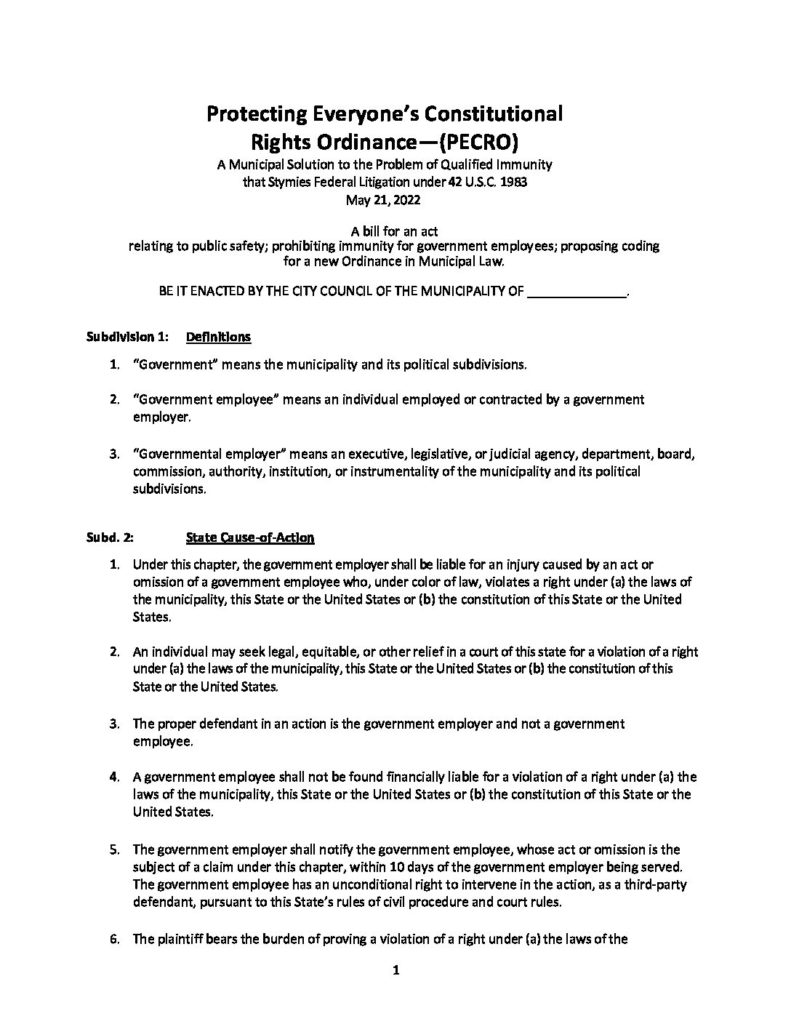
Protecting Everyone’s Constitutional Rights Ordinance
Qualified immunity is a judge-made doctrine that shields local, state and federal government officials–not just police–from accountability. In 1982, the U.S. Supreme Court created the doctrine to ensure, in its words, it would be difficult…
Immunity and Accountability
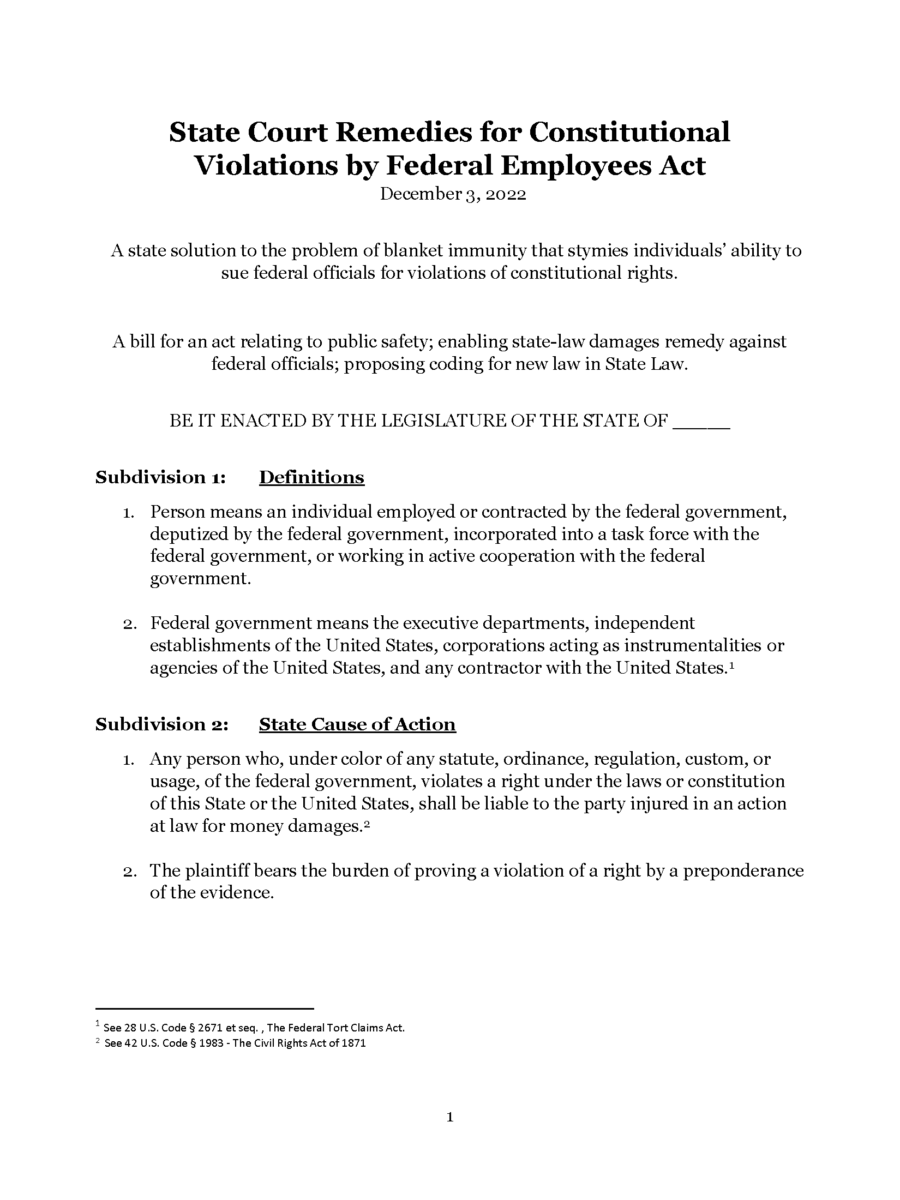
State Court Remedies for Constitutional Violations by Federal Employees Act
State legislators’ most important responsibility is to protect rights under the laws and constitutions of the United States and their states. This responsibility includes providing a remedy of damages against government officials who violate those…
Economic Liberty | Occupational Licensing
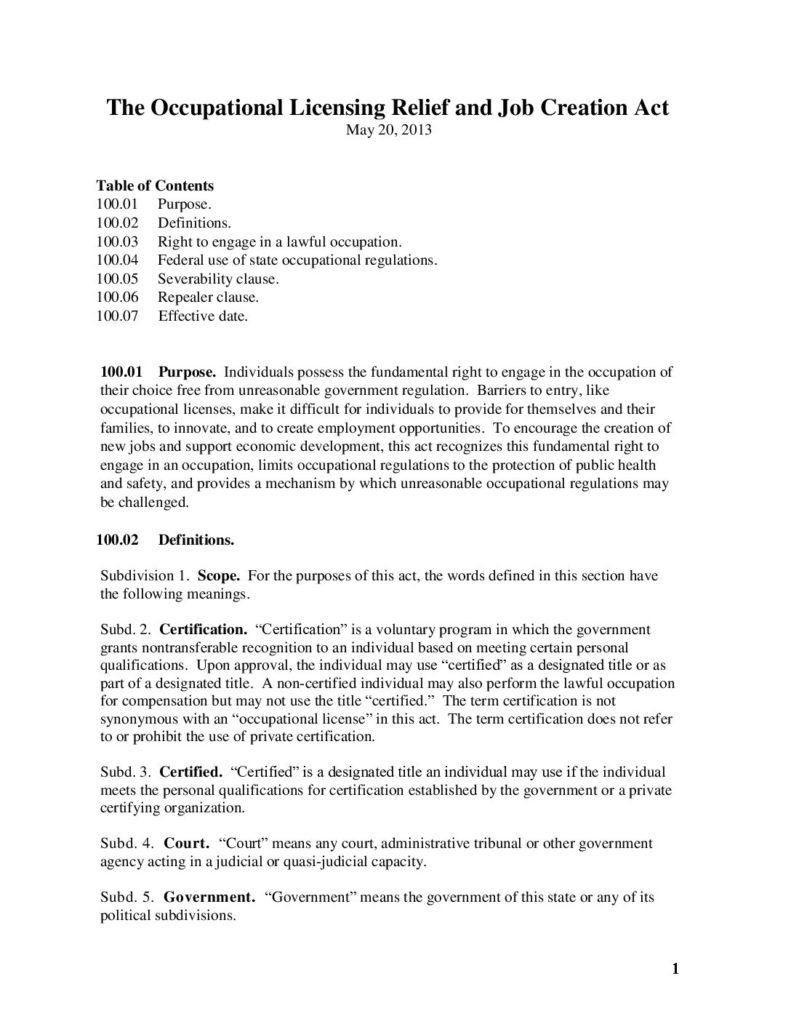
Occupational Licensing Relief and Job Creation Act
About a fifth of the American workforce must get a permission slip from the government—known as an occupational license—to legally work in their chosen occupations. Getting a license can be costly and time-consuming, requiring fees,…
Economic Liberty | Fresh Start
FRESH START: Collateral Consequences in Occupational Licensing Act
A job is one of the best ways to reduce recidivism, but many occupational licensing laws make it difficult—and sometimes even impossible—for returning citizens to obtain work. Licensing laws often have morality clauses that automatically and permanently bar people with criminal records from working—without any individualized…
Food Freedom | Private Property
Vegetable Garden Protection Act
People have used their property to grow food since the dawn of modern civilization. Americans are no different. Our national identity is rooted in the Jeffersonian ideal of farmers and settlers. While fewer people earn their living…

Cosmetology | Economic Liberty
Salon Inspection Act: Freeing Beauty and Barbering Professionals from Occupational Licensing
The beauty industry offers great opportunities for work and entrepreneurship, yet outdated occupational licensing laws often prevent people from successfully entering this field. States require aspiring cosmetologists, barbers, estheticians, and nail technicians to spend hundreds of hours and thousands of…
Economic Liberty | Occupational Licensing
Occupational Regulation Defense Act
Occupational licensing is under increasing scrutiny. Groups as ideologically diverse as the Obama White House, the Trump Administration’s Federal Trade Commission, the Brookings Institution, the National Conference of State Legislators and the Institute for Justice, have…
Economic Liberty | Vending
Mobile Food Vendor Freedom Act
Everyone benefits from food trucks. With low start-up costs, food trucks offer first-time entrepreneurs the opportunity to experiment, accumulate capital and build businesses. For established restauranteurs, they are a means to expand, build their brands…
Economic Liberty | Private Property | Zoning Justice Project
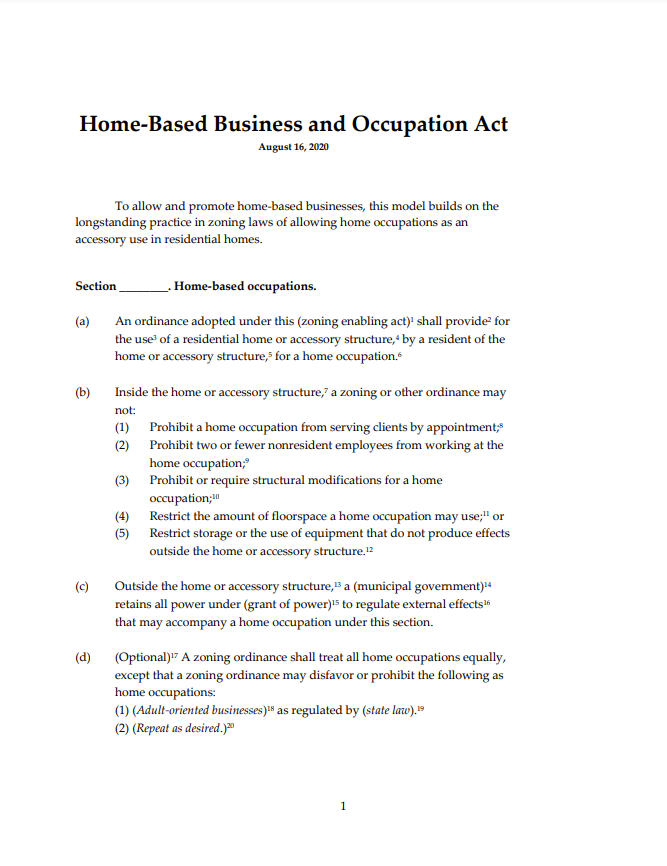
Home-Based Business and Occupation Act
The pre-COVID custom of Americans living in one place and working in another is historically unusual. As one scholar noted, “The phenomenon of leaving home to go to work did not become the norm until the Industrial…

Economic Liberty | Food Freedom
Food Freedom Act
Selling homemade food is a great way for entrepreneurs with big dreams but little capital to start a business. Working from their homes, they can avoid spending tens of thousands of dollars on commercial kitchen space.
Cosmetology | Economic Liberty
Eyebrow Threader Opportunity and Freedom Act
Eyebrow threading is an ancient grooming technique that dates back thousands of years to parts of South Asia and the Middle East. Using only a simple cotton thread to form loops as they work, threaders…
Eminent Domain | Private Property
Eminent Domain Act
Despite mass public outcry following the U.S. Supreme Court’s infamous decision in Kelo v. City of New London, eminent domain for private gain continues to threaten homeowners and small businesses. While 43 states reformed their laws…
Economic Liberty | Vending
Mobile Food Vendor Freedom Municipal Ordinance
Starting a food truck has helped many entrepreneurs realize the American dream. These mobile kitchens create jobs and provide an economic boost to the communities they serve. Unfortunately, many counties and cities make it near…
Occupational Licensing
Animal Husbandry Workers Freedom & Opportunity Act
Animal husbandry is a specialty in agriculture and animal science. It focuses on breeding and care of farm animals, including cows, pigs, chickens, sheep and horses. Workers play a crucial role in maintaining the health…