New Campaign Seeks To Shut Down Mass Surveillance
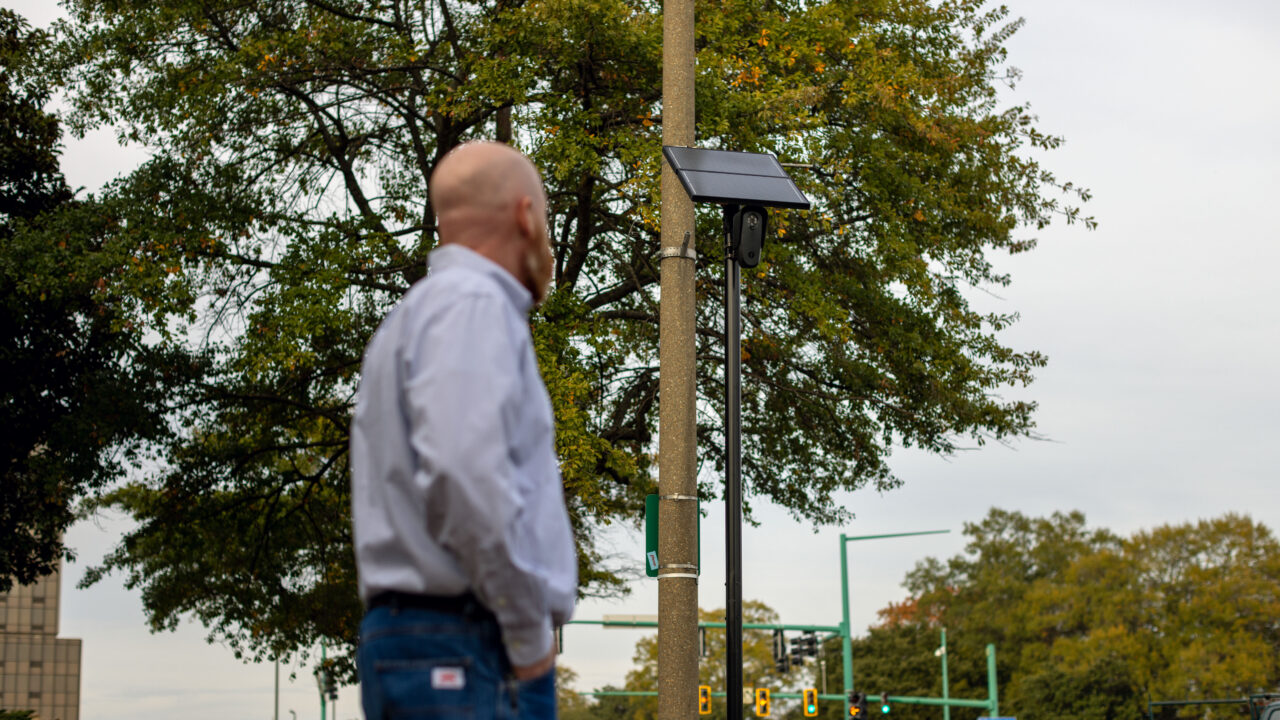
In August, IJ launched the Plate Privacy Project, a nationwide campaign to stop the unrestrained use of automatic license plate reader (ALPR) cameras in thousands of American communities. The campaign, part of IJ’s Project on the Fourth Amendment, brings IJ’s trademark combination of cutting-edge litigation, boots-on-the-ground activism, bipartisan legislative advocacy (including a new model bill), and media capabilities to oppose this new and growing form of warrantless mass surveillance.
These cameras, many from the company Flock Safety, constantly track vehicles, capturing where people go and when, without suspicion of wrongdoing. More than just license plate readers, they create unique “vehicle fingerprints” using things like bumper stickers, dents, and more. This information goes into a database that officials can access without a warrant and, if desired, share with other officials across the country. Unlike red-light or speed cameras, these cameras don’t just record individual traffic violations, but track all drivers’ movements continually.
By tracking people wherever they go, even across state lines, these cameras reveal the most intimate details about people’s lives. ALPR cameras are found near sensitive locations like churches, gun ranges, abortion clinics, halfway houses, immigration attorneys’ offices, and more. And the harm is not merely theoretical; it’s already happening. Officials have used Flock cameras for immigration enforcement (despite a Flock policy that prohibits this), to find a woman who left Texas for an abortion, to monitor visitors to gun shows, and to stalk an ex-girlfriend.
IJ’s opposition to ALPR cameras began in earnest with our lawsuit against Norfolk, Virginia’s use of more than 170 Flock Safety cameras late last year. In July, IJ’s legal team conducted depositions of Norfolk city officials and representatives from Flock.
As part of the discovery process, the city tried to compel our clients to turn over personal information, including details about their private lives and movements. IJ objected to this fishing expedition, arguing the requests infringed on the very privacy rights at issue in the case. The court sided with IJ on every point, stating “the Court is not persuaded that plaintiffs must surrender their own privacy interests to vindicate their constitutional rights.”
Our litigation is moving quickly. Briefing will begin after depositions of IJ’s clients and industry experts, and the case is set for trial in February.
The Plate Privacy Project will also build on our efforts to mobilize public opposition to ALPR cameras. Earlier this year, IJ secured a victory in Greers Ferry, Arkansas, when the city agreed to remove a license plate reader in front of a local couple’s house. That win sent a clear message: The Constitution doesn’t bend for new technology in the hands of government snoops. That message is now echoing nationwide as cities like Austin, Scarsdale (New York), and Sedona (Arizona) have opted to end their contracts with Flock.
While the government marches toward ever-expanding surveillance, IJ demands that new technology comply with constitutional guarantees. See how you can get involved at plateprivacy.com.
Jessica Bigbie is an IJ attorney.
Also in this Issue
Liberty & Law
IJ Makes Headlines

Liberty & Law
Victory! Farmers Vindicate The Right To A Real Judge

Liberty & Law
Rogue Detroit Prosecutor Must Stand Before Judge

Liberty & Law
Where’s The (Cultivated) Beef? IJ Takes On Texas’ Ban On Cultivated Meat

Liberty & Law
How IJ Stopped The Biggest Forfeiture Heist In American History

Liberty & Law
IJ And SPN Establish Chip Mellor Prize For Excellence In Public Interest Litigation

Liberty & Law
Are Federal Officials Above The Law?

Liberty & Law
Home Sweet Business: Victory For Garage-Based Entrepreneurs In Nashville

Liberty & Law
IJ Fights For Family’s Freedom To Build Backyard Cottage
Liberty & Law
Another Real Class Act(ion) At The Crossroads Of America
Subscribe to get Liberty & Law magazine direct to your mailbox!
Sign up to receive IJ's bimonthly magazine, Liberty & Law, along with breaking news updates about the Institute for Justice's fight to protect the rights of all Americans.