How Flock is trying to take credit for the post-pandemic crime drop
Boosters of automated license plate reader (ALPR) surveillance make grand claims about the capabilities of their technology. Flock Safety, for instance, says its mission is to “eliminate crime. Full stop.” In 2021 it announced a goal of reducing all crime in America by 25% in three years. Today, the company claims communities using their technology have seen “crime reductions of up to 70 percent.”
The company’s promotional efforts are peppered with claims of purported crime drops: A 62% reduction of crime in Cobb County, Georgia. A 32% drop in Houston homicides. An across-the-board 25% decrease in San Francisco.
But these marketing factoids mistake correlation for causation by skipping over a critical piece of context: Flock aggressively expanded nationwide in the post-pandemic years, when crime rates were receding from a COVID-era spike. That receding tide affected virtually every American city, regardless of the law enforcement technologies they used.
Flock Safety, in other words, had the good fortune of scaling up during one of the steepest crime declines in modern American history, and has spent several years taking credit for it.
Consider San Francisco. In March 2024, the city began work on a 400-camera network of Flock ALPRs. The following year Mayor Daniel Lurie characterized the cameras and associated technology as a “turning point for public safety,” and earlier this year Flock CEO Garrett Langley credited the cameras with a 25% drop in crime in 2025.
The city’s actual crime data, however, tell a much more nuanced story.
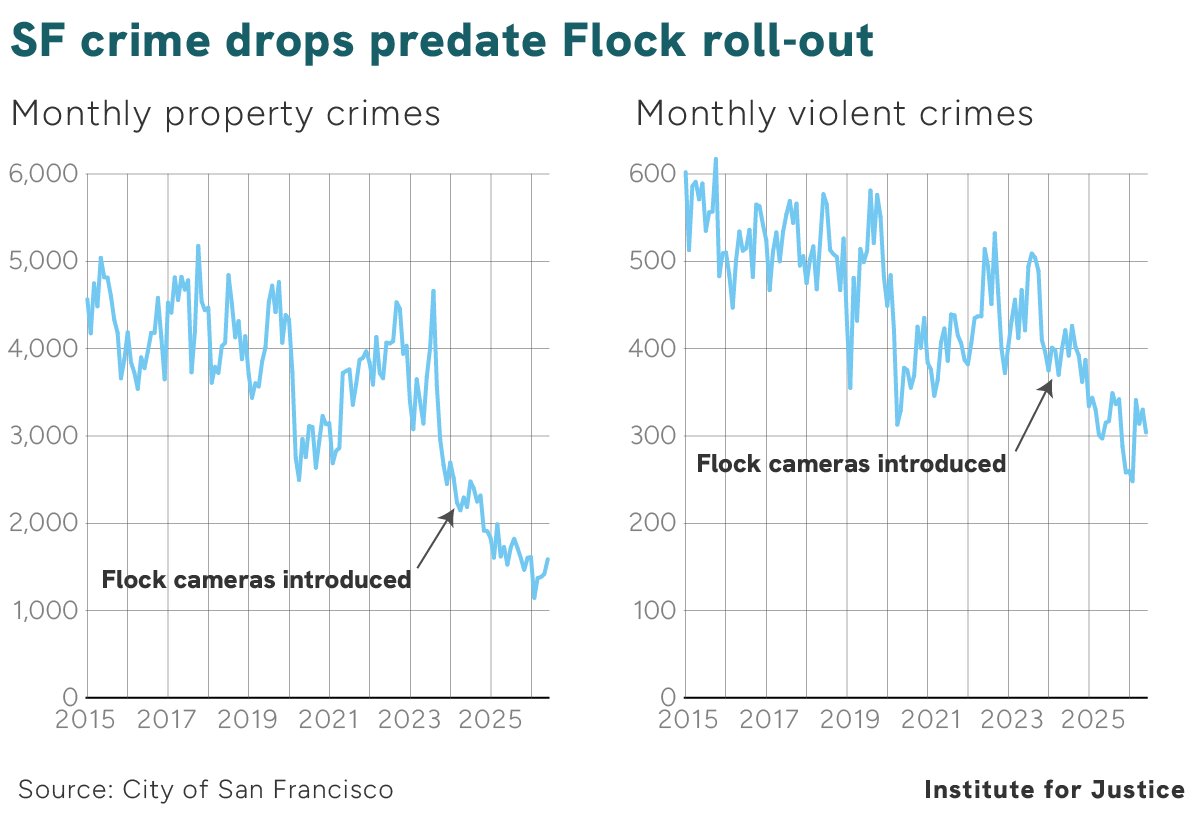
As the chart above shows, property crime began falling precipitously in the latter half of 2023, before the first Flock camera was installed (city officials noted as much at the time). Violent crimes follow a similar trajectory. The decreases observed in 2024 and 2025, in other words, continued a pre-existing trend.
There are many possible explanations for the turnaround that began in 2023. Some California authorities cite better law enforcement coordination and changes in policing practices. Other experts point to the gradual recovery from the society-wide disruptions of the pandemic. In any event, while it’s possible Flock Safety cameras contributed in some way to the pre-existing trend once they were introduced, the data show that crime numbers were already improving months before the first cameras were installed.
ALPR marketing narratives are further undercut by the simple fact that crime rates sometimes increase after the installation of surveillance cameras. This doesn’t mean that the cameras caused those increases, any more than Flock’s promotional materials prove the cameras reduce crime. But it illustrates how crime trends are complex and noisy year-over-year, and how poorly they lend themselves to single-cause explanations.
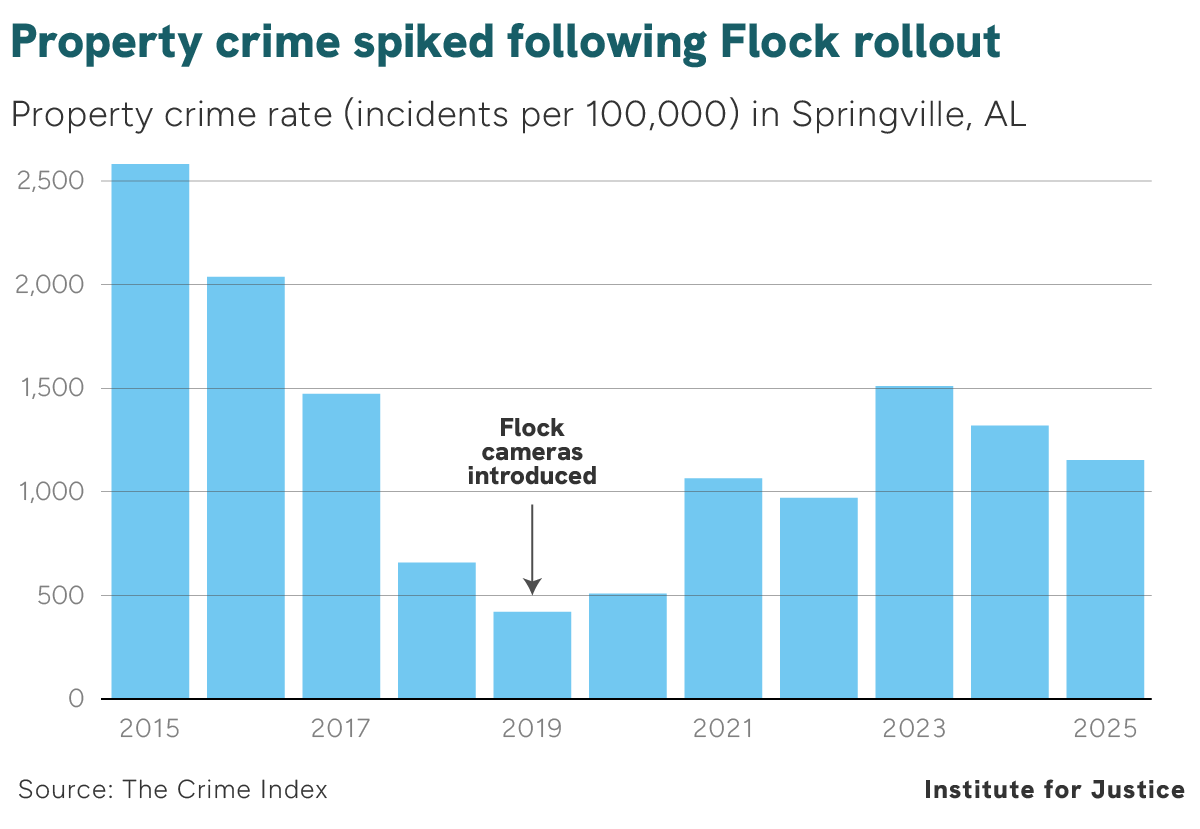
Take Springville, Alabama, which entered into a contract with Flock Safety in 2019. That year the property crime rate was 419 incidents per 100,000 people, according to FBI data compiled by the Crime Index. By 2023 it had more than tripled, to 1,510 per 100,000. It has since subsided somewhat, but remains elevated relative to its pre-pandemic baseline.
Or consider Marietta, Georgia, which introduced Flock cameras in 2017. Local authorities have lavished praise on the system, but in the three years following its introduction the violent crime rate spiked from 349 to 489 incidents per 100,000 people. It has since fallen below its pre-pandemic level.
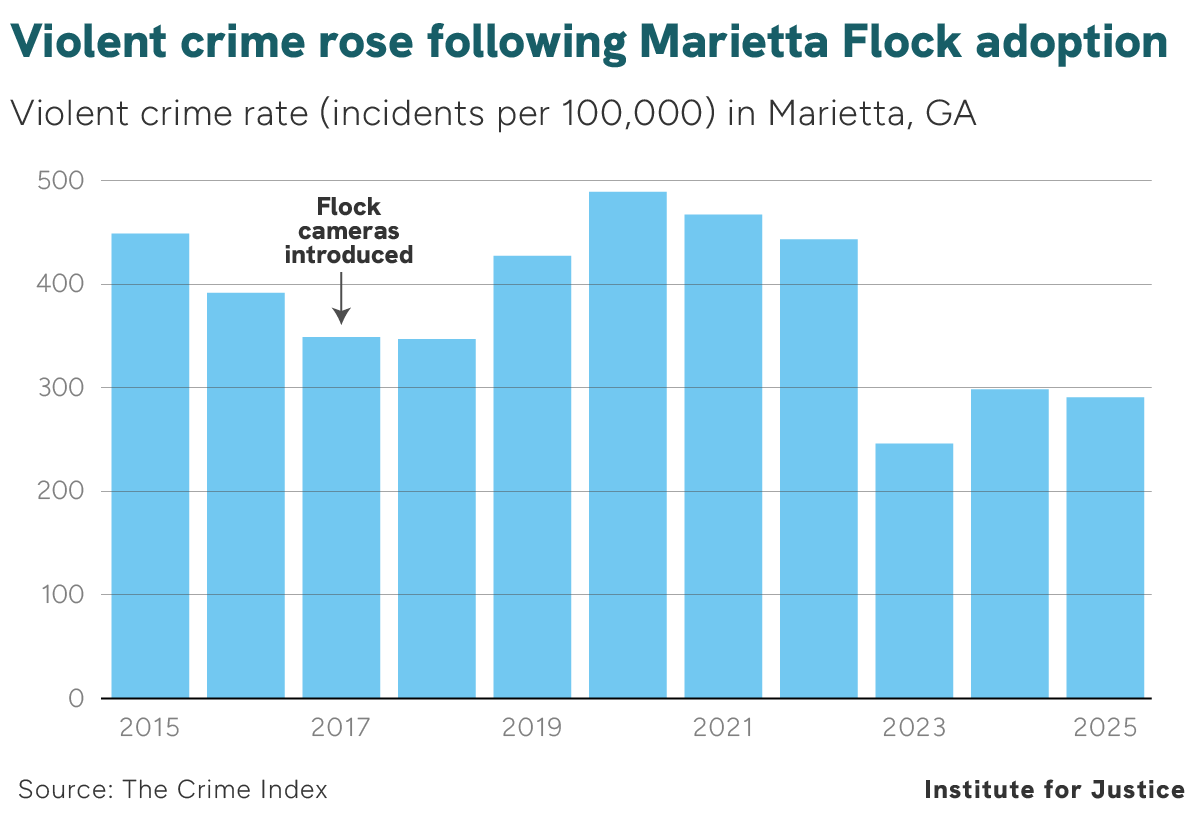
None of this is to suggest the Flock cameras caused these observed spikes in crime, any more than the cameras caused the decreases in other cities cited by the technology’s boosters. Rather, they illustrate that crime rates don’t depend simply on the presence or absence of Flock cameras or any other single enforcement technology. Crime is a complex social problem, and its ebbs and flows are driven by many complex factors that differ greatly from place to place.
Academic studies of ALPR efficacy are in their infancy. Systematic, national analyses of the effects of ALPR deployment are limited to a single working paper released this summer, purporting to show a modest drop in motor vehicle thefts and a modest improvement in clearance rates. But data limitations and the inherent challenges of measuring complex social phenomena make it difficult to draw firm conclusions.
While the benefits of ALPR technology remain unproven, the harms are well-documented. The Institute for Justice has cataloged more than 200 cases of ALPR abuse and misuse, including more than 60 stalking incidents, 33 errors resulting in the arrest or detention of innocent people, and more than 100 additional cases of officers disciplined or criminally charged for misusing ALPR systems.
Those documented cases are likely just the tip of the iceberg, as more abuses come to light every day. As a result, hundreds of communities across the United States have already canceled their contracts with Flock and other ALPR providers. Others are considering restrictions on ALPR use and even outright bans on the technology.
To learn more, visit IJ’s Plate Privacy Project.
Is Government Tracking Your Every Move?
IJ is fighting to restore constitutional limits on surveillance — for every American.
More on 4th Amendment Project
4th Amendment Project
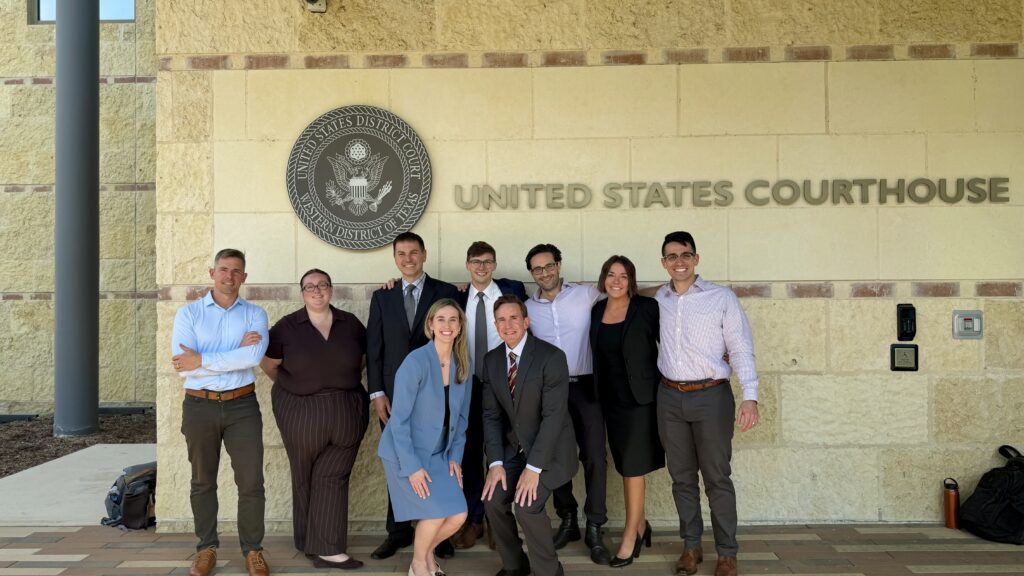
Federal Jury Strikes Down Texas Sheriff’s Surveillance-Driven Traffic Stop Program
4th Amendment Project
Do Flock cameras actually reduce crime? The jury is still out.
4th Amendment Project