No License Required: The Long Fight For The Right To Speak

At IJ, we often warn our clients that fights for liberty can take a long time to win. It’s not at all unusual for our cases to last for five or even 10 years before we wrestle the government to a final judgment. But we doubt most IJ clients even expect the fate of Texas veterinarian Ron Hines, who first appeared in the pages of this magazinemore than 13 years ago when we filed a First Amendment challenge on his behalf—a challenge he finally won, once and for all, just a few months ago.
Longtime readers will remember Ron as the veterinarian who offered helpful advice to pet owners over email—some of them in Texas, but many in other countries and, one time, even on an oil rig. The Texas veterinary board punished him for that, claiming it was illegal for him to offer any advice about an animal he hadn’t examined in person. Ron teamed up with IJ to sue, eventually winning a sweeping victory from a federal court of appeals establishing that Ron’s advice about people’s pets was protected by the First Amendment. When the U.S. Supreme Court turned away Texas’ request to hear the case this past summer, that victory became permanent.
Ron’s hard-fought victory isn’t the only free-speech win we notched in recent months. Indiana death doula Lauren Richwine won a permanent victory establishing her First Amendment right to give advice to families navigating the grieving process. And Virginia-licensed counselor Elizabeth Brokamp clinched a first-round victory for her telemedicine practice when a trial court held that she has the right to talk to people about what they’re going through—even if her clients happen to be sitting in D.C. using their computer instead of sitting physically in Elizabeth’s Virginia office across the river.
These victories are momentous. But to a lot of reasonable people, they might seem obvious. After all, how hard can it be to convince a court to hold that the First Amendment protects sending people emails about their pets?
Very hard, it turns out. Not because there was anything wrong with Ron’s advice or that of our other clients, but because there was something very wrong with the way courts treated rules that made it illegal to speak without a license.
It Started With A Tour Guide
Back in 2008, when we first filed a lawsuit challenging Philadelphia’s licensing law for tour guides, a lot of reasonable people would have thought that was easy, too. After all, Philadelphia’s law made it illegal to talk about the Liberty Bell without the city’s permission. Surely that was unconstitutional.
At the time, most lawyers thought laws licensing people who talked for a living should be treated like any other economic regulation. And courts are extremely eager to uphold economic regulations. Not always—we win those cases, too—but more often than they should.
But that consensus opinion was why we knew this area was important. Particularly with the rise of the internet (this was, remember, in 2008), we knew more and more people would earn a living by selling their ideas or their stories or their advice, and we knew that we didn’t want to live in a world where the government could freely decide who was or wasn’t allowed to sell their ideas or their stories or their advice. So we sued—and prepared to turn a case about tour guides into a broader campaign.
Here, too, success took a while. In response to our lawsuit, Philadelphia declined to enforce its licensing law. Our first courtroom victory came in 2014, when the D.C. Circuit finally agreed with our legal arguments and struck down D.C.’s similar licensing requirement for guides.
The court’s opinion began: “This case is about speech and whether the government’s regulations actually accomplish their intended purpose. … When, as occurred here, explaining how the regulations do so renders the government’s counsel literally speechless, we are constrained to disagree.”
A Powerful Engine, Indeed
Unsurprisingly, this alarmed lawyers who were very invested in the status quo. After that initial win, two legal academics (one the then-dean of Yale Law School) wrote an article warning of the disastrous consequences of our “startling” victory. “It is no exaggeration,” they wrote, “to observe that the First Amendment has become a powerful engine of constitutional deregulation.” (They meant this as a bad thing.)
Our critics weren’t wrong—at least, they weren’t wrong that our occupational-speech practice was important. From that initial win about tour guides, we went on to successfully defend the right to speak for a living all across the country, in widely different contexts. We defended the rights of startups that wanted to use technology to draw maps for use by others. We defended the rights of people who wanted to run schools teaching people practical, useful skills like horseshoeing. And we defended the rights of people with useful things to say—people ranging from veterinarians to counselors to health coaches—to give their advice without first asking the government’s permission.
That doesn’t mean we’re done, of course. The Supreme Court has signaled interest in our position, though it has yet to take a case that would squarely resolve the issue. Meanwhile, there are still plenty of courts just getting it wrong. We’ve won several important victories in the past year, but we’ve lost cases as well. Even as we saw appellate courts hold that Lauren Richwine has the right to talk to families about death or that Ron Hines has the right to send emails about pets, we saw courts in other parts of the country hold that taking (or even just drawing) a picture wasn’t really speech at all but just economic “conduct” the government could regulate as it pleased.
And there are, as ever, plenty of lawyers who think we’re wrong. But that’s as it should be. The point of IJ is to identify important fights, sometimes years in advance, and then to win them one carefully chosen case after another. We plan to win this one—not just in some places, but in all places.



Also in this Issue

Liberty & Law
VICTORY! Pennsylvania Supreme Court Unanimously Protects Landowners From Warrantless Spying
Liberty & Law
You Know IJ. Learn How It Began.

Liberty & Law
A Government of Laws, Not of Men: IJ’s Rule of Law Pillar

Liberty & Law
Raise A Glass To Entrepreneurship

Liberty & Law
Ninth Circuit Knock-Down Of Outrageous Federal Financial Surveillance

Liberty & Law
Cert Granted! IJ Brings Excessive Fines And Forfeitures Back To The Supreme Court
Liberty & Law
James King’s Case Is Over. The Work It Started Isn’t. Six Years Of IJ’s Project On Immunity And Accountability

Liberty & Law
IJ Challenges Warrantless CBP Raid
Liberty & Law
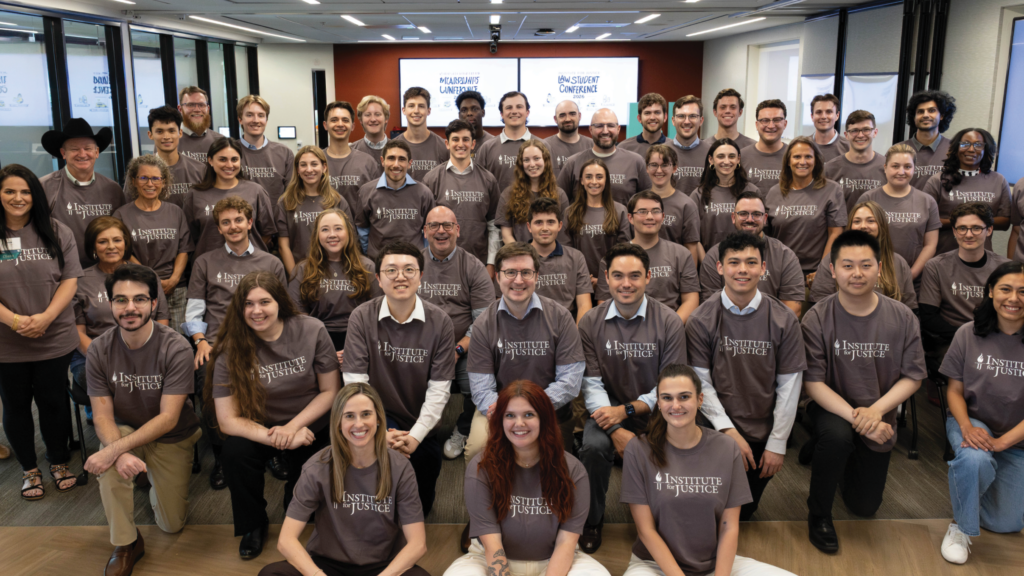
Then And Now: Training The Next Generation Of Litigators For Liberty

Liberty & Law
A Pain In The Zoning Code: Leavenworth Prohibits Home-Based Physical Therapy

Liberty & Law
Back To School & Back To Work: IJ Launches Education Entrepreneurship Project

Liberty & Law
From One Braiding Salon To Nationwide Reform

Liberty & Law
IJ Makes Headlines
Subscribe to get Liberty & Law magazine direct to your mailbox!
Sign up to receive IJ's bimonthly magazine, Liberty & Law, along with breaking news updates about the Institute for Justice's fight to protect the rights of all Americans.