VICTORY! Jury Holds Texas County Liable For Baseless Highway Stops
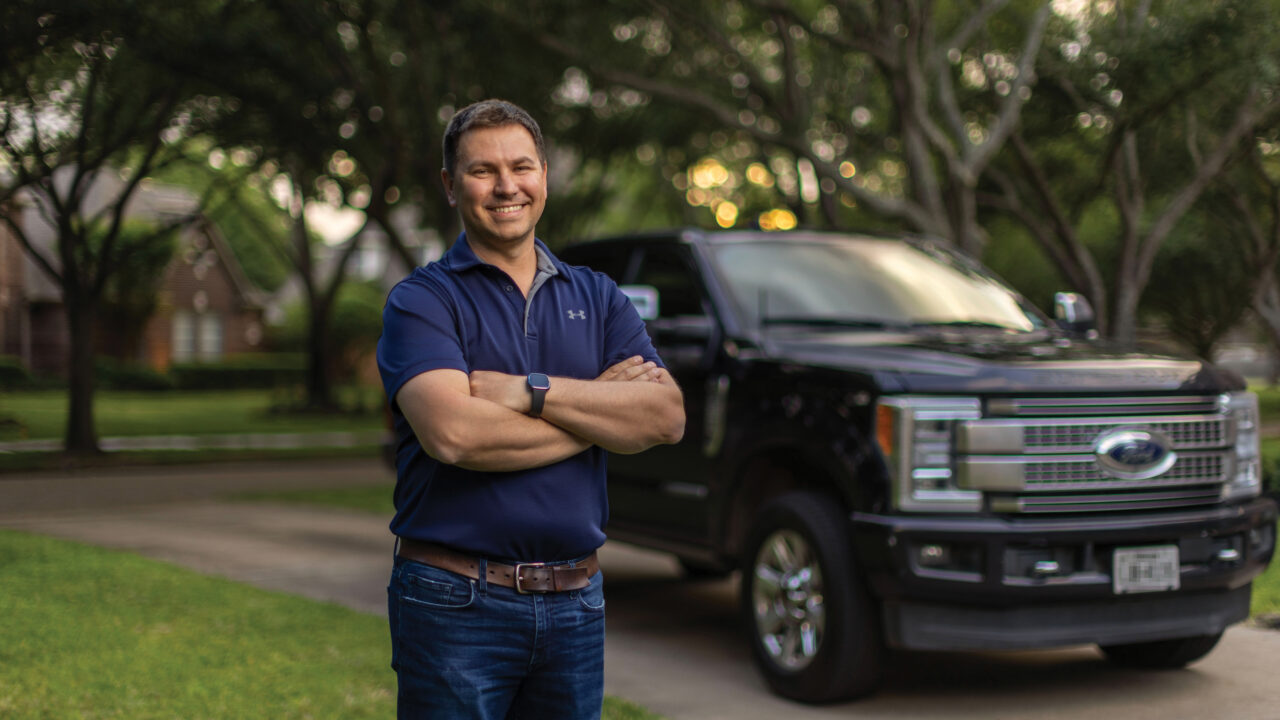
Seventy-six minutes. That is how long Bexar County sheriff’s deputies held Alek Schott on a highway shoulder without any real reason to suspect him of a crime. In September, a federal jury in San Antonio agreed that was unconstitutional and held the county responsible.
In March 2022, Alek was driving home from a work trip when a deputy pulled him over near San Antonio for supposedly drifting out of his lane. Yet Alek’s own dash camera shows that he never drifted.
What happened next was no ordinary traffic stop. Within seconds, the deputy told Alek he was getting a warning but then ordered him into the front seat of the police car and interrogated him about money, drugs, his trip, and his family. His records came back clean in under three minutes, but the questioning continued.
When Alek refused to consent to a search, the deputy called for a drug dog. The dog alerted, and three officers searched Alek’s truck. They found nothing.
IJ stepped in to enforce the constitutional limits on traffic stops. Under the U.S. Supreme Court’s decision in Whren v. United States, police can use any traffic violation, no matter how minor, as a pretext to pull over a driver they really want to investigate for something else.
Unfortunately, that leaves only three constitutional rules of the road between ordinary drivers and a roadside fishing expedition. (1) The police must actually see a violation before stopping someone. (2) They must have a real reason to suspect another crime before extending a stop. And (3) they must have a real reason to believe the car holds contraband, like an alert from a reliable drug dog, before searching it.
Bexar County’s criminal interdiction unit routinely violated these rules.
Deputies picked targets in two ways. First, they used license plate reader data, sometimes shared in an off-the-books WhatsApp chat, to target cars based on how and where they traveled. Second, they targeted cars for ordinary driving, like slowing down near a police car, on the theory that criminals can look like ordinary people.
Alek didn’t really sue for money. He sued to stop constitutional violations on Texas highways, and that work continues.
Once a car was a target, it was getting stopped and searched, no matter what the driver did. Those stops often played out just like Alek’s did. Deputies greeted every driver with a smile and promised just a warning. Then they interrogated the driver in the front seat of their police car, a tactic designed to force consent to a search or create an excuse to call for the drug dog. The unit’s favorite drug dog was rewarded for alerting, not for finding drugs—so he alerted whether or not drugs were there, giving the green light for a search.
Hundreds of innocent drivers were caught in this net.
After a five-day trial, a jury ruled for Alek on all three of his claims. It determined that the stop, the extended detention, and the search each violated the Fourth Amendment. Crucially, it found that these violations stemmed from county custom, not one bad deputy. And the jury awarded Alek the $76 he asked for: $1 for every minute of the traffic stop.
Of course, Alek didn’t really sue for money. He sued to stop constitutional violations on Texas highways, and that work continues. Even after sitting through the trial, the county’s representative testified that the county needed no policy changes. IJ will next ask the court for a permanent injunction, and we stand ready to defend the victory if the county appeals.
The Fourth Amendment promises every American the right to be secure against unreasonable searches and seizures. Thanks to Alek, that promise means more in Texas today.

Also in this Issue
Liberty & Law
The Fourth Amendment Is Back On The Jobsite In Alabama

Liberty & Law
VICTORY: Humboldt County Reforms Predatory Code Enforcement Scheme

Liberty & Law
Sixth Circuit To East Cleveland: You Can’t Tow Away Dissent

Liberty & Law
Opening The Road For Mobile Beauty Entrepreneurs In South Carolina

Liberty & Law
Ten Years, Two Lawsuits, One Unbroken Principle

Liberty & Law
New IJ Research Shows Public Benefits Becoming Private Burdens
Liberty & Law
From the Courtroom to Capitol Hill: Challenging Mass Surveillance
Liberty & Law
Keep Swingin’: The Long Game For Liberty
Liberty & Law
IJ Makes Headlines
Subscribe to get Liberty & Law magazine direct to your mailbox!
Sign up to receive IJ's bimonthly magazine, Liberty & Law, along with breaking news updates about the Institute for Justice's fight to protect the rights of all Americans.