250 Years Of Declaring–And Enforcing–Our Rights
It seems like everyone is doing something for “America’s Big 250.” For good reason, of course! But at IJ we wanted to do something a little bit different when reflecting on 250 years of independence. Instead of focusing on the Declaration of Independence, we decided to shine a spotlight on other declarations from 1776: the declarations of rights that many states adopted in that fateful year.
Most IJ cases rely on the Bill of Rights in the U.S. Constitution or a similar “bill” or “declaration” (they essentially mean the same thing) in a state constitution. All of these documents go back to constitutional declarations of rights from 1776. The first was the Virginia Declaration of Rights, drafted by George Mason. It inspired similar declarations in Pennsylvania, Maryland, Delaware, and North Carolina later that year. Eventually, all state constitutions had a declaration or bill of rights.
Only a few years after 1776—even before the U.S. Bill of Rights—people were using these declarations in court to prevent legislatures from violating rights. Not too different from what we now do at IJ.
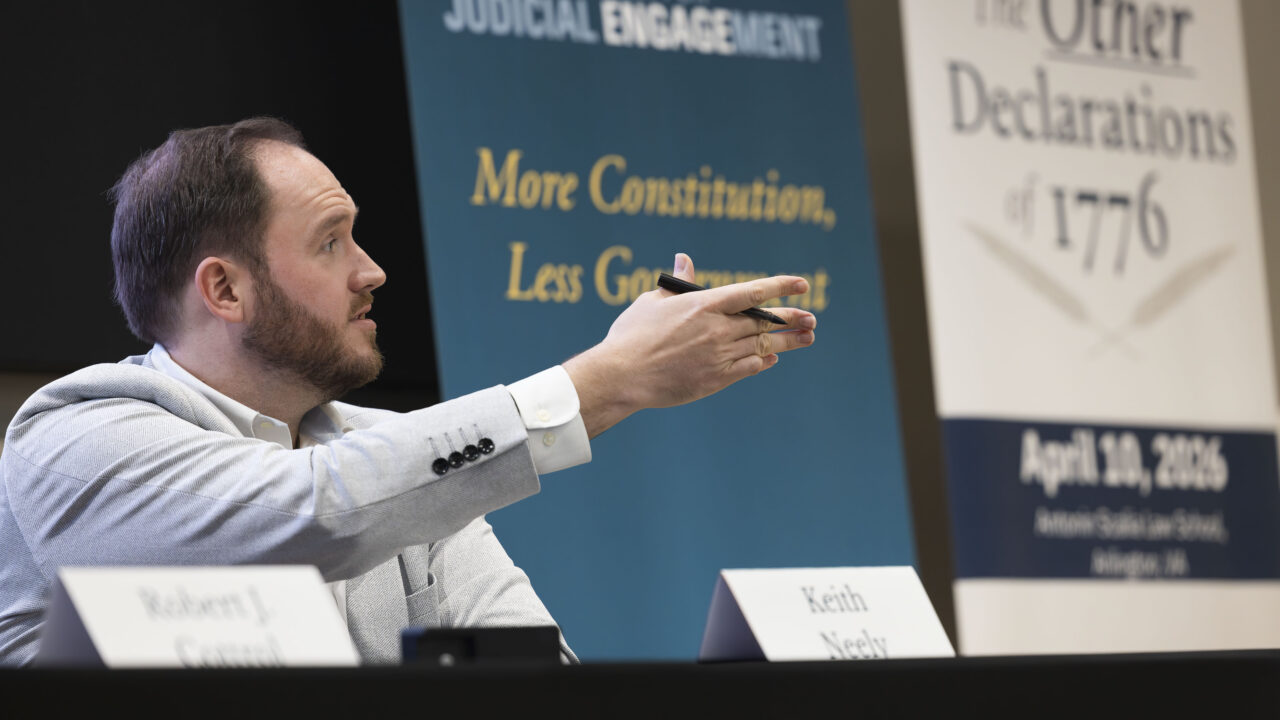
To explore the birth of this “constitutional rights technology,” on April 10, we joined our friends at the Liberty & Law Center at Antonin Scalia Law School to host a conference, “The Other Declarations of 1776.” As a bonus, Scalia Law is part of George Mason University, so the founding father of constitutional rights was part of the conference (at least in spirit).
We brought together scholars and lawyers for an exploration of how these declarations came to be and what their legacies are today. Scholars—including IJ Senior Attorney Josh Windham—presented articles about the “other” declarations, which will be published in the Georgetown Journal of Law and Public Policy. Sessions also included commentary from senior law professors and historians.
For our keynote address, we heard from one of the top experts on the history of state constitutions, Nicholas Cole of Oxford University—who, ironically, is British. He got things off to a good start for a talk about 1776 by repeatedly stating, “You were right, we’re sorry.”
Of course, at IJ we’re most interested in how to enforce rights in court. So we capped the day off with a mock argument of a famous case from 1795: Vanhorne’s Lessee v. Dorrance. It considered whether a Pennsylvania land redistribution statute violated the state’s constitution. Retired Justice Barry Anderson of the Minnesota Supreme Court presided over the three-judge “court” and grilled IJ Senior Attorneys Diana Simpson and Sam Gedge. The judges ruled the law was unconstitutional, despite Sam’s best efforts—he was a good sport and argued the “judicial abdication” side.
We often take our system of written constitutionalism for granted. It’s worth remembering, however, that courts couldn’t declare laws “unconstitutional” before 1776 because written constitutions didn’t exist. George Mason and others changed all that. Whenever we argue a case at IJ, we stand on their 250-year-old shoulders.u
It seems like everyone is doing something for “America’s Big 250.” For good reason, of course! But at IJ we wanted to do something a little bit different when reflecting on 250 years of independence. Instead of focusing on the Declaration of Independence, we decided to shine a spotlight on other declarations from 1776: the declarations of rights that many states adopted in that fateful year.
Most IJ cases rely on the Bill of Rights in the U.S. Constitution or a similar “bill” or “declaration” (they essentially mean the same thing) in a state constitution. All of these documents go back to constitutional declarations of rights from 1776. The first was the Virginia Declaration of Rights, drafted by George Mason. It inspired similar declarations in Pennsylvania, Maryland, Delaware, and North Carolina later that year. Eventually, all state constitutions had a declaration or bill of rights.
Only a few years after 1776—even before the U.S. Bill of Rights—people were using these declarations in court to prevent legislatures from violating rights. Not too different from what we now do at IJ.
To explore the birth of this “constitutional rights technology,” on April 10, we joined our friends at the Liberty & Law Center at Antonin Scalia Law School to host a conference, “The Other Declarations of 1776.” As a bonus, Scalia Law is part of George Mason University, so the founding father of constitutional rights was part of the conference (at least in spirit).
We brought together scholars and lawyers for an exploration of how these declarations came to be and what their legacies are today. Scholars—including IJ Senior Attorney Josh Windham—presented articles about the “other” declarations, which will be published in the Georgetown Journal of Law and Public Policy. Sessions also included commentary from senior law professors and historians.
For our keynote address, we heard from one of the top experts on the history of state constitutions, Nicholas Cole of Oxford University—who, ironically, is British. He got things off to a good start for a talk about 1776 by repeatedly stating, “You were right, we’re sorry.”
Of course, at IJ we’re most interested in how to enforce rights in court. So we capped the day off with a mock argument of a famous case from 1795: Vanhorne’s Lessee v. Dorrance. It considered whether a Pennsylvania land redistribution statute violated the state’s constitution. Retired Justice Barry Anderson of the Minnesota Supreme Court presided over the three-judge “court” and grilled IJ Senior Attorneys Diana Simpson and Sam Gedge. The judges ruled the law was unconstitutional, despite Sam’s best efforts—he was a good sport and argued the “judicial abdication” side.
We often take our system of written constitutionalism for granted. It’s worth remembering, however, that courts couldn’t declare laws “unconstitutional” before 1776 because written constitutions didn’t exist. George Mason and others changed all that. Whenever we argue a case at IJ, we stand on their 250-year-old shoulders.
Anthony Sanders is the director of IJ’s Center for Judicial Engagement.
Also in this Issue

Liberty & Law
Winning The Fight Against Bogus Blight
Liberty & Law
Two Wins For The First Amendment
Liberty & Law
Policing For Profit—And Without Due Process

Liberty & Law
Food Trucks Are Perfect Vehicles For Cutting-Edge Challenges

Liberty & Law
Reining In The Regulators

Liberty & Law
Challenging The Plate-Reader Panopticon From Coast To Coast

Liberty & Law
Justice Delivered Federal Court Closes The Book On Pagedale’s Policing-For-Profit Scheme

Liberty & Law
IJ To Put Agency Judges On Trial At The U.S. Supreme Court

Liberty & Law
Closing The Open Fields Loophole In Idaho
Liberty & Law
IJ Updates: Spring 2026

Liberty & Law
IJ Makes Headlines
Subscribe to get Liberty & Law magazine direct to your mailbox!
Sign up to receive IJ's bimonthly magazine, Liberty & Law, along with breaking news updates about the Institute for Justice's fight to protect the rights of all Americans.