Policing For Profit—And Without Due Process
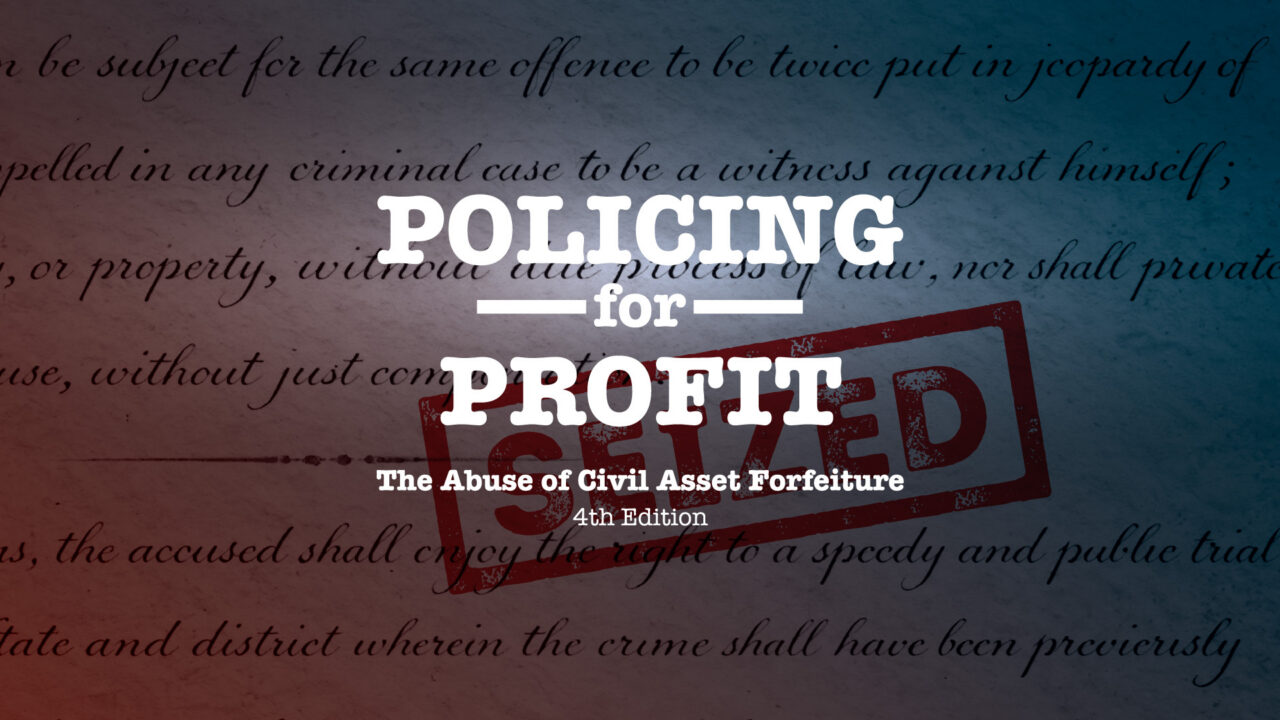
Through civil forfeiture, law enforcement can take and keep your cash, car, or even home without so much as charging you with a crime. Since the launch of our forfeiture project in 2010, IJ has been fighting back. We’ve successfully litigated 29 cases in state and federal courts. We’ve returned $21.8 million in seized assets to the rightful owners. And dozens of states have adopted reforms increasing transparency, tightening rules for civil forfeiture, or both.
But there’s still a lot of work to do. Just two years ago, the U.S. Supreme Court ruled that due process does not require a prompt post-seizure hearing because, as the Court understands it, the forfeiture process itself includes a timely hearing. Though the Court signaled keen interest in reviewing other aspects of civil forfeiture, it lacked a full picture of how forfeiture works in practice.
Enter the fourth edition of IJ’s landmark forfeiture report: Policing for Profit.
For the first time, this edition documents the civil forfeiture procedures leading up to a hearing. It finds that in most cases, owners never get a hearing at all, let alone a timely one. In fact, most owners lose by default—between 62% and 76% in three states with data. This means no real hearing before a judge, no arguments from both sides, and no neutral examination of the forfeiture’s legal justification before property is lost forever.
And the likely reason for many, if not most, defaults is that getting to court is hard. Owners face confusing notices, tight deadlines, and complex filing requirements. And they face them alone if they can’t afford a lawyer or it doesn’t make economic sense to hire one—which is likely to be the case with many forfeitures. The typical cash forfeiture across 24 states is just $1,678, about half the estimated $3,300 it costs in attorney fees alone to contest a simple state-court forfeiture case.
The few owners who do reach a hearing often wait months. Totaling just the known statutory deadlines, the average civil forfeiture process takes over six months to reach a courtroom.
During this time, owners are often without their property, which can create hardship and intense pressure to settle, even if they did nothing wrong. Only about half of civil forfeiture laws specify a procedure for seeking a quicker pretrial hearing, and these are often limited.
The absence of judicial oversight compounds the problems detailed in earlier editions of Policing for Profit, including the ones captured by our law grades: the often low evidentiary standards for connecting property to crime when—if—a civil forfeiture case gets to court; the often poor protections for innocent owners at risk of losing property because someone else committed a crime; and the often large shares of proceeds flowing back to law enforcement.
Even though there was significant progress in reforming forfeiture law over the last 15 years, this edition demonstrates that trend has cooled. Thirty-five states and the federal government still earn a D+ or worse for laws that make civil forfeiture easy and lucrative for law enforcement. Only Maine has enacted wholesale reform, abolishing civil forfeiture. It and New Mexico earn the nation’s only As.
By the numbers, civil forfeiture remains a massive problem. Annually since 2014, the federal government has consistently forfeited between $2 billion and $3 billion, while 34 states have consistently forfeited between $300 million and $350 million.
Though legislatures have been hesitant to address the fundamental problems with forfeiture, we’re not going to stop trying to persuade them to end civil forfeiture and the financial incentive that fuels it. And like the three editions before it, the fourth edition of Policing for Profit has an important role to play. We are working diligently to get it into the hands of lawmakers.
But our real target now is the courts and the legal community. Courts, especially the U.S. Supreme Court, are increasingly recognizing that civil forfeiture is at odds with due process and property rights and holding the government to account. Policing for Profit makes a compelling case that this trend should continue—and accelerate.
Mindy Menjou is IJ’s assistant director of strategic research.
Also in this Issue

Liberty & Law
Winning The Fight Against Bogus Blight
Liberty & Law
Two Wins For The First Amendment
Liberty & Law
250 Years Of Declaring–And Enforcing–Our Rights

Liberty & Law
Food Trucks Are Perfect Vehicles For Cutting-Edge Challenges

Liberty & Law
Reining In The Regulators

Liberty & Law
Challenging The Plate-Reader Panopticon From Coast To Coast

Liberty & Law
Justice Delivered Federal Court Closes The Book On Pagedale’s Policing-For-Profit Scheme

Liberty & Law
IJ To Put Agency Judges On Trial At The U.S. Supreme Court

Liberty & Law
Closing The Open Fields Loophole In Idaho
Liberty & Law
IJ Updates: Spring 2026

Liberty & Law
IJ Makes Headlines
Subscribe to get Liberty & Law magazine direct to your mailbox!
Sign up to receive IJ's bimonthly magazine, Liberty & Law, along with breaking news updates about the Institute for Justice's fight to protect the rights of all Americans.